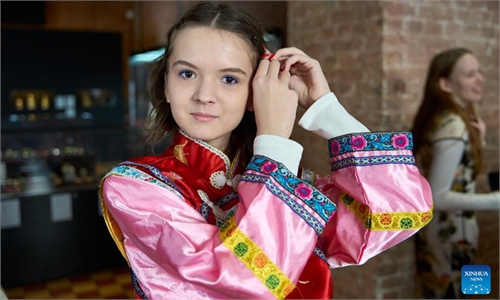
International visitors celebrate Chinese New Year at a Shanghai memorial, experience China's rich intangible cultural heritage
By in Shanghai Published: Jan 27, 2025 06:05 PM

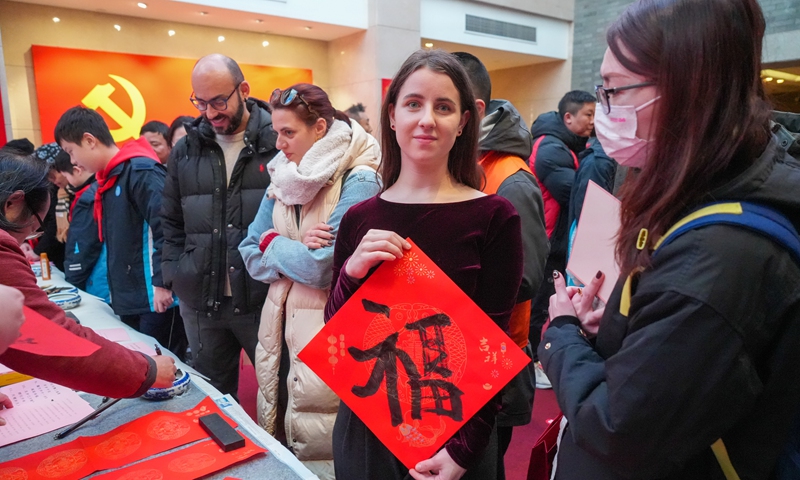
Hungarian student Léna Czako poses with the Chinese character “fu (good fortune)” she wrote on January 27, 2025. (Photo: Lu Ting/Global Times)
Encouraged by those around her, Hungarian student Léna Czako picked up an ink-dipped brush and wrote the Chinese character "fu (good fortune)" on a piece of red paper. Her attempt was quite good, and a nearby Chinese calligraphy master smiled and gave her a thumbs-up.
This scene unfolded at a calligraphy display booth at the Memorial Hall of the Second National Congress of the Communist Party of China in Shanghai on Monday, just two days before the 2025 Chinese New Year, or Spring Festival.
The memorial hosted a series of traditional Chinese cultural activities to celebrate the upcoming festival, attracting numerous Chinese and international visitors eager to explore and experience China's rich and diverse intangible cultural heritage skills, such as paper cutting, dough figurine making and calligraphy.
Czako, a student at the Shanghai Academy of Fine Arts, had taken calligraphy classes at school. Wandering around the various intangible cultural heritage booths, she said it was a very nice experience that allowed her to learn more about China and its vibrant culture.
"I particularly love calligraphy; it's very beautiful," Czako told the Global Times.
At the memorial's celebration event on Monday, the atmosphere was buzzing with visitors flocking to the various intangible cultural heritage display booths. The calligraphy booth was the most popular. As the Chinese New Year is just around the corner, visitors from different countries lined up in anticipation of receiving a Spring Festival couplet written on the spot by the calligraphy masters the event invited, including Zhu Zongmin, a member of the Chinese Calligraphers Association.
A Spring Festival couplet, or "chunlian" in Chinese, consists of two lines of text that are usually written on red paper and hung on either side of a doorway. It is a traditional form of Chinese poetry that is typically displayed as one of the Chinese New Year celebrations. At Zhu's booth, lots of foreign visitors invited Zhu to write couplets for them and asked him about the meanings of the characters.
Zhu welcomed this interaction. "Posting couplets and the character 'fu' during the Spring Festival is a lively symbol of Chinese culture," he told the Global Times. "I hope that more foreigners can use the Spring Festival to learn more about our traditional culture."
Australian visitor Dahvida Falanitule attended the Monday celebration with his wife, who is a Shanghai native. Having been living in Shanghai for over 25 years, Falanitule said the city has become his second home.
Falanitule shared some of the activities he and his family enjoy during the Chinese New Year, such as tasting traditional festive food and snacks and watching lantern shows at Yuyuan Garden. "Every year, it's always a wonderful time for me to immerse myself in the wonderful cultures of China. I'm very grateful to be part of it," Falanitule told the Global Times.
In December 2024, the United Nations Educational, Scientific and Cultural Organization (UNESCO) added "Spring Festival, social practices of the Chinese people in celebration of the traditional New Year" to the Representative List of the Intangible Cultural Heritage of Humanity.
According to the memorial, various intangible cultural heritage displays and experiential activities will continue throughout the Spring Festival holidays (until February 3), allowing visitors to not only tour this revolutionary site and receive red (patriotic-themed) education, but also closely engage with China's intangible cultural heritage and experience the colorful festive atmosphere.
"We are combining traditional culture and red culture, with the beautiful lives of people today, to tell the stories of China in diverse and vivid ways," You Wei, deputy director of the memorial, told the Global Times. "Whether they are Chinese or foreign visitors, I hope that when they walk in here they can truly immerse themselves in these stories."
RELATED ARTICLES