US extra fees on Chinese ships discriminatory bullying, undermining global supply chains: Chinese experts
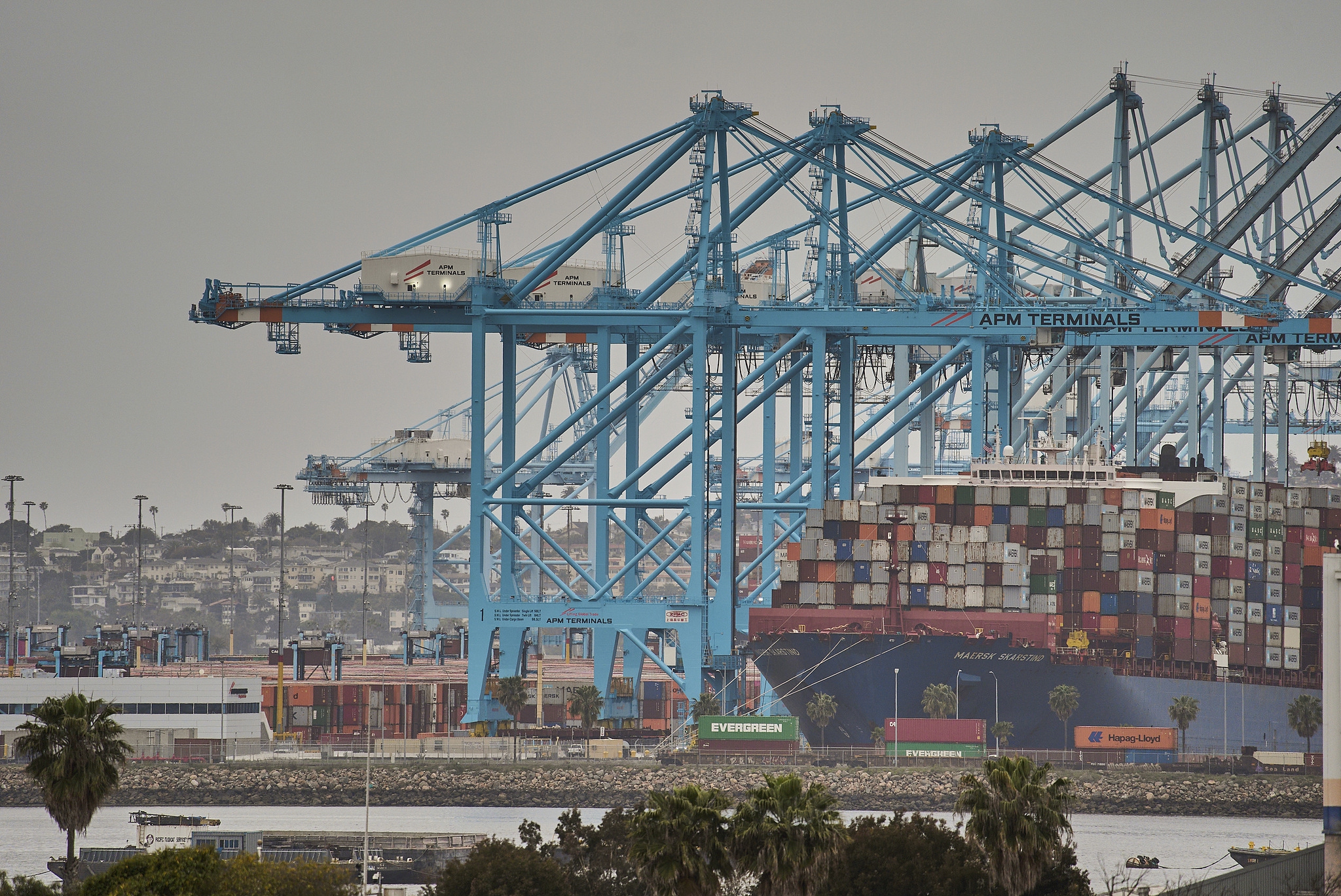
The "Maersk Skarstind" container ship is moored at the APM Port of Los Angeles in Los Angeles Tuesday, April 15, 2025. Photo: VCG
The Trump administration announced Thursday new fees on Chinese-built vessels, with operators charged based on net tonnage or container volume. Chinese experts described the actions as discriminatory trade bullying, noting that it not only disrupts global supply chains, but also damages the country's credibility. They warned that the tariff approach would force logistics companies to pass costs onto export goods, undermining efforts to reduce the trade deficit and causing significant harm to the US.
Targeting China's shipbuilding industry will accelerate the US's decline in global trade, they stressed.
The fees will be charged once per voyage and not per port, as initially proposed, according to CNBC.
Beginning April 17, 2025, Chinese vessel operators and owners will be subject to a service fee based on net tonnage, starting at $0 per net ton, increasing to $50 per net ton by October 14, 2025, and gradually rising to $140 per net ton by April 17, 2028. The fee will apply up to five times per year per vessel, though the container-based fee remains unspecified, according to CNBC.
USTR said on its official website that China largely achieved its dominance through its increasingly aggressive and specific targeting of these sectors, severely disadvantaging US companies, workers and the broader economy.
"Ships and shipping are vital to America's economic security and the free flow of commerce," said US Trade Representative Jamieson Greer. "The Trump administration's actions will begin to reverse Chinese dominance, address threats to the US supply chain, and send a demand signal for US-built ships," Greer claimed.
Li Yong, a senior research fellow at the China Association of International Trade, told the Global Times on Friday that "this is a form of trade bullying beyond tariffs, specifically targeting China." He said the extra fees on Chinese-built vessels "unjust and unprecedented in global trade," emphasizing that the move not only harms Chinese ship industries but also disrupts global shipping and logistics, affecting all companies using Chinese-built ships.
Li said that the measure not only impacts China but also severely disrupts the global shipping, particularly for countries that rely heavily on Chinese vessels. "The global maritime sector will strongly oppose this decision. The move undermines the global supply chain and logistics, further escalating tensions in international trade tensions," Li said.
More importantly, "these unfair measures will ultimately harm the US, as Chinese-made vessels hold a significant share of the global fleet," Li said. "Targeting China's shipbuilding industry will accelerate the US's decline in global trade," he added.
He also noted that the new port fees could "drive more shipping companies to bypass US ports, weakening the country's maritime standing."
The US will implement a two-phase plan for fees on Chinese vessels. In the first phase, beginning after 180 days, fees will be imposed based on net tonnage for vessel owners and operators of China, with incremental increases over the following years. Operators of Chinese-built ships will also face fees based on net tonnage or containers, with similar increases. To encourage US-built car carrier vessels, fees will be imposed on foreign-built car carriers based on their capacity, according to USTR's website.
The second phase, starting in three years, will include restrictions on transporting liquefied natural gas (LNG) via foreign vessels to incentivize US-built LNG ships, with these restrictions increasing over the next 22 years, the USTR website said.
At a May 19 hearing, the USTR will discuss proposed tariffs on ship-to-shore cranes, chassis that carry containers and chassis parts. China dominates the manufacture of port cranes, which the USTR plans to hit with a tariff of 100 percent, according to Reuters' report.
"Shipping involves both imports and exports," Zhou Mi, a senior research fellow at the Chinese Academy of International Trade and Economic Cooperation, told the Global Times on Friday. "The tariffs will force logistics companies to pass the costs onto export goods, undermining efforts to reduce the trade deficit. Despite strong opposition and clear facts, the US continues with these measures, questioning the value of the hearings. Businesses may view them as a formality and could withdraw support, weakening the effectiveness of US trade rules."
After the last hearing, a wave of opposition emerged from the global maritime industry, including domestic port and vessel operators, as well as US shippers of goods ranging from coal and corn to bananas and concrete, according to a Reuters report.
In response to the US government's announcement of new port fees for Chinese-built and operated vessels, set to take effect in mid-October, which is part of the Trump administration's efforts to revive the US shipbuilding industry and reduce China's dominance in the sector, Foreign Ministry spokesperson Lin Jian said on Friday that China has repeatedly stated its position on the issue. "I would like to reiterate that imposing port fees and additional tariffs on cargo handling equipment harm the interests of both others and itself. It raises global shipping costs, disrupts supply chain stability, and increases inflationary pressures in the US, ultimately harming American consumers and businesses, without revitalizing the US shipbuilding industry," he said.
"We urge the US side to respect the facts and multilateral rules, immediately cease its wrongdoings. China will take necessary measures to firmly safeguard its legitimate rights and interests," Lin said.
RELATED ARTICLES