HK tourists' mainland trips during break for Easter holiday set new single-day entry record at Shenzhen ports
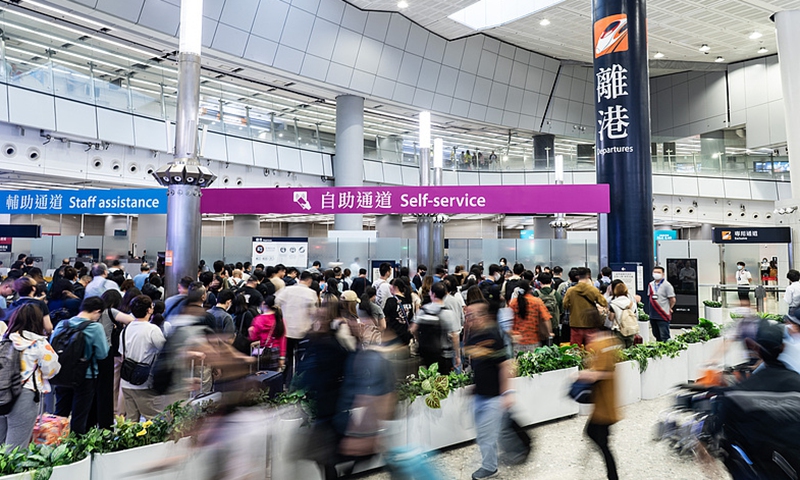
Passengers prepare to travel during the Easter holiday by high-speed rail at the West Kowloon Station in Hong Kong on April 18, 2025. Photo: VCG
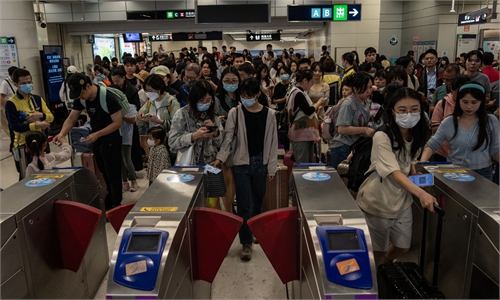
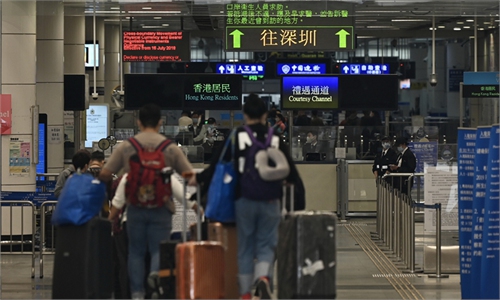
The number of border crossings from the Hong Kong Special Administrative Region (HKSAR) to Shenzhen in South China's Guangdong Province reached a single-day record high during the Easter holiday, with travelers from Hong Kong also scattered around various cities across Chinese mainland.
Local media attributed the surge to earthquake concerns in neighboring countries, and an expert told Global Times on Sunday that Chinese mainland's expanding high-speed rail network attracts in-depth travel with convenience.
According to statistics from the Shenzhen-Hong Kong port authorities, the land ports between Shenzhen and HKSAR on Friday recorded 898,300 inbound and outbound passenger trips, of which 288,300 outbound, 610,000 inbound, the official WeChat account of Shenzhen port reported on Saturday night.
The single-day inbound passenger flow reached a record high, which is a 5.77 percent increase from last year's Hong Kong public holidays and a 28.45 percent increase over the first day of Qingming Festival, the statistics showed.
Also, Futian Port in Shenzhen handled 812 cross-border tour groups on Friday, a 53 percent year-on-year increase, setting a new record high for single-day tour group arrivals since the port resumed operations.
According to statistics from Hong Kong Immigration Department, as of 9 pm on Saturday, a total of 494,000 departed the city, with 378,000 heading north to Chinese mainland, HKCHA reported on Sunday.
Many HKSAR residents chose to spend their holiday hiking in Shenzhen, visiting parks to enjoy spring scenery, and indulging in shopping and dining, according to HKCHA.
A 27-year-old HKSAR tourist surnamed Lau, currently vacationing in Shenzhen, told the Global Times on Sunday that she was enjoying her trip. "I planned to savor the local cuisine over the next few days before stocking up on daily necessities and souvenirs to bring back home."
"The dining experience in the mainland is different. On Saturday morning, my two friends and I bought breakfast for about 60 yuan ($8) in Shenzhen, and we couldn't even finish it. Hotel prices are also much lower here compared to Hong Kong," Lau said.
"Mainland consumption offers excellent value for money relative to HKSAR tourists' income levels, and the convenient transportation links make tourists more inclined to travel and shop on the mainland," Zhang Lingyun, professor and the executive editor-in-chief of the Tourism Tribune, told the Global Times on Sunday. "Technologies such as card swiping and facial recognition devices have made the journey from HKSAR to the mainland simpler and faster compared to entry procedures for international tourists."
Meanwhile, Hong Kong tourists aren't only heading to Guangdong or nearby regions. One tourist from Hong Kong traveling on the Chinese mainland posted on Chinese social media platform Xiaohongshu, also known as RedNote, asking fellow travelers to share their destinations in the comments.
Among more than 2,000 replies, responses came from all over the country, including Southwest China's Xizang Autonomous Region, Chengdu in southwest China's Sichuan Province, Beijing, and scenic destinations from other regions.
"The appeal of in-depth travel on the mainland lies in its vast territory, diverse resources, significant regional differences between the north and south, and abundant cultural, ethnic, and natural landscape attractions. Additionally, service quality, management standards, and relatively high cost-performance ratios are important factors attracting tourists," Zhang said.
According to HKSAR media outlet Sing Tao Daily, recent earthquakes in neighboring Southeast Asian regions and speculations of a major impending quake in Japan prompted many residents to change their travel plans.
RELATED ARTICLES