A sign for British Steel is pictured in north Lincolnshire, north east England on April 10, 2025. Photo: VCG
The plan by British Steel to shut down its Scunthorpe plant due to massive losses has drawn wide attention. In order to keep the plant in operation, the UK Parliament recently approved plans to take emergency control of British Steel's blast furnaces.
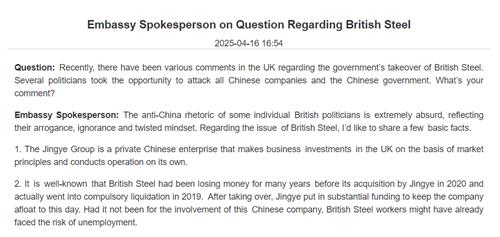
As the last remaining facility in the UK that produces virgin steel, closure of the Scunthorpe plant would mark the complete abandonment of Britain's domestic steel industry. British Steel has long suffered from financial difficulties and, at one point, entered liquidation proceedings. It was the massive capital injection from Chinese company Jingye Group that kept the British Steel afloat until now.
Paradoxically, some British politicians have blamed the Chinese investor for British Steel's predicament, using it as a pretext to hype the so-called China investment threat, which casts a shadow over the promising recovery of China-UK economic and trade cooperation.
For years, the UK's steel industry has lagged in capacity, suffered from high labor costs, and fallen behind in technology, making it difficult to compete with more modern steelmakers around the world. With the UK government neglecting heavy industry, British steel producers have struggled to meet the material demands of high-end manufacturing, leading to their growing marginalization in the global market.
The imbalance in the UK's industrial development is now widely acknowledged. While the shift toward services increased capital returns, it squeezed out space for the growth of the manufacturing sector and exposed a deep-rooted issue: The dominance of financial capital has led to the hollowing out of the real economy.
In recent years, the concept of the "financial curse" has emerged as a major topic in the UK's industrial policy debate. The overly inflated financial services sector in London has resulted in a shortage of material resources and manpower in other industries. This has exacerbated social inequality and intensified deindustrialization. Traditional industrial regions - such as coal and steel-producing areas - have experienced rising unemployment. At the same time, the distribution mechanism dominated by financial capital has led to wealth being concentrated at the top, widening the gap between the rich and the poor and fueling social division.
Brexit has significantly harmed the UK's financial services sector. International investors have shown declining interest in the UK financial market, and the advantages of the UK's services-led economy have diminished. At the same time, trade costs between the UK and the EU have risen due to customs procedures, differences in technical standards and supply chain restructuring - all of which have dealt a heavy blow to bilateral trade. As of the end of June 2024, the UK's public sector net debt had reached 99.5 percent of GDP. Interest payments alone take up a large share of government expenditure, leaving little room for funding the upgrades required by heavy industry.
To halt the decline of manufacturing, the Keir Starmer administration has introduced the "Invest 2035: the UK's modern industrial strategy." However, the strategy emphasizes advancing industrial transformation rather than restoring traditional sectors. Specifically, advanced manufacturing, technology and financial services remain the favored pillars of the Labour government's industrial policy, while industries such as steel have long been neglected. The UK government's taking control of British Steel is largely a symbolic gesture with limited real-world effect. Blaming Chinese capital for the stagnation of the UK's domestic steel industry is entirely baseless. The hostile attitude of certain British politicians toward China seriously undermines the country's overall business environment. Politicizing business issues and maliciously stoking anti-China rhetoric will only erode the confidence of Chinese enterprises in investing in the UK and damage bilateral economic and trade cooperation.
Gao Jian is director of the Center for British Studies at Shanghai International Studies University. Fu Borui is an assistant research fellow of the Center for British Studies at Shanghai International Studies University. opinion@globaltimes.com.cn
RELATED ARTICLES