Global carmakers flock to Shanghai, eyeing deeper integration into China’s innovation ecosystem
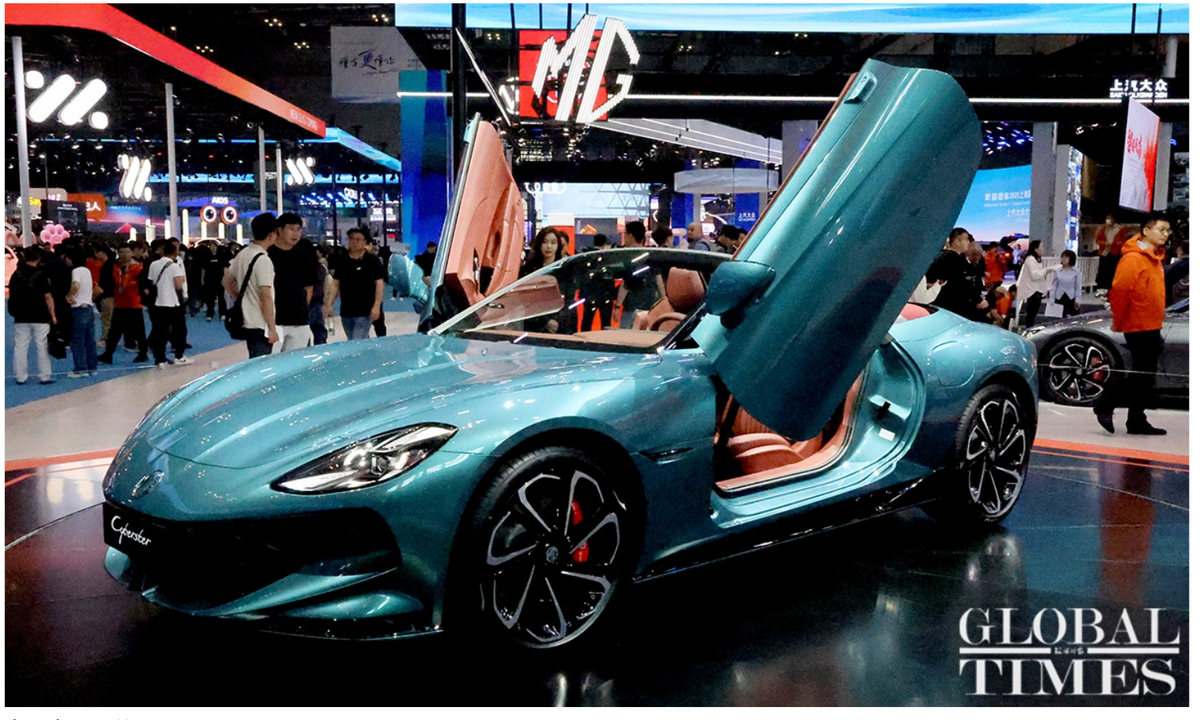
The 2025 Shanghai International Automobile Industry Exhibition, or Auto Shanghai, opened on a record-breaking scale on April 23, 2025. With over 100 world premieres in the spotlight, it serves as a global showcase of automotive innovation and cutting-edge technologies. Photo: Chen Xia/GT
During the ongoing Shanghai International Automobile Industry Exhibition, a key barometer of the global auto industry, multinational carmakers and industry suppliers are showcasing their products and technologies, and reaffirming their confidence in and deep reliance on the Chinese market. Despite rising uncertainties in the global market, many are stepping up investment and accelerating integration into China's innovation ecosystem.
The deepening collaboration between foreign carmakers and Chinese tech companies has emerged as a highlight of this year's auto show. BMW, for instance, is focusing on partnerships with local firms in the field of artificial intelligence (AI).
"Key advances in AI are happening right here in China," Oliver Zipse, board chairman of BMW AG, said in a statement the company sent to the Global Times on Thursday.
"With leading Chinese tech players, we are therefore strengthening AI partnerships for integration into our vehicles in China. Together with Alibaba, we are developing the next level of human-vehicle voice interaction based on large language models," Zipse said.
"Starting later this year, we will also integrate AI reasoning from DeepSeek into our newest vehicles in China," Zipse noted.
Another auto giant, Mercedes-Benz, is making a strong appearance at the Shanghai auto show with 28 models across its full brand lineup. China is "our most important market and crucial for our tech innovations," said Ola Kaellenius, chairman of the board of management of Mercedes-Benz, in a statement that the company sent to the Global Times on Thursday.
"We develop our products locally in China, for China. And increasingly also in China for the world. One cornerstone of our global R&D network is located right here in Shanghai," Kaellenius said.
"Mercedes-Benz is ever strengthening its commitment to China. We keep investing in our local capabilities and we intensify cooperation with Chinese partners. Latest examples include the integration of ByteDance's Doubao AI Large Language Model as well as Douyin into our cars," Kaellenius noted.
Despite the US repeatedly resorting to tariff threats against its trading partners - adding to global economic uncertainty - the auto show has still drawn nearly 1,000 leading companies from 26 countries and regions. Spanning over 360,000 square meters, the exhibition will see the debut of more than 100 new vehicle models, according to the expo organizer.
"At BMW, we will continue to advocate for free trade and open markets. Because economic growth thrives through opening, not closing. Furthermore, we believe that global challenges require more cooperation, not less," Zipse said.
Beyond multinational carmakers, the show also features world-leading auto suppliers - including Bosch, Joyson Electronics, TI Fluid Systems and Desay SV - all of which are demonstrating their advancements in intelligent technologies, along with innovations in core automotive components and future development trends.
At the expo, German multinational engineering and tech company Bosch signed a strategic cooperation memorandum with Chinese tech company Horizon Robotics to deepen cooperation in advanced driver assistance systems, according to a statement the company sent to the Global Times on Thursday.
China has become the fitness center worldwide for automotive intelligence. Bosch serves as an ideal partner for Chinese original equipment manufacturers to develop local solutions while also identifying opportunities for global scalability.
"We look forward to collaborating with outstanding partners like Horizon Robotics to jointly advance the global development of intelligent driving technologies," Christoph Hartung, president of Bosch cross-domain computing solutions, said in the statement.
China's 2025 Government Work Report identified intelligent connected new-energy vehicles as "new-generation intelligent terminals," signaling a paradigm shift in the auto industry - from a traditional means of transportation to intelligent mobile spaces, Cui Dongshu, secretary-general of the China Passenger Car Association, told the Global Times.
RELATED ARTICLES