Exclusive: Planet cannot sustain Chinese people having same living pattern as Americans? former Argentine Ambassador to China disputes the claim

Former Argentine Ambassador to China Sabino Vaca Narvaja Photo: Xie Wenting/GT
Recently, China and the US reached multiple positive agreements during trade meeting held in Geneva, agreeing to significantly reduce bilateral tariffs. In an interview with Global Times, former Argentine Ambassador to China Sabino Vaca Narvaja (Niu Wangdao) stated that China-US cooperation aligns with the interests of people around the world. As two major global powers reach consensus, the positive effects will be exponentially amplified.
The positive outcome of the Geneva meeting once again proves a fundamental reality: the economies of China and the US are deeply interdependent, Narvaja told Global Times. He noted that the meeting also highlighted the importance of dialogue for global stability. The US has likely come to realize that unilateral protectionist measures are ineffective. Trade isolation not only fails to strengthen America's status, instead, it weakens its global credibility and leadership.
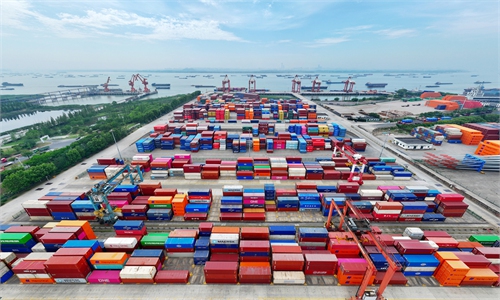
US bookings for container transport from China to the US spiked almost 300 percent in the wake of the US and China pausing punishing tit-for-tat tariffs, container-tracking software provider Vizion said on Wednesday. The average bookings for the seven days ended Wednesday soared 277 percent to 21,530 20-foot equivalent units from 5,709 TEUs for the average for the seven days that ended on May 5, said Ben Tracy, the company's vice president of strategic business development said, according to the Reuters.
Narvaja emphasized that the resumption of rational dialogue between China and the US provides an opportunity to shift their relationship toward a model of regulated competition and pragmatic cooperation. He said the two countries' collaboration in areas such as financial stability, trade, technological innovation, and energy transition will not only benefit their own development but also create a more favorable global environment.
For emerging economies, he noted, the easing of tensions between China and the US enhances predictability in international affairs, enabling them to better formulate development strategies, attract investment, and expand exports.
Emerging nations should adopt pragmatic diplomacy, engage both China and the US with strategic autonomy and maturity, and not just remain observers—but become architects of solutions, he said, noting that we must articulate our interests and propose responses grounded in our realities.
During the interview, Narvaja also highlighted China's resilience and adaptability in the face of trade frictions. He mentioned China's complete industrial system, diversified export markets, and growing global influence gained through vast domestic and overseas infrastructure investments under the Belt and Road Initiative. Technological innovation has strengthened China's resistance to external pressure. The country cultivates over a million engineering graduates annually, and it has a large number of top-tier AI researchers, he said.
In response to a controversial and widely-criticized past comment then US President Barack Obama made in 2010 that "If over a billion Chinese citizens have the same living patterns as Australians and Americans do right now, then all of us are in for a very miserable time; the planet just can't sustain it," Narvaja said that Obama's remark reflected an outdated mindset that development is a privilege of a few nations, a notion disproven by today's reality.
China has lifted more than 800 million people out of poverty and created a stable middle-income population of over 400 million who enjoy access to high-quality goods, services, education, and healthcare, and all this was achieved without replicating the excessive consumption and pollution characteristic of Western industrialization, he said.
He further stated that China's technological breakthroughs and development model have made it increasingly possible for more countries and populations to achieve the standard of living once considered exclusive to the West. This has profound implications for world peace and shared prosperity, he said, citing China's leadership in clean energy transition, long-term decarbonization planning, and ecological development.
Most importantly, China's development is not based on exploiting the resources of the Global South, but on promoting win-win cooperation, he added.
RELATED ARTICLES