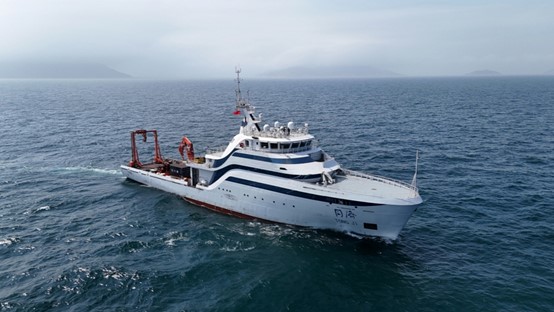
China's first intelligent oceanographic research vessel, the Tong Ji
China's first intelligent oceanographic research vessel, the Tong Ji, has successfully completed its maiden sea trial. The vessel is scheduled to embark on its first scientific expedition in the South China Sea this August, which will last for nearly a month, according to a report published on the website of the local government in Shanghai on Friday.
The Tong Ji is Tongji University's first oceanographic research ship, which marks a significant milestone in the country's marine science and technology capabilities. Weighing 2,500 tons with a length of 81.5 meters, the vessel is classified for unlimited navigation zones, excluding polar ice areas. It can reach a maximum speed of 15 knots and an economic cruising speed of 11 knots, the report said.
The Tong Ji is equipped with advanced features such as autonomous navigation in open waters, assisted berthing and unberthing, remote control operations, energy efficiency monitoring and fault diagnosis. It is capable of carrying work-class remotely operated vehicles (ROVs) and multiple modular container laboratories onboard, enabling it to support a wide range of scientific missions and cross-disciplinary operations, according to the report.
The vessel integrates capabilities for ocean geology, chemistry and biology research, making it a versatile platform for advancing China's marine science agenda.
According to Tuo Shouting, a deputy dean of the School of Ocean and Earth Science at Tongji University, the Tong Ji represents a significant advancement over previous vessels of similar tonnage in China. Enhancements include more optimized layouts for laboratory and deck space, improved compatibility for multi-task operations, and modular design capabilities that support a broader range of scientific missions.
"The vessel has made notable upgrades in deck and lab space configuration, as well as in task compatibility," Tuo said. "We've added offshore-grade ROV systems and specialized subsea cable maintenance facilities on the aft deck using a modular design."
To improve safety for at-sea personnel transfers, the ship also features a wave-compensated gangway system — a sophisticated boarding device designed to ensure secure embarkation in challenging ocean conditions.
Built on a 2,000-ton class platform, the Tong Ji maximizes functional space through smart design: It offers a 460-square-meter working deck, 320 square meters of laboratory space and personal cabins with an average area of 10.2 square meters per person. The vessel also includes over 100 square meters dedicated to communal areas such as meeting rooms, a lecture hall, lounge spaces and a fitness zone. Despite its compact size, the Tong Ji delivers scientific capabilities on par with a 3,000-ton class research vessel, according to the report.
The research vessel also marks a breakthrough in the exploration of intelligent and unmanned technologies. These notations represent key capabilities: remote control of the vessel from shore-based centers, autonomous navigation and collision avoidance in open waters, intelligent energy efficiency management, and an integrated smart platform.
Notably, the engine room is fully unmanned and supports autonomous operation of onboard equipment without human presence, significantly enhancing operational efficiency and safety during long-duration missions, the report said.
Global Times
RELATED ARTICLES

