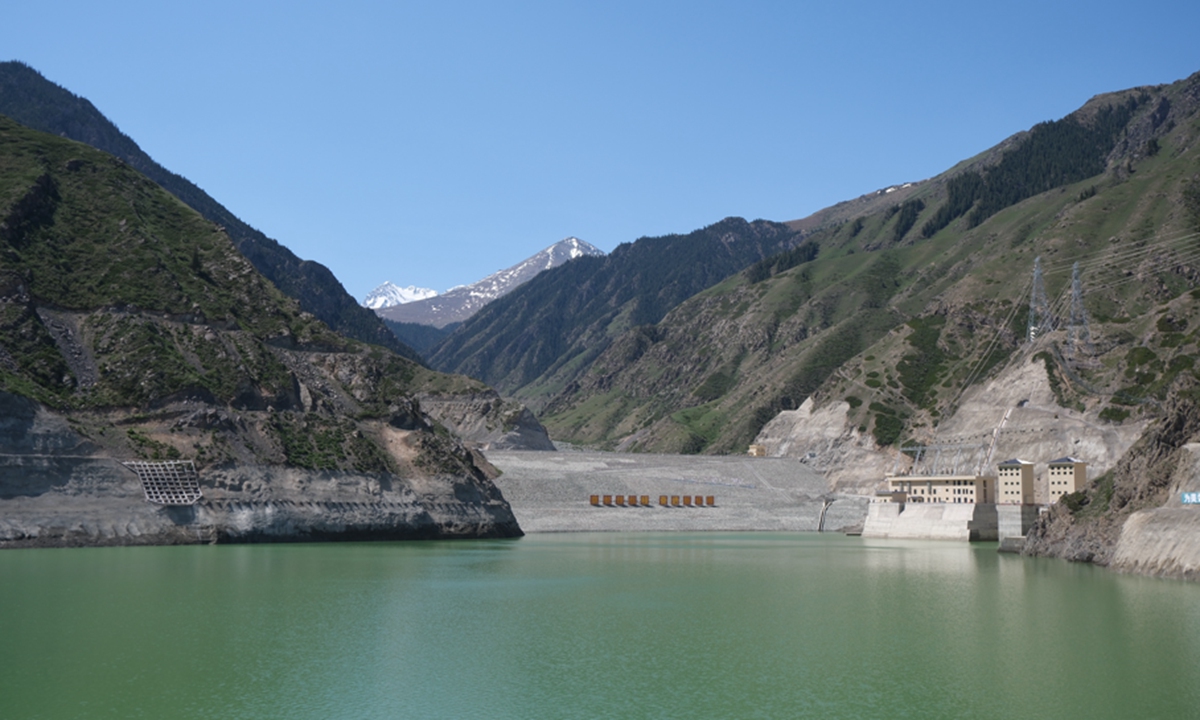
Downstream reservoir area of the Fukang pumped-storage power station Photos: Li Yawei/GT

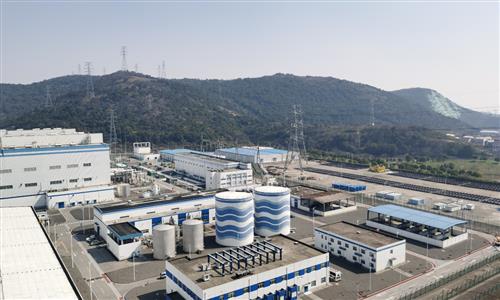
Convert station of the Changji-Guquan UHVDC transmission line project
Nestled deep in the Tianshan Mountain in Northwest China's Xinjiang Uygur Autonomous Region, the pumped-storage power station and ultra-high-voltage converter station stand as sentinels of progress. These engineering marvels not only inject robust vitality into the power grids of Xinjiang region and China's northwestern regions but also bear witness to the unwavering dedication of countless builders.
On Thursday, a Global Times reporter visited two power projects and heard stories from engineers who poured sweat into concrete foundations, crafting an invisible lifeline that now hums with clean energy for millions.
The State Grid Xinyuan Fukang pumped-storage power station in Fukang city leverages a 400-meter elevation difference to enable efficient power generation and storage.
As the first operational pumped-storage facility in Northwest China, it consumes over 2.6 billion kilowatt-hours of clean energy annually while reducing carbon dioxide emissions by 496,000 tons, demonstrating significant energy-saving and emission-reduction benefits.
"Acting like a grid regulator, it has generated over 1.7 billion kWh and pumped more than 2.1 billion kWh since operations began, fully utilizing its functions in peak shaving, frequency regulation, and energy storage," said Lu Jiangang, a deputy director of the station's engineering department.
After graduating from Shihezi University with a degree in hydraulic engineering, Lu devoted himself to the station's construction for 10 years. Behind his passion lies his deep regret towards his family, having not visited his parents in Northwest China's Gansu Province for eight years while dedicating his youth to his profession.
"But ensuring a stable electricity supply for residents makes all my efforts worthwhile," Lu told the Global Times. During downtime, he regularly chats with his parents and shares updates about his work with them. "My parents know I'm contributing to the nation, and they take great pride in that," he added.
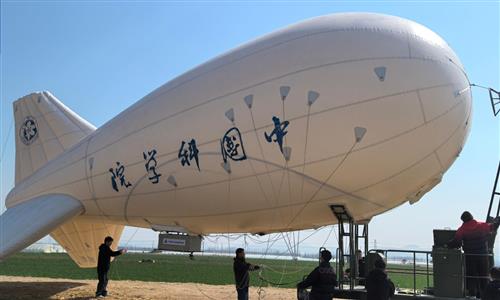
Lu loves his work and strives to excel through dedication. In recent years, Lu and his engineering team has adopted technological innovations ranging from drone-enhanced land surveys to tackling ecological restoration challenges in alpine and arid regions.
Their achievements include national and provincial-level quality control awards, four invention patents, 20 utility mode patents, and over 90 percent conversion rate for research outcomes.
In addition, the power station also brought tangible benefits for local villagers. The construction has brought transformative changes with upgrading 20 kilometers of local roads to asphalt, creating 3,500 jobs during construction, and generating annual fiscal revenue of 64 million yuan during infrastructure development.
Huanxbek Sayean, a Kazakh engineer overseeing logistics center projects from Altay's Habahe county, represents another example of Xinjiang's power pioneers.
Thanks to national ethnic minority policies, Huanxbek became his village's first college graduate after studying in Nanjing, East China's Jiangsu Province.
Despite opportunities in more developed cities, he chose to return hometown after completing graduate studies at Hohai University.
"When I left Xinjiang, I vowed to contribute to my homeland," said Huanxbek, noting that "now seeing villagers' lives improve fills me with pride."
Another critical project, the Changji-Guquan UHVDC transmission line - the world's highest-voltage, longest-distance and highest-capacity project in the sector - stretching 3,293 kilometers from Xinjiang to East China's Anhui Province and is built on similar dedication.
Lei Xiaosong, a post-1990s technician from Sichuan Province, helped safeguard this power artery since 2017.
Lei recalled a 2022 winter emergency repair story with the reporter from the Global Times.
In Xinjiang's winter, where temperatures can plunge to -30 C, Lei and his colleagues spent nine hours conducting emergency repairs on power lines.
"At the time, the cold wind felt like knives stinging our faces. Even in heavy winter clothing, our hands and feet went completely numb," he recalled.
Securing the grid's stability is our only focus, Lei said without hesitation.
Despite the challenges, he finds camaraderie with colleagues-turned-comrades and takes pride in contributing to national development.
From mountain valleys to Gobi deserts, countless grid workers like Lu, Huanxbek and Lei continue weaving their youth into transmission towers and substations.
Their perseverance flows through power lines, carrying Xinjiang's energy from Tianshan's foothills to homes thousands of miles away.
RELATED ARTICLES