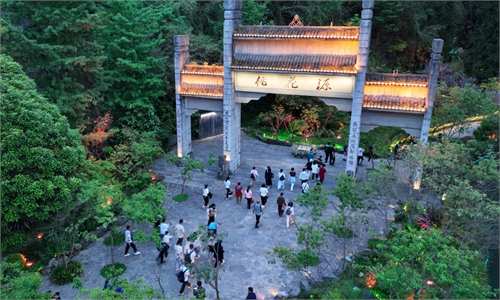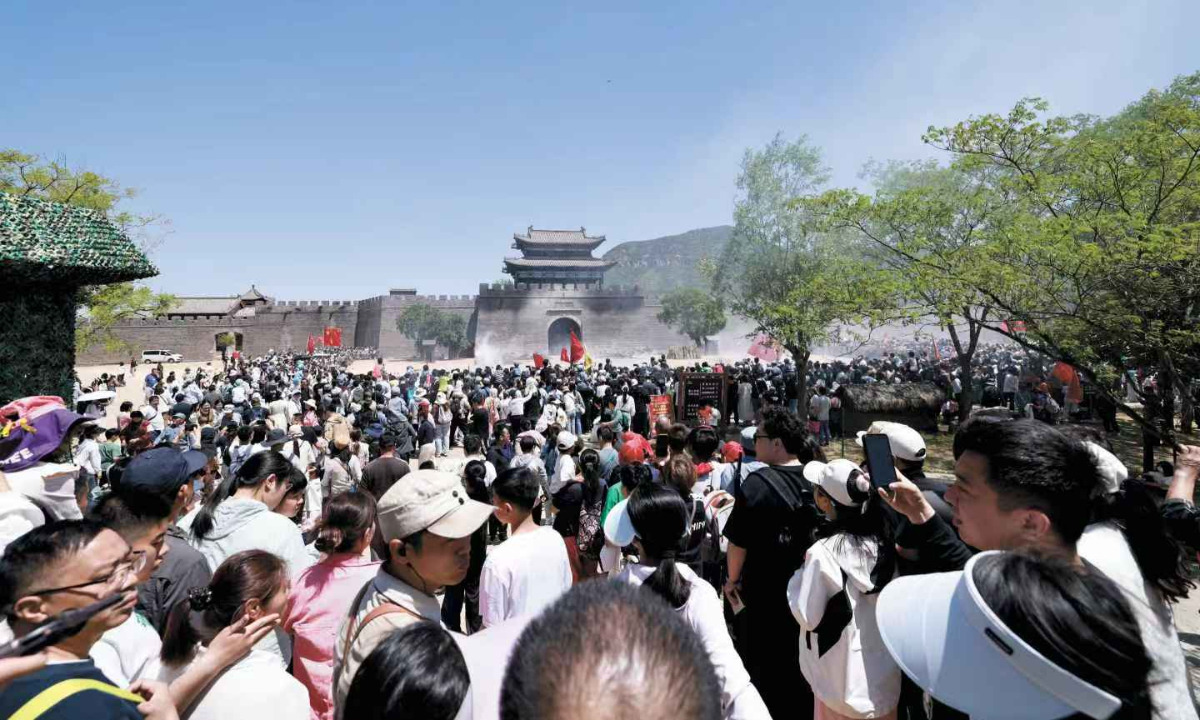
Tourists experience the immersive “red tourism” project named “follow the regiment commander to attack the county town” at a tourism attraction in Linyi, East China’s Shandong Province on May 2, 2025. Photo: Courtesy of Yan Jisuo
At the command of the "regiment commander," tourists armed with prop broadswords and prop pistols charged into the "county town" alongside the "Eighth Route Army."
The viral tourist experience named "follow the regiment commander to attack the county town" at a tourism attraction in Linyi, East China's Shandong Province, has remained a hot topic since gaining popularity on Chinese social media during the National Day holidays in 2024. Even after the 2025 May Day holidays, it continues to be a favorite.
The project recreates a 1941 wartime scene from the Chinese People's War of Resistance against Japanese Aggression, where tourists don military uniforms and immerse themselves in the history under the guidance of non-player characters. Some netizens have jokingly called it "the most suitable cosplay for Chinese people."
Tourists immersed in story
"Here, I felt like I had traveled back in time to the fiery era of the war," said Zhao Jiaxin, a 21-year-old university student from Jinan, Shandong Province.
The entire experience lasts about half an hour and is divided into four parts: mobilization rally, assault march, attacking the county town and victory celebration.
Zhao said her favorite part was the realistic details of the experience. When storming the county gate, intense gunfire and explosions played through the sound system, sandbag barricades were set up and two prop cannons were placed nearby. There were also thick smoke effects, explosive sound effects and the sight of over a thousand people charging forward. They were waving rifles, red-tasseled spears and broadswords while shouting battle cries, which made the ground tremble beneath their feet.
After successfully recapturing the county town, visitors could experience the jubilant victory celebration. "That's when I truly understood what the Chinese saying 'a bond as close as fish and water between the army and the people' means," Zhao said.
The immersive experience made her momentarily forget she was just acting, instead making her feel the passion and fervor of the revolutionary era.
According to Yan Jisuo, deputy general manager of the tourism attraction, most of the actors in the project are staff members and local villagers.
Previously, the People's Daily reported that the actor playing the "regiment commander" once shared in an interview that three generations of his family had served in the military. Though he never enlisted himself, playing the role fulfilled a dream for him. "After each performance, even though I'm a bit tired, I can't help but think about how our ancestors endured real gunfire and artillery back then. Seeing how much visitors appreciate this project makes it all feel very meaningful."
Creative development
While widely praised, some have raised concerns about whether the entertainment aspect might undermine the solemnity of red history. Yan explained that given the area's rich red cultural heritage and advantages in film and television resources, their professional team ensures the rationality of the storyline and special effects.
Yan noted that the tourism area is located in Yinan county, one of the key birthplaces of revolutionary spirit, and has been a classic red tourism destination for 16 years. In its early stages, the site only featured a few red-themed memorial halls for visitors.
Later, numerous anti-war films and TV dramas were shot here, turning it into a renowned red film and television base. Over 450 productions have been filmed on-site.
Targeting different red education themes, the tourism area previously developed small-scale immersive courtyard performances. These were concise yet impactful, using local dialects to reenact true historical events.
"As we realized our theatrical productions had matured, we decided to take immersive performances out of the courtyards and onto the streets, creating a large-scale experience where visitors feel transported back to the wartime era as soon as they enter," Yan recalled.
Thus, in April 2023, the "attack the county town" project was born. "Judging by the packed crowds at every show, the results have been positive." Most visitors are young adults like Zhao. Some foreign tourists have also participated. "Occasionally, we see translators assisting them. Though they may not grasp every detail, they generally understand the story and have given positive feedback," Yan said.
Despite the physical demands of the activity, elderly visitors, even one in a wheelchair, have joined in, Yan added.
"Last year, we hosted a 90-year-old veteran from Southwest China's Sichuan Province, our oldest participant so far. He had fought in the War to Resist US Aggression and Aid Korea and spoke highly of our project. He said, 'You've done an excellent job. Young people today need experiences like this to understand the sacrifices made during wartime.'"
Learning of history
Regarding the connection between immersive entertainment and learning red history, Zhao also expressed a positive view.
"To be honest, I don't usually seek out revolutionary films or TV shows on my own. However, after participating in this project, I even searched for and read more about the revolutionary spirit in this place," she said.
"By stepping into a role and feeling a sense of responsibility, visitors gain an intuitive understanding of history's hardships. This kind of education is far more impactful than textbooks."
Many young people are also keen on immersive red culture experiences offered by museums, memorial halls and Party-mass activity centers, including activities like jubensha, also known as script murder games.
For example, Party members, officials and young student leaders visiting the Changsha Library in Central China's Hunan Province have opted for its red-themed jubensha to immerse themselves in revolutionary spirit. These games incorporate suspense elements against a backdrop of real historical events, using role-playing, interactive reading and logical reasoning to create a vivid Party history education activity. This deeper engagement helps young people understand the history of the Party's founding, reported a local media outlet in Changsha.
These immersive red projects continue to evolve. Yan shared that for the 80th anniversary of the victory, the "attack the county town" project added more interactive elements, such as militia clapper-talk performances and group singing of revolutionary songs. Plans are also underway to enhance the realism of the battlefield. "While cramming historical materials before exams, I've often thought: If I could actually talk to the people in these texts or experience these events firsthand, I wouldn't need to memorize them, they'd become a part of me. I believe immersive experiences are making that possible," Zhao said.
RELATED ARTICLES