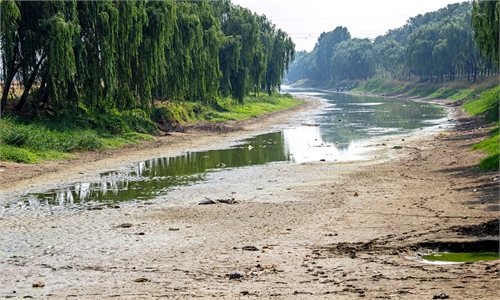
Tourists walk in the Qingzhou Ancient City Tourist Area in Weifang, East China's Shandong Province on May 16, 2025. Photo: IC
Amid the arrival of the first heatwave in the northern regions in China on Sunday, local authorities in parts of Northwest China have already implemented a range of measures to combat an ongoing severe meteorological drought, including planting drought-resistant crops and activating backup water sources.
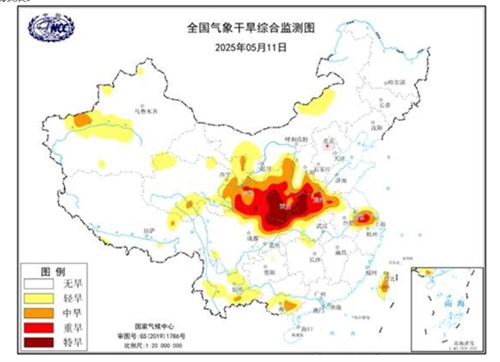
Northwest China's Shaanxi and Gansu provinces, as well as Central China's Henan Province, have recently seen dry weather with little rain, leading to severe or higher-level meteorological drought, according to a report by Weather China.
In the next three days, drought areas in these places will remain dry with rising temperatures, likely worsening the drought, the report said, as winter wheat also faces high risk from hot, dry winds, which could possibly hinder grain filling and cause premature aging.
The rainfall in Pingliang of Gansu is 40 percent to 70 percent below normal, causing severe drought, CCTV News reported on Sunday. So far, 118,700 people and 11,800 livestock face drinking water shortages, with overwintering crops being affected.
A total of 25 emergency backup water sources in Pingliang have been activated to ease the water shortage for people and animals, and 16 sealed electromechanical wells are also used, which can increase the water supply by about 3,300 cubic meters per day, CCTV reported.
The agricultural and natural disaster emergency command office in Gansu also launched a level-four drought emergency response at 9 am on Saturday as drought conditions have been developing rapidly in some areas of eastern and central Gansu since mid to late April.
In Huan county of Gansu, 700,000 mu (46,690 hectares) of farmland has been affected, with over 500,000 mu of winter wheat and corn damaged, CCTV said. Local people are being guided to plant drought-resistant crops like potatoes to complete 2.2 million mu of grain sowing to ensure food security, according to CCTV.
Parts of regions in Shaanxi will experience daytime temperatures above 35 C from Monday to Wednesday, and risk of dry hot winds affecting winter wheat is high in some of regions, according to a continuing warning issued on May 16, The Paper reported.
The recent drought and high temperatures primarily affected the grain-filling stage of the summer crops, which are winter wheat sown last winter, thereby adversely impacting the summer grain yield, Ma Jun, director of the Beijing-based Institute of Public and Environmental Affairs, told the Global Times on Sunday.
Ma added that winter wheat is currently at a critical stage - the grain-filling period. At this time, it requires sunlight, warmth, but also, crucially, moisture, Ma said. "If the persistent drought and high temperatures continue, especially the drought, it may hinder the grain-filling process, which would negatively affect the overall summer grain yield."
However, the countermeasures, including enhancing irrigation and applying foliar fertilizers to improve the wheat's resistance, could help with the crops.
Previously, Tongchuan in Shaanxi has deployed 100 agricultural drones to carry out the "one-spray, three-preventions" operations, according to a CCTV report.
RELATED ARTICLES