China updates rules for government agencies to curb extravagance and promote long-term thrift practices
By and Liang Rui Published: May 23, 2025 10:33 PM

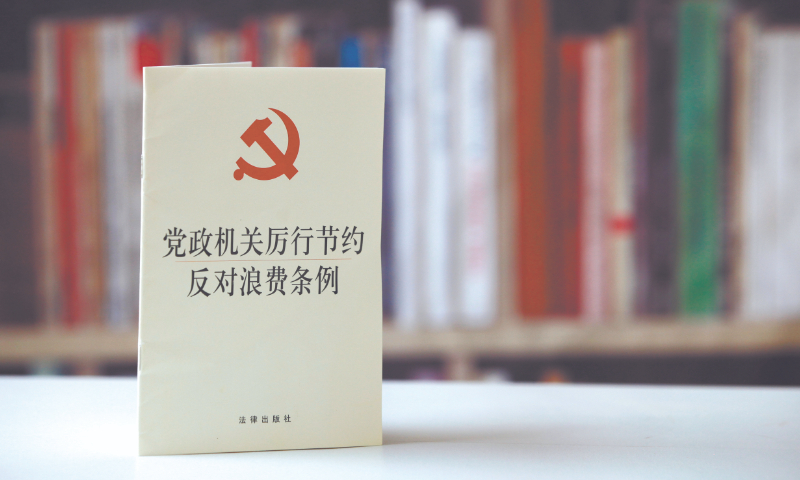
The Regulations on Practicing Thrift and Opposing Waste in Party and Government Organs. Photo: VCG
The Communist Party of China (CPC) Central Committee and the State Council recently issued a revised version of the Regulations on Practicing Thrift and Opposing Waste in Party and Government Organs (hereinafter referred to as the Regulations), urging all localities and departments to implement the measures faithfully.
According to People’s Daily, the previous version was released in 2013. The newly revised version is more comprehensive and detailed in its requirements.
For instance, the Regulations stipulate that governments should streamline meetings and strictly adhere to prescribed expenditure scopes and standards for conference fees.
In terms of energy efficiency, the Regulations call for the “promotion of energy-saving technologies and products, elimination of high-energy-consuming facilities, and active use of new and renewable energy sources.” They also encourage “the use of water-saving appliances,” “centralized recycling of non-confidential wastepaper and discarded electronic devices,” and “a push toward paperless offices to reduce consumption of disposable office supplies.”
The document further urges the establishment and strengthening of supervisory mechanisms to prevent waste, with violations subject to disciplinary action.
The Global Times spoke with three civil servants about concrete measures China has taken to practice thrift and oppose waste across many sectors. Their firsthand accounts, supplemented by media analyses, reveal tangible progress since the 18th CPC National Congress in curbing extravagance, elevating public consciousness, and deepening understanding of austerity policies.
Changes in the office
In 2013, to facilitate thorough implementation of the eight-point decision, the country formulated and issued the Regulations, gradually establishing an anti-extravagance institutional system with the Regulations as the core framework, supplemented by specialized supporting rules and regulations. This system effectively curbed prominent misconduct such as “waste at dining tables” and “unhealthy practices in private clubs,” according to People’s Daily.
For Li Mu (pseudonym), a civil servant working in Beijing’s legal system, frugality was a routine part of his work day, and it has especially become ingrained since the release of the original Regulations in 2013.
At Li’s office, double-sided printing is mandatory except when single-sided copies are required for archival purposes. All documents are proofread by assistants and clerks before printing to minimize unnecessary waste, and used single-sided paper is placed next to the printer for reuse as scrap paper.
“We turn off unnecessary lights. If there’s sufficient daylight, we switch off the lights, and we always turn them off when leaving the room. Air conditioning is set to a minimum of 26 degrees Celsius in summer and a maximum of 20 in winter,” Li said.
“We avoid food waste, walk more, take the stairs instead of the elevators,” she told the Global Times. “For training sessions, we take public transportation or group shuttle buses.”
“It’s a good policy. We should start with ourselves and follow it down-to-earth,” she added.
Following the publication of the new Regulations, Lin Ming (pseudonym), a civil servant from East China’s Shandong Province, attended a briefing on the updated policy.
“The new version is more comprehensive, more refined, and sets more specific requirements,” he told the Global Times.
According to Lin, the department he works for has implemented key measures such as enforcing strict hospitality standards.
“These mandatory measures have changed the extravagant habits of some officials,” he noted.
Lin said the central government has been promoting implementation through continuous directives and periodic inspections. Some departments have been penalized for violations such as renting offices unlawfully or exceeding office space standards.
Crossing the line
The current revision adopts a dual approach combining goal orientation with problem orientation, modernizing provisions on regulations like budget management, official hospitality, conference activities, and resource conservation. By strengthening accountability for practicing frugality and opposing waste, and through targeted gap-filling and systematic upgrades, the amendments further reinforce the institutional bulwark against extravagance, said People’s Daily.
Lin said that in some regions, there are still incidents such as drinking violations, reflecting a lingering outdated mindset.
The updated Regulations address this issue explicitly, stipulating that “working meals during official receptions must not include luxury dishes, cigarettes, or alcohol.”
“To ‘control your mouth,’ you must first ‘guard your mind,’” an article public on Zhejiang Xuanchuan, a WeChat account affiliated with the Zhejiang government, said. “Only when each individual builds a strong moral defense can they resist the temptation of indulgence, allowing integrity to flourish and reinforcing the CPC’s clean and upright image.”
“Since the central authorities rolled out this policy, it is clearly meant to be a long-term effort, not a temporary campaign. Some individuals initially resist the idea due to entrenched habits of waste and extravagance,” said Wang Dong (pseudonym), a civil servant working in Central China’s Henan Province. “Change must begin with a shift in mindset.”
“This is not about coping with material scarcity. It is a form of wisdom, a way to cultivate personal integrity, and a spiritual cornerstone for maintaining national stability,” Wang said.
RELATED ARTICLES