Forum calls for igniting cultural creativity through deepening reform
Digital tools highlighted at event for culture, boost intl delivery: observer
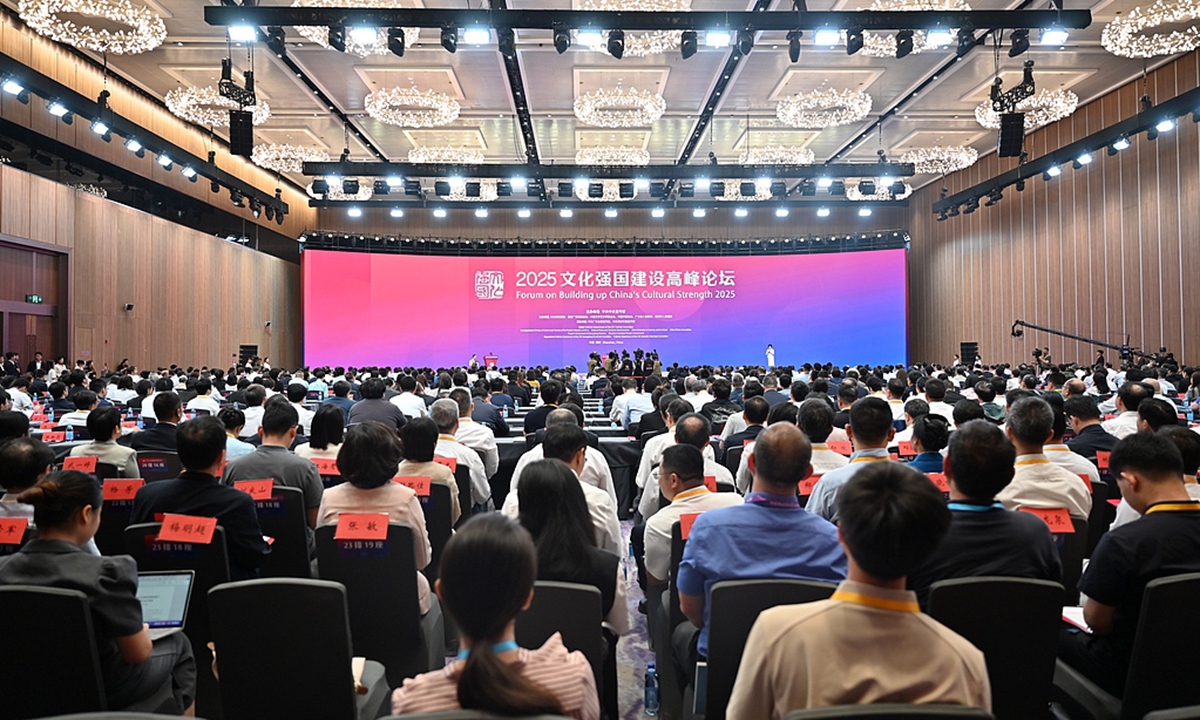
Forum on Building up China's Cultural Strength 2025 kicks off in Shenzhen, South China's Guangdong Province on May 26, 2025. Photo: VCG
At the Forum on Building up China's Cultural Strength 2025 held in Shenzhen, South China's Guangdong Province, senior officials, professionals from cultural sectors and experts on diverse disciplines called on thoroughly implementing the Global Civilization Initiative, advancing open cooperation in the cultural field, and deepening exchanges and mutual learning among different civilizations.
Themed "deepening reform in the cultural sector to ignite cultural creativity," the forum was hosted by the Publicity Department of the Communist Party of China (CPC) Central Committee.
Li Shulei, a member of the Political Bureau of the CPC Central Committee and head of the Publicity Department of the CPC Central Committee, attended the conference and delivered a keynote speech.
The forum of this year consists of a main forum on Monday and 10 breakout sessions, including building Chinese intellectual system of philosophy and social sciences, transformation of mainstream media, cultural heritage preservation and inheritance, and development of art and literature, as well as publishing and film industries. Experts are also exchanging ideas on empowering culture with science and technology, according to the organizer.
As a cultural forum of the high level in China, Forum on Building up China's Cultural Strength was initiated in 2023. Focusing on the main them of the times, building a communication platform, and leading cultural trends, the 2025 edition of this significant forum is to further rally a strong joint force to promote cultural innovation and prosperity, so as to build up China's cultural strength, observers said.
Attendees to the forum included officials of publicity departments, representatives of cultural enterprises and public institutions, and scholars and experts.
The participants agreed that it is imperative to boldly advance reform in the cultural sector, further release and develop cultural productive forces, and steadily promote cultural prosperity.
Reform in the cultural sector should focus on addressing the key challenges hindering cultural development, the participants said.
They also called for efforts to advance the integration of culture and science and technology, as well as to promote openness and cooperation in the cultural sector.
Zhang Yiwu, a professor of cultural studies at Peking University, told the Global Times on Monday that the forum provides a platform for boosting cultural development, promoting inter-disciplinary communication and integration, and deepening global understanding of China through a cultural perspective.
Cultural strength is an integral part of comprehensive national strength; it is the outcome of rising cultural confidence and will conversely further consolidate our cultural confidence, Zhang said.
Culture as a bond
Zhang Zhiqiang, a research fellow and director of the Institute of Philosophy at the Chinese Academy of Social Sciences, said on Monday at the forum that the Chinese civilization has endured for millennia without interruption and remained resilient despite numerous hardships. He concluded that behind the continuous development of Chinese civilization are generations of Chinese nationals who have driven its progress through constant innovation.
When scholars and experts are analyzing culture as a bond in the Chinese national and Chinese civilization from a theoretical perspective, the public can feel the bond when they are joyfully witnessing the return of China's earliest known silk texts from the US, the display of archeological and research breakthroughs in museums, and the everyday experience of cultural events and products, Sun Jiashan, a researcher at the Central Academy of Culture and Tourism Administration, told the Global Times on Monday.
By guarding and inheriting the treasure of Chinese culture, we enhance national cohesion, consolidate the national spirit and boost cultural confidence, marching forward toward Chinese modernization and national rejuvenation, the expert said.
New trends
One notable trend for this year's forum is cultural innovation and the role of science and technology.
At the main forum on Monday, Shen Zhuanghai from Wuhan University pointed out the necessity of using digital and AI technologies for cultural innovation.
Shen cited blockbuster movie Ne Zha 2 as an example of how Chinese culture and cutting-edge technologies, when combined, can turn into real success. We should grasp the developments in digital and AI technologies, and promote their integration with cultural innovation, so as to unleash the cultural force in promoting Chinese modernization.
The 21st China (Shenzhen) International Cultural Industries Fair, which concluded on Monday, offered an artificial intelligence (AI) exhibition area for the first time, Xinhua reported.
The five-day event is being held across eight exhibition halls — three comprehensive spaces and five specialized areas. The specialized halls cover a broad array of fields, including international cultural trade, cultural tourism, art and design, film and gaming, and intangible cultural heritage.
The AI exhibition area showcases the latest products from 22 local tech companies, such as robots, drones, smart glasses, and smart earphones. Through interactive experiences, visitors can get a glimpse into the charm and future application scenarios of AI technologies.
Culture is not only a spiritual bond that unites people's hearts, but also a key factor in improving the well-being of the people, therefore, also an important driver for economic growth, observers noted.
In 2024, cultural and related industry enterprises above the designated scale in China achieved operating revenue of 14.151 trillion yuan, a 6 percent increase compared to the previous year, according to official statistics.
More than 9,100 workshops of intangible cultural heritage allow "old skills" to be new highlights of income; more than 388,000 public spaces become cultural lounge for residents; cultural tourism and new business models inject new momentum into economic growth, per Xinhua.
People consume culture products but also enrich culture, and with handy tools of new technologies, it is important to explore ways to integrate traditional culture with contemporary popular culture, explore new models of culture development and diversify channels for dissemination of Chinese culture, Sun Jiashan said.
RELATED ARTICLES