ASEAN Summit stresses greater integration, resilience against trade disruptions
Member countries urged to ensure agenda of sustainable, equitable development
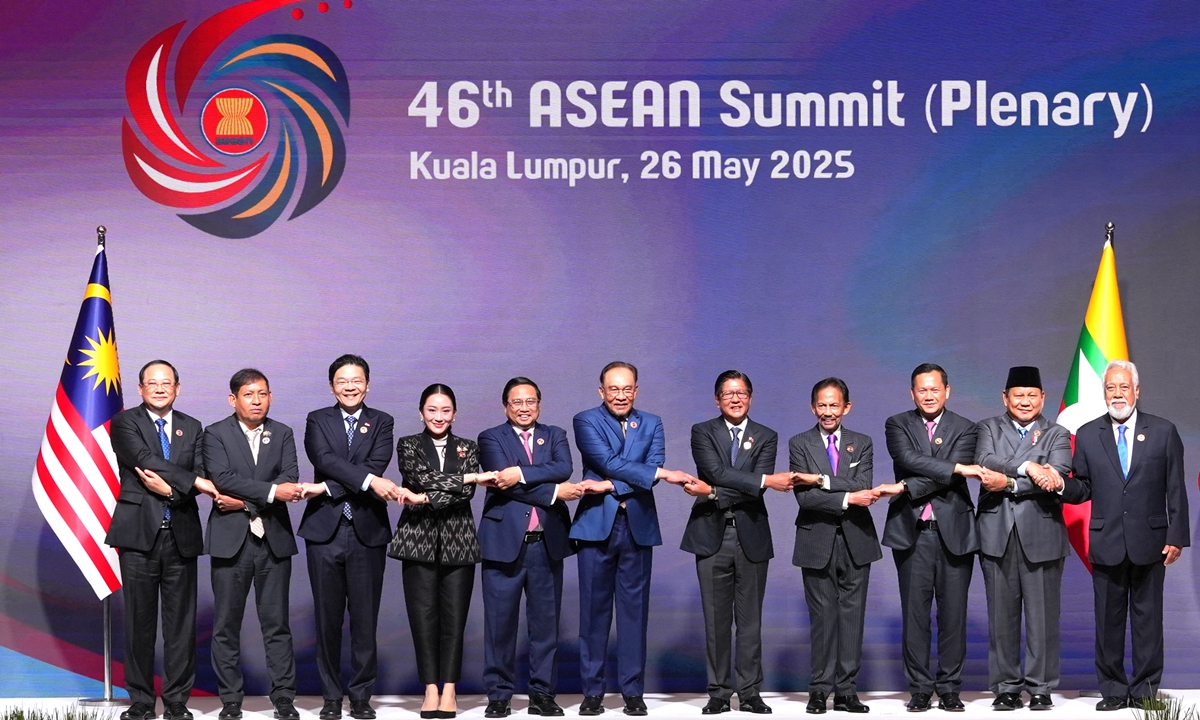
The 46th ASEAN Summit kicks off in Kuala Lumpur, Malaysia, on May 26, 2025, with greater regional integration and resilience against trade and economic disruptions high on the agenda. Photo: cnsphoto
The 46th Association of Southeast Asian Nations (ASEAN) Summit kicked off on Monday in Kuala Lumpur, with greater regional integration and resilience against trade and economic disruptions high on the agenda amid the global trade uncertainties.Malaysia is the chair of ASEAN for 2025, and is hosting the ASEAN Summit and related summits under the theme "Inclusivity and Sustainability," according to Xinhua News Agency.
Speaking at the opening ceremony of the plenary session, Malaysian Prime Minister Anwar Ibrahim urged ASEAN members to work together to face the challenges brought about by a changing world order to ensure the agenda of sustainable and equitable development is not sidelined, Xinhua reported.
Leaders of the ASEAN later signed the Kuala Lumpur Declaration on ASEAN 2045: Our Shared Future, a key document guiding the next 20-years of the grouping, at the summit on Monday.
In his remarks following the signing ceremony of the declaration, Malaysian Prime Minister Anwar Ibrahim said the document would pave the way for the grouping's future direction, taking into account emerging challenges while putting sustainable and inclusive development at the forefront, per Xinhua.
In the face of US tariff barriers and global trade protectionism, the unity of ASEAN member states and its cooperation with China and other regional organizations like the Gulf Cooperation Council (GCC) are particularly valuable, experts said. It serves as a strong counter to worldwide conservatism, and will also enhance regions' resilience and ability to withstand risks, they noted.
The summit comes as growth across the region has taken a hit from US' threatened tariffs, with levies of up to 49 percent set to be imposed on member states unless they can make deals before a July deadline, according to the South China Morning Post.
Malaysia has sought a unified bloc meeting with US President Donald Trump to discuss the tariffs. Officials are hopeful it could happen later this year, multiple media reported.
Upgraded cooperation
As the world's fifth-largest economy, ASEAN and China are each other's largest trading partners and key investment partners. In the face of the US "tariff storm", China-ASEAN cooperation is gaining renewed vitality, as negotiations for the China-ASEAN Free Trade Area 3.0 (CAFTA) were fully concluded last week, marking a crucial step toward greater mutual openness.
As a priority in bilateral economic and trade cooperation, the development of the CAFTA 3.0 represents a landmark achievement in jointly upholding and advancing free trade, the Chinese Ministry of Commerce said on May 21.
Xu Liping, director of the Center for Southeast Asian Studies at the Chinese Academy of Social Sciences, said that the CAFTA 3.0, with focus on emerging sectors such as the digital economy and green economy, will unlock greater cooperation potential between China and ASEAN. The agreement will also facilitate freer and more efficient trade and investment flows, further strengthening regional cooperation, Xu told the Global Times on Monday.
"Against the backdrop of rising global unilateralism, and in the face of trade barriers and worldwide protectionism, China-ASEAN cooperation will bolster the region's resilience and risk resistance, making this partnership all the more invaluable," said Xu.
Amid a complex international landscape, it is inevitable that certain regional countries may create disruptions under the influence of external forces, Xu noted. "However, despite a few discordant voices, they do not represent the mainstream. The majority of ASEAN nations continue to prioritize collaboration, and the broader trend of regional cooperation is unstoppable."
'Institutional breakthrough'
At the opening ceremony of the ASEAN Summit on Monday, Anwar also stressed the importance of strengthening cooperation with friendly partners of the grouping, noting the significance of the first ever ASEAN-GCC-China summit set to open on Tuesday.
Chinese Premier Li Qiang arrived in Kuala Lumpur on Monday to attend the summit at the invitation of Malaysian Prime Minister Anwar Ibrahim.
Replying to media inquiry about China's expectations on the summit especially with regard to the current trade war with the US, Chinese Foreign Ministry spokesperson Mao Ning said that through the summit, China looks to enhance cooperation with member states of ASEAN and GCC.
Adityarini Christina, Treasurer of the West Java Provincial Branch of the Indonesian Democratic Party of Struggle, emphasized the significance of the trilateral summit in promoting cross-regional cooperation and strengthening the unity of Global South countries. She told the Global Times on Monday that the summit is crucial, particularly for Indonesia.
Christina mentioned that in recent years, numerous Chinese companies have established a presence in Indonesia, with West Java region being a notable example. "Companies such as BYD have not only created job opportunities for local residents but also contributed positively to the regional economy. Indonesia is a concrete example of a Global South country that has benefited significantly from such cooperation," she added.
"Why can't we be better than the West?" she said, further noting that compared to other regions, Asia is safer, more stable, and has greater opportunities to grow bigger and stronger.
Wirun Phichaiwongphakdee, Director of Thailand-China Research Center of The Belt and Road Initiative (CTC), believes the establishment of this trilateral mechanism represents a significant institutional breakthrough in Global South cooperation, Wirun told the Global Times on Monday. "This framework not only responds proactively to the multipolar trend but also marks a new stage of institutionalized collaboration among developing nations," Wirun said.
"Structurally, it brings together three key players: China as the institutional architect and industrial leader of the Global South, ASEAN as the most cohesive regional organization, and the GCC as the economic and energy hub of the Arab world. Together, they create the first institutionalized strategic dialogue platform connecting Asia-Pacific and the Middle East," Wirun noted.
The expert sees this trilateral summit serving three major purposes. First, it addresses the fragmentation in South-South cooperation; second, it facilitates strategic alignment between China's Belt and Road Initiative, Master Plan on ASEAN Connectivity 2025, and GCC member Saudi Arabia's Vision 2030 - all sharing common goals of high-quality development and openness. Third, it offers Global South's experience to global governance, providing institutional support for building a community with a shared future for mankind.
"I have always stressed that the 'strength of the Global South' represents not just the rise of economic might, but more importantly, the emergence of their political stances and governance philosophies," Wirun said. "The multilateral consensus between China, ASEAN and GCC countries is gradually solidifying and being translated into action. This Global South multilateral consensus offers valuable experience to the world."
Prior to his leg of trip to Malaysia, Premier Li Qiang paid an official visit to Indonesia from Saturday to Monday. During the visit, Premier Li held talks with President Prabowo Subianto and they jointly attended the Indonesia-China Business Reception. He also met with Speaker of Indonesia's House of Representatives Puan Maharani and held a symposium for Chinese enterprises operating in Indonesia.
RELATED ARTICLES