Can France move beyond ‘Eurocentrism’ and grasp Southeast Asia’s strategic rhythm?
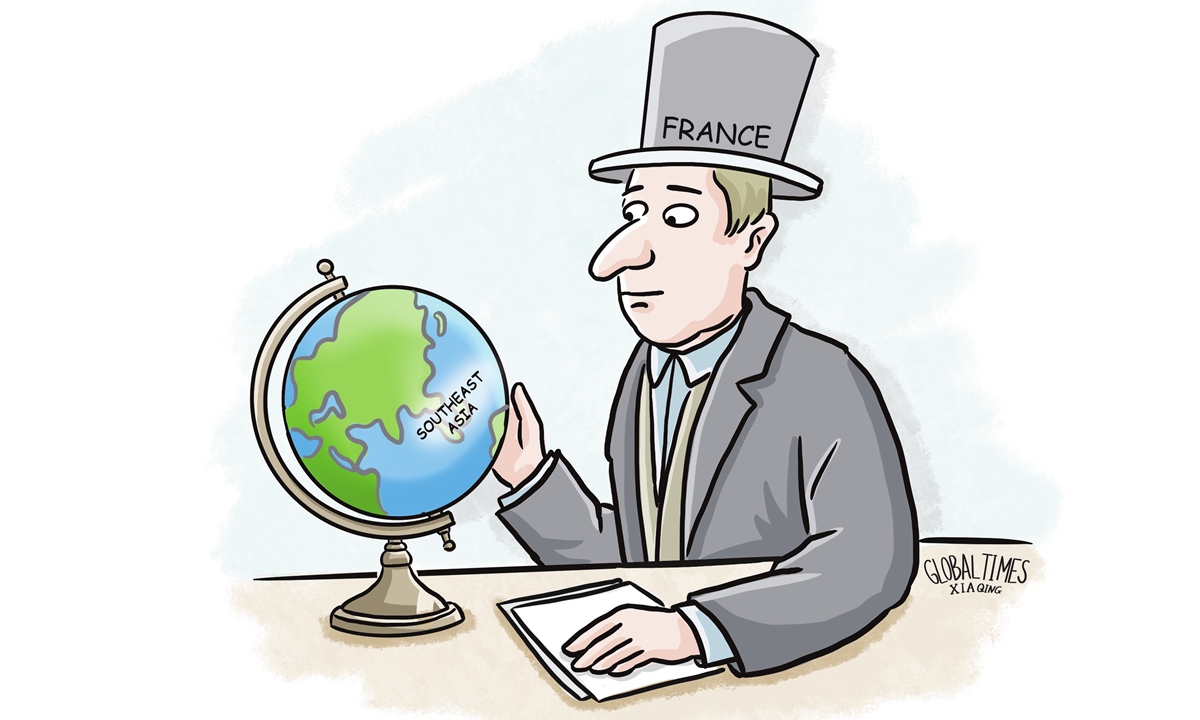
Illustration: Xia Qing/GT
French President Emmanuel Macron embarked on a six-day trip to Southeast Asia on May 25, with Vietnam as his first stop, followed by Indonesia and Singapore. This trip represents France's attempt to reclaim its position and seize new opportunities, serving as a concrete manifestation of its pursuit of tangible interests through its Indo-Pacific Strategy.
From an economic perspective, Vietnam, Indonesia and Singapore are not only the most representative "middle powers" within Southeast Asia, but they also play pivotal roles in reshaping global industrial and supply chains. Vietnam has signed a free trade agreement with the EU, providing an institutional framework for France-Vietnam economic cooperation. It serves as a major manufacturing hub for French industrial offshoring in Asia and has become a hotspot for French investment in the automotive and renewable energy sectors. Indonesia, as the largest economy in ASEAN, boasts a young workforce and abundant resources such as nickel and lithium, making it a crucial pillar for France's energy transition and mining strategy. Singapore, as a regional financial and digital hub, serves as France's most stable bridge to ASEAN and the South Pacific.
From a diplomatic perspective, France has long championed a multipolar world order and emphasized an independent and autonomous European path. Macron has advocated that Europe should become a "third pole" beyond China and the US - a position that resonates, to some extent, with Southeast Asia's preference for strategic balance. The three countries visited by Macron this time are not only key ASEAN members but also representatives of the emerging Global South power landscape. France aims to use these visits to convey its message to ASEAN and the wider Global South, enhancing its involvement in emerging multilateral cooperation frameworks. Amid a turbulent international environment, France increasingly needs to leverage its diplomatic footholds in Southeast Asia to recalibrate its global strategy and bolster the international voice of both France and the EU.
From a security perspective, the three countries visited are key targets for France's arms sales and defense cooperation. Indonesia signed a contract to purchase two Scorpène submarines from France last year, marking a breakthrough for France's military industry in Asia. Singapore provides logistics and bases for France's Indo-Pacific deployment. Additionally, France promotes "European strategic autonomy," trying to demonstrate through its Indo-Pacific involvement that the EU is not a NATO vassal, but a global force capable of influencing the region's balance.
On non-traditional security, France views climate governance as a "legitimate channel" into Southeast Asia. As a key executor and advocate of the Paris Agreement, France deepens environmental and development cooperation through platforms such as the Adaptation Fund and the Green Climate Fund, particularly in green infrastructure, carbon reduction and ecological restoration. Indonesia and Vietnam, significantly impacted by climate change, along with Singapore, a hub for climate technology and green finance, form a new fulcrum for France's climate diplomacy in Asia.
Compared to Macron's previous visits, this trip is more systematically strategic, aiming to establish Southeast Asia as a key area in France's Indo-Pacific Strategy, moving beyond symbolic visits and bilateral trade promotion.
Notably, Southeast Asia has recently become a global diplomatic "hotspot," a trend that is by no means accidental. The tariff war initiated by the US in 2025 increased global economic uncertainty, prompting major economies to engage in high-level diplomacy with the region. Southeast Asia, located at the junction of the Pacific and Indian Oceans, connects Asia, Africa and Europe, influencing the formation of the future international order through its institutional choices and agenda-setting in the "middle ground." However, France's distance from Southeast Asia raises questions about its ability to move beyond "Eurocentrism," grasp the region's strategic rhythm and meet its real needs.
The author is an associate professor at the School of Government, Shanghai University of Political Science and Law. opinion@globaltimes.com.cn
RELATED ARTICLES