HKSAR welcomes establishment of International Organization for Mediation
By Published: May 27, 2025 10:26 PM

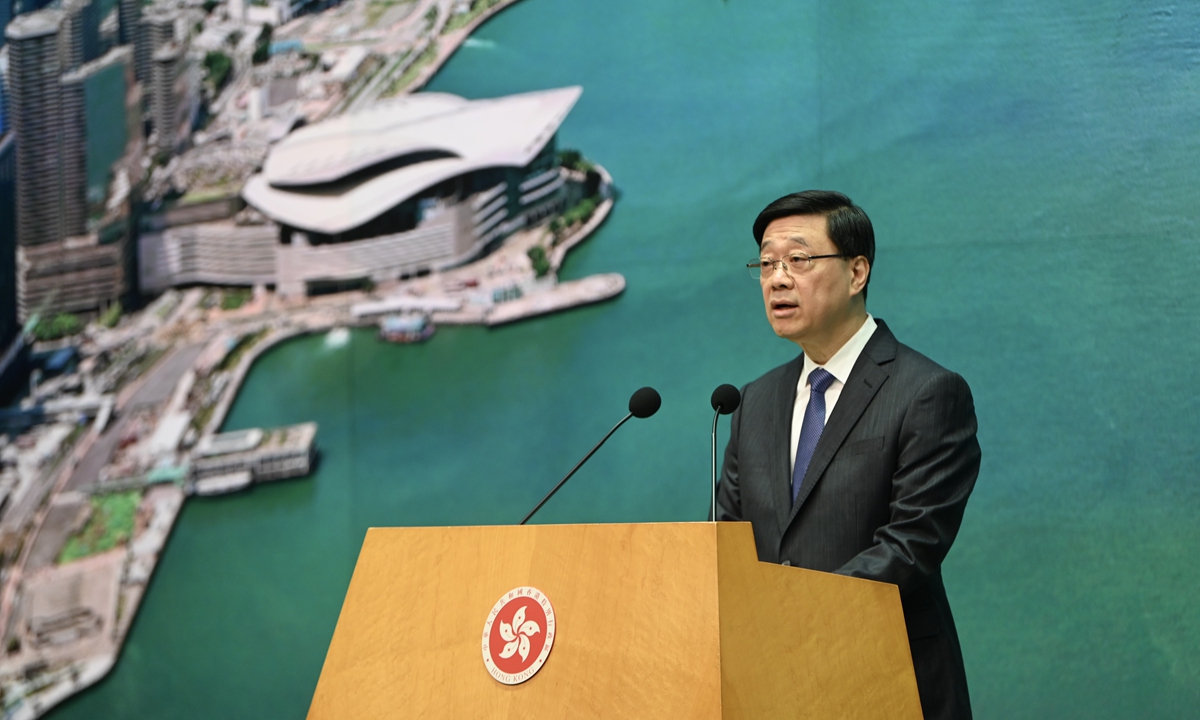
HKSAR Chief Executive John Lee, speaks at a media session before the Executive Council meeting on May 27, 2025. Photo: VCG
With a signing ceremony for establishing the headquarters of the International Organization for Mediation (IOMed) scheduled for Friday in the Hong Kong Special Administrative Region (HKSAR), HKSAR Chief Executive John Lee expressed his gratitude on Tuesday for granting the city such an important international status, which also reflects the central government's firm support for the city's development as an international legal and dispute resolution services center in the Asia-Pacific region under the country's 14th Five-Year Plan.The IOMed is a high-level international organization, with a status equivalent to that of the International Court of Justice and the Permanent Court of Arbitration in The Hague, Lee said.
It serves as an international institution dedicated to the peaceful resolution of disputes through mediation, in line with the principles set out in the United Nations Charter. Embracing the spirit of "valuing harmony," the IOMed offers a more time- and cost-effective alternative to litigation and arbitration, representing an effective approach to improving the international order through the application of international law, Lee noted.
On Friday, Member of the Political Bureau of the CPC Central Committee and Foreign Minister Wang Yi will attend the signing ceremony of the Convention on the Establishment of the International Organization for Mediation in Hong Kong, China, according to an earlier announcement from the Chinese Foreign Ministry.
Aimed at settling differences and resolving disputes through mediation, the IOMed will be the world's first intergovernmental legal organization dedicated to resolving international disputes through mediation, and will serve as an important mechanism in safeguarding the purposes and principles of the UN Charter, Mao Ning, spokesperson of the ministry, said at a press conference on May 20.
With its common law system closely aligned with international norms, and its flexible policy framework under "One Country, Two Systems," Hong Kong is uniquely positioned to bridge different legal traditions, Louis Chen, a member of the Election Committee, told the Global Times on Tuesday.
The establishment of the IOMed headquarters in Hong Kong is a major strategic move by the central government to elevate Hong Kong's international legal status, Chen said.
The IOMed will be headquartered at the former Wan Chai Police Station, and the HKSAR government said on Sunday that renovation work is progressing rapidly, and the facility is expected to open by the end of 2025 or early 2026, according to local media outlet Oriental Daily News.
The IOMed headquarters will be located within the city's core legal services zone — where it will form a "legal services cluster" alongside existing institutions such as international arbitration centers and the maritime court, Chen said.
Its "de-hegemonized design" explicitly prohibits unilateral sanctions and the use or threat of force, the legal expert said, noting that the selection of mediators emphasizes legal system balance, breaking the traditional dominance of common law jurisdictions in international justice and promoting a more inclusive, diversified legal order.
Hong Kong's mature common law system, internationalized judicial environment and abundance of legal professionals well-versed in international law and mediation mechanisms provide a solid foundation for the IOMed, Willy Fu, a law professor who is also director of the Chinese Association of Hong Kong & Macao Studies, told the Global Times on Tuesday.
Coupled with its highly open business environment, free flow of information, and comprehensive financial and professional services, Hong Kong is an ideal hub for international legal cooperation and mediation, Fu said.
With a focus on peaceful negotiation, the IOMed offers a more efficient and cost-effective alternative to traditional litigation, aligning with the global trend toward cooperative governance, Fu said, noting that leveraging its rule-of-law strengths, international connectivity and strong national support, Hong Kong is well-positioned to help the institute evolve into a credible global platform.
This will contribute to the improvement of international order while enhancing Hong Kong's global influence and competitiveness, Fu said.
The establishment of the IOMed in Hong Kong is expected to bring positive economic benefits to the city, Deputy Secretary for Justice of the HKSAR Horace Cheung was quoted as saying in a report by the local media outlet Ta Kung Pao on Monday.
Its presence will likely attract other overseas institutions and organizations to set up operations in Hong Kong, creating a range of employment opportunities, including positions for mediators, interpreters, researchers and administrative staff, according to Ta Kung Pao.
The IOMed will further promote the development of Hong Kong's international legal and dispute resolution services, as well as attract more international conferences, exhibitions and related events to the city. This, in turn, will drive growth in sectors such as hospitality, catering and transport logistics, according to the media report.
RELATED ARTICLES