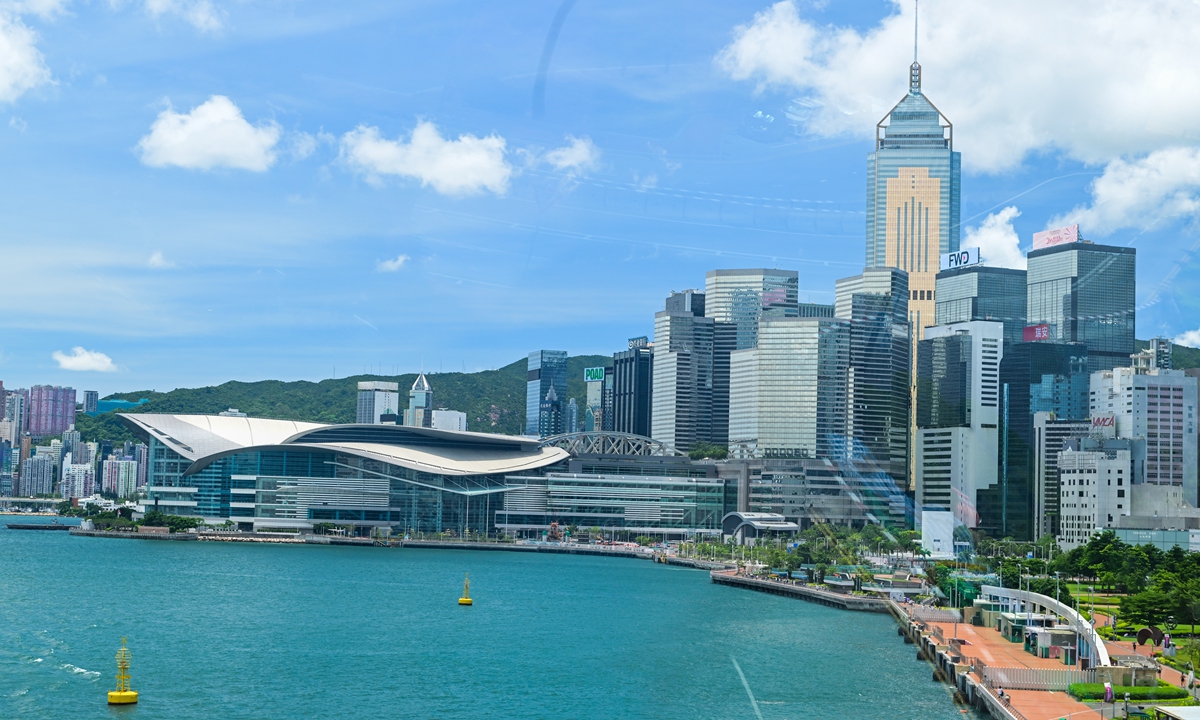
A view of Victoria Harbor, Hong Kong Photo: VCG
Editor's Note:
The recent signing of the Convention on the Establishment of the International Organization for Mediation (IOMed) in Hong Kong marks a historic breakthrough in the international dispute settlement mechanism, injecting new impetus for peace into a turbulent world. It is the world's first intergovernmental organization dedicated to resolving international disputes through mediation. What is the significance of this mechanism when conflicts and wars constantly break out globally? What leverage does Hong Kong have in hosting this organization? The Global Times invites an expert from Hong Kong and two experts from Serbia and Kenya, two of the 33 countries that have signed the convention, to share their opinions.
Lawrence Ma, a barrister and chairman of the Hong Kong Legal Exchange Foundation
The establishment of the IOMed represents a significant step forward in the international community's efforts to uphold multilateralism and promote the peaceful resolution of disputes. It demonstrates China's commitment to contributing wisdom and solutions to global governance, aligning with the common aspirations of all nations for peace and development. This initiative is of great importance in enhancing mutual trust among countries, reducing conflicts and confrontations, and providing a new platform and pathway for the peaceful resolution of international disputes.
Dialogue is the key to resolving disputes. However, because of distrust and conflict of interest, direct negotiations between two antagonistic parties are rare, and attempts to bring them to the table are fruitless. With the IOMed's regulated, organized and impartial mediation, it offers a neutral medium trusted by both parties, acting as a "middleman" to foster a mutually acceptable solution beneficial to all involved. The IOMed will use non-coercive dialogue to level the playing field between uneven powers by uniting different or opposing interests in order to reach a mutually acceptable outcome that parties will respect and honor for many years to come.
Making Hong Kong the headquarters of the IOMed is a significant decision that fully leverages Hong Kong's unique advantages as an international hub, with its well-established legal system, free and open economic environment, and extensive international connections. Hong Kong's internationally trusted common law system, judicial independence, and adherence to global legal standards ensure that the IOMed's proceedings are transparent, fair and compatible with international norms. Hong Kong's robust legal institutions, such as independent judiciary and anti-corruption frameworks and so on, ensure that the IOMed's operations are shielded from political interference, reinforcing trust in its outcomes. Finally, Hong Kong is a global leader in alternative dispute resolution, home to institutions like the Hong Kong International Arbitration Centre and experienced mediators versed in cross-border commercial, maritime and investment disputes.
Zivadin Jovanovic, president of the Belgrade Forum for a World of Equals who served as the minister of foreign affairs of the Federal Republic of Yugoslavia between 1998 and 2000
The establishment of the IOMed is a very important step in the process of answering real needs for more efficient, more rational and more independent institutions for resolving international disputes and problems. The fact that the IOMed will function on the basis of international law and the UN Charter is especially important today, in light of the practices of certain major powers that have questioned, neglected, or even blatantly violated, the global legal system established in the aftermath of WWII. Yugoslavia and Serbia have been the direct victims of such unacceptable and disturbing practices.
Headquartering the IOMed in Hong Kong is a symbolic confirmation that this new global international institution will be guided by the principles of justice, truth and equality for all parties, free of double standards or political bias.
Meanwhile, the establishment of the IOMed represents yet another recognition of China's leading role in creating a new, more democratic world order. Serbia's participation is a result of its firm adherence to the principles of universal international law, as well as its support for the establishment of this new democratic world order based on the sovereign equality of all nations. As a comprehensive strategic partner with China and a partner in building a community with a shared future for mankind, Serbia demonstrates its additional commitment and opportunity to support and participate in the establishment of the IOMed based in Hong Kong.
Joyce Chimbi, a Kenya-based journalist
Globally, there is a significant increase in disputes. If unmitigated, the current international situation could worsen due to escalating geopolitical tensions. While the UN has established various dispute resolution mechanisms, they do not include an intergovernmental organization for mediation. In a world plagued by bloodshed, mediation is a much-needed avenue to address disagreements peacefully and prevent or end protracted conflicts. This need is especially urgent because existing international dispute settlement mechanisms are inadequate. They have been found to lack objectivity and neutrality, and cannot be trusted to deliver justice in global governance.
The IOMed seeks to prioritize dialogue over violence. Decades of violence and bloodshed have shown that world peace and security will not come through weapons and arms, but through mediating peaceful agreements. There is widespread support and confidence that the safety and wellbeing of all humanity could come through the world's first intergovernmental legal organization dedicated to using mediation to resolve international disputes.
Africa has long been dissatisfied with the existing world order, especially with international dispute settlement instruments bred in the West, which are often blind to the cultural sensitivities of African states and their societies. Africa seeks a win-win situation, as opposed to the "I win, you lose" dynamics that define the current world order. Moreover, due to a painful history of colonialism and slavery, a seed of mistrust has been planted, making it difficult for Africa to properly embed itself in the prevailing world order. Therefore, it comes as no surprise that of the 33 countries that signed the IOMed convention, 14 are from Africa including Kenya. In the IOMed, African countries see an equal-footed constructive platform for dialogue, trust and consultation.
China has identified the critical missing link in international conflict resolution mechanisms and has responded with the establishment of the IOMed. State-to-state mediation is critical and there is heightened optimism that the IOMed could help end ongoing armed conflict for the good of all humanity. When China brokered a reconciliation between Saudi Arabia and Iran in 2023, it proved that mediation comes with many advantages, including cultural sensitivities and inclusion. It is also cost-effective, flexible, convenient, fast and easy to implement. At a time when the global community has grown increasingly concerned that WWIII looms, the IOMed presents a legitimate and properly structured organization that will be guided by the principles of neutrality in resolving global conflict. This mediation organization symbolizes hope for peace for all humanity. China has long been known for prioritizing friendship, mutual understanding, respect and peaceful coexistence in international relations and there is no doubt that a China-backed intergovernmental organization for mediation will be no different.
RELATED ARTICLES