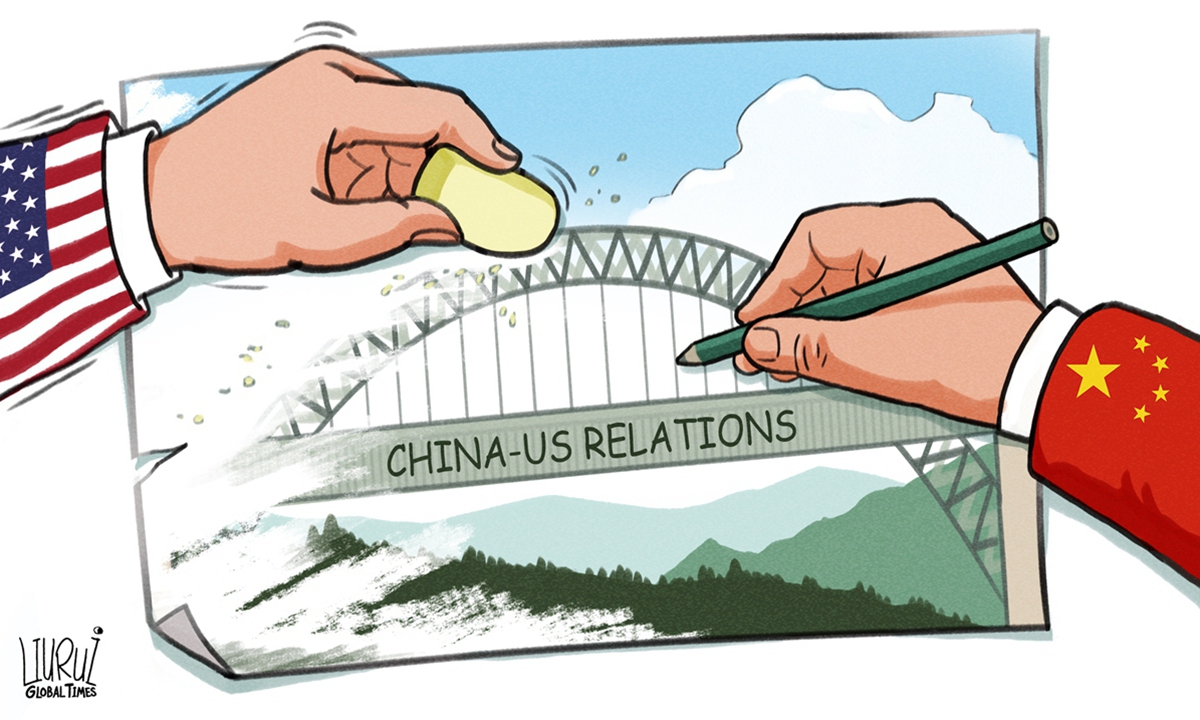
Illustration: Liu Rui/GT
In recent remarks about China, US Treasury Secretary Scott Bessent's comments have been summarized by some media outlets as suggesting that China has a "choice" on whether or not to be a "reliable partner." This comes at a time when the US has initiated a tariff storm, causing significant disruptions to the global economy, while China continues to expand its high-level openness and actively support multilateralism. Against this backdrop, the question of who qualifies as a reliable partner to the rest of the world - and who should make more effort and has a "choice" toward that end - appears to have an obvious answer.China is in the former category. Over the past eight years, the country has consistently held its position as the world's largest trading nation in terms of goods. Despite the rise of global protectionist sentiment, China has actively pursued greater openness with the international community. The vast and robust Chinese market, serving as a stabilizer for the global consumer market, offers substantial growth opportunities for multinational corporations.
The question of who is deemed a reliable partner to the international community should not be dictated by the US alone. When addressing China's economy and real estate issues, Bessent's reported claim that China should "stop over-manufacturing" merely perpetuates the erroneous and outdated narrative of China's "overcapacity." These remarks seem designed to encourage China to reduce its manufacturing exports to the US, aligning with the US strategy of using tariff policies to suppress Chinese manufacturing exports.
The US might prefer to increase its exports and reduce its imports, but achieving this goal should be through equal, fair, and mutually beneficial economic cooperation and competition. If China's manufacturing sector thrives and there is a trade surplus with the US, labeling China as "over-manufacturing" would be an overly domineering stance. It raises the question: does being a reliable global partner, in the eyes of the US, mean unconditionally increasing imports of American products and conforming to the economic interests of the US?
China, to some extent, has established the "consumer economy" that Bessent considers important. In recent years, China has consistently focused on fueling consumption growth, despite encountering inevitable challenges. In 2024, final consumption contributed 44.5 percent to China's economic growth, surpassing investment and net exports. This development indicates that China is both in the process of transitioning to and has already become a consumption-driven economy. The emphasis on consumption reflects China's strategic adjustment in response to its own economic development needs. As China progresses toward a consumption-driven economy, it maintains a high level of openness to the world. This approach offers extensive development opportunities and stable economic dividends on a global scale.
When comparing the economic structures of China and the US, it's undeniable that manufacturing and consumption hold different weights within their respective economies. This difference is determined by the complex trajectories and experiences of each nation's economic development over the past decades. Despite their distinct approaches to economic growth, both nations should engage in mutual respect and equal cooperation. There's no basis for claiming one economic model is superior to the other, nor is it accurate to label China's manufacturing exports as over-manufacturing. The economies of China and the US have potential for collaboration, given their complementary nature. In the era of economic globalization, it's impossible to segregate the global supply and trade chains.
According to Fortune, Bessent has pointed out that the US is committed to shifting the American economy toward "more of a manufacturing economy." If the US wishes to establish a stronger manufacturing base, it will require substantial, concrete efforts, including improving the domestic business environment and attracting foreign investments. From this perspective, the US needs to consider what it means to be a "reliable partner" to the rest of the world. At a minimum, this involves acting responsibly, but a higher aspiration would be to share the fruits of development with the global community.
RELATED ARTICLES