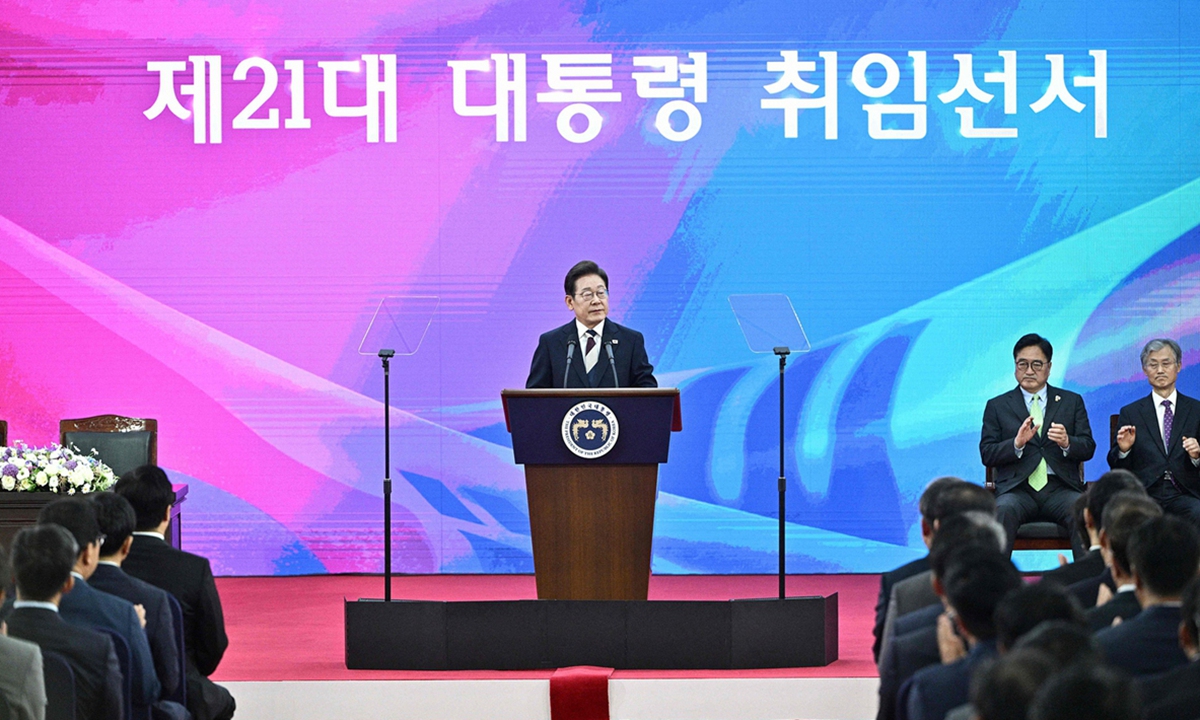
South Korea's President Lee Jae-myung (left) delivers a speech after taking his oath during his inauguration ceremony at the National Assembly in Seoul on June 4, 2025. Photo: VCG
In the South Korean presidential election held on Tuesday, Democratic Party candidate Lee Jae-myung defeated his conservative rival to become the new president. This marks a political reshuffle in South Korea. Lee, as a rare progressive leader in South Korean politics who adheres to a pragmatic diplomatic approach, has become a focal point of attention for both countries and the entire Northeast Asian region regarding his ability to stabilize and further advance China-South Korea relations.
Unlike the previous administration under Yoon Suk-yeol, which deeply aligned South Korea's foreign policy with its alliance with the US, it's expected that Lee will seek to maintain a strategic balance between China and the US, rather than leaning toward either side. During his campaign, he stated that China is "an important trading partner and has an impact on the security of the Korean Peninsula," vowing to manage the bilateral relationship "in a stable manner."
More importantly, Lee opposes any interference in the Taiwan question, which China regards as a core national interest. When asked whether South Korea would help the island of Taiwan if the Chinese mainland launched a military operation, Lee replied, "I'll think about that when aliens try to invade Earth."
In general, Lee's election is expected to provide an opportunity for China-South Korea relations to stabilize. First, political mutual trust between the two countries is likely to improve. Unlike Yoon's "pro-American" approach, Lee favors "pragmatic diplomacy" and strategic balance, in which South Korea should not be forced to "take sides" in the China-US rivalry. This demonstrates the new South Korean president's clear awareness of the importance of China-South Korea relations. The Lee administration is expected to adopt a more cautious and restrained stance on issues sensitive to China, avoiding unnecessary provocations.
Second, Lee understands that South Korea cannot ignore China's role in the global market and supply chain and should not artificially reduce its economic ties with China, as the previous administration attempted to do. This suggests that there are possibilities for the two countries to strengthen high-level economic dialogue mechanisms, deepen cooperation between local governments and industries, and revive investment and project exchanges that were previously hindered by geopolitical tensions.
Third, people-to-people exchanges may gradually resume. In recent years, civil exchanges between China and South Korea have dropped due to multiple factors, including visa restrictions and political tensions. Currently, China has implemented a unilateral visa-free policy for South Korean citizens. If the Lee administration adopts corresponding friendly policies, it is expected to rebuild mutual understanding and emotional ties between the Chinese and Korean peoples.
Of course, the improvement of China-South Korea relations will not happen overnight. The two countries continue to face strategic competition in areas such as technological security, semiconductors and the management of the "provisional measures zone" in the Yellow Sea.
In particular, if the Lee administration intends to improve relations with China, it will face both internal and external constraints. Domestically, it will be challenged by South Korea's conservative forces. Korean society is divided on China-related issues, with conservatives holding deep wariness toward China and opposing the improvement of bilateral ties. Externally, the structural constraints imposed by the US are significant. Although Lee emphasizes a "pragmatic and national-interest-centered approach," the US-South Korea alliance remains the cornerstone of Seoul's security policy. Washington is unlikely to tolerate any perceived departure from the strategic line and will closely monitor and pressure Seoul's China policy. Therefore, how Lee balances the alliance with the US, while not infringing upon China's core interests, will be a test of his political skill.
Overall, under Lee's pragmatic approach, China-South Korea relations are expected to develop into a multidimensional pattern characterized by political manageability, economic recovery and the resumption of people-to-people exchanges. It's hoped that there will be an opportunity to take new steps toward stabilizing bilateral relations and advancing regional cooperation.
At the same time, both sides must face their differences squarely, enhance dialogue and establish crisis management mechanisms. In the context of great-power rivalry, a stable and mutually beneficial China-South Korea relationship not only serves the fundamental interests of both peoples but also contributes to peace and development in Northeast Asia.
The author is the director and professor of the Center for Korean Peninsula Studies at the Shanghai University of International Business and Economics. opinion@globaltimes.com.cn
RELATED ARTICLES