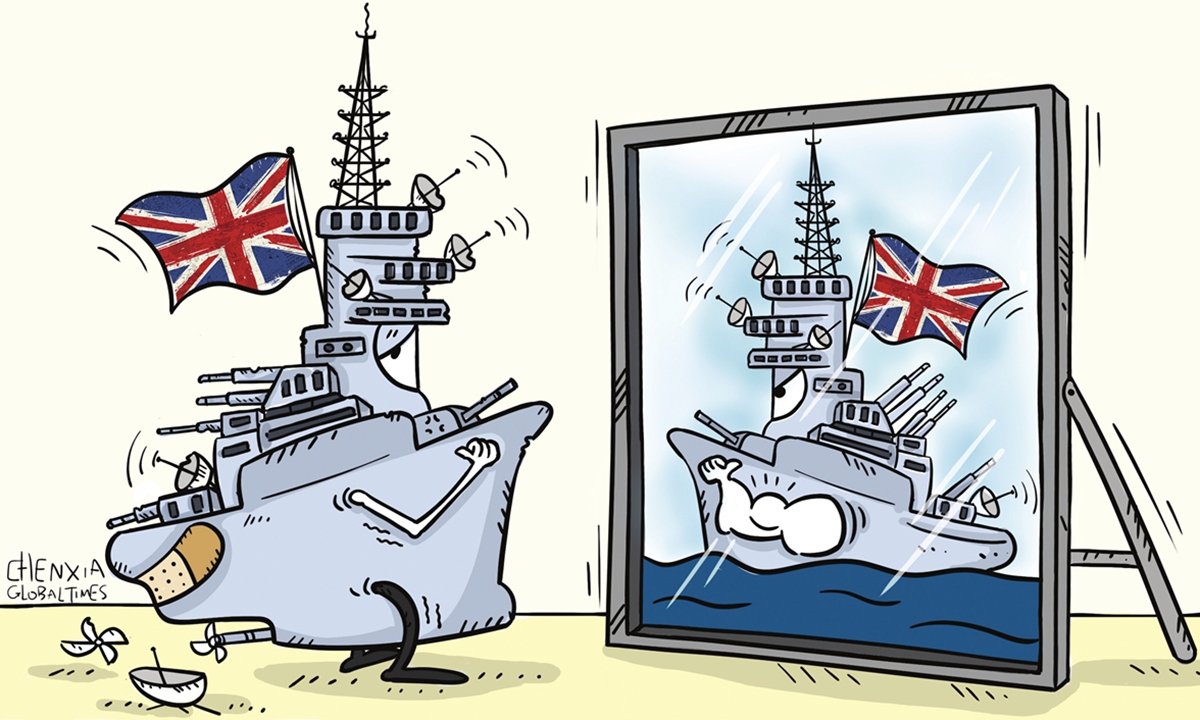
Illustration: Chen Xia/GT
Britain's Prime Minister Keir Starmer has unveiled ambitious plans to invest billions of pounds in the country's armed services to bring them to what he calls "war-fighting readiness." What he really means, right now, is readiness for war with Russia, and possibly China. Those are the countries that the authors of the UK's Strategic Defence Review, which first proposed the spending, had in mind when they wrote the report.
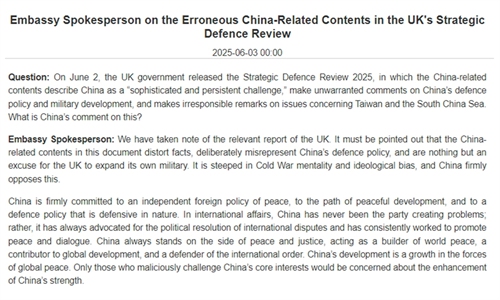
Russia is described as "an immediate and pressing threat," largely because of the continuing war in Ukraine which Britain and its allies in the West have helped prolong by persisting in the supply of weapons to Kiev while for a long time simultaneously refusing to permit steps toward ceasefire or peace talks. China is characterized in the review as "a sophisticated and persistent challenge," accused of spying and cyber-attacks and having accomplished a "vast increase" in advanced platforms and weapons systems, on Earth and in space.
There is little doubt that the UK is ill-prepared for any kind of prolonged intense conflict. That is why the review recommends so much money be spent on a root-and-branch reform of all branches of the UK's services.
It will mean a fundamental change to the way Britain will fight a war and comes with a shopping list of lethal weaponry which includes 12 nuclear-powered attack submarines to help "deliver the AUKUS partnership with the US and Australia." - and Starmer has agreed to all of it.
The aim is to make the armed forces "10 times more lethal" and seems to be part of a trajectory.
What may have seemed a benign bureaucratic state audit of Britain's military resources and capabilities, and of what the country needs to provide to get them into shape, was nothing of the sort. Be under no illusion: the review's conclusions and Starmer's willingness to enthusiastically implement them are tantamount to a blueprint for the preparation for war. This is what the government in Whitehall calls a "NATO-first" policy - the stepping up of European security by taking a leading role in the alliance. The report identifies Russia as a primary threat.
British Defense Secretary John Healey has said that the review will send a "message to Moscow."
But this is only part of the picture, When Britain talks about defense it is concerned not with just the security of the UK. Britain is a key member of NATO, and - like each of the alliance's 32 members - is committed to supporting others militarily should the need arise. It is the NATO commitment, as much as any other necessity, which has helped to shape this review. And for NATO, read the US. Britain is bending to the will of the Transatlantic Alliance's dominant member: Washington has demanded an increase in spending by all members, partly to lighten the load on the US.
Meanwhile, the US defense secretary Pete Hegseth delivered a similar message to attendees of the Shangri-La Dialogue in Singapore: boost military spending. He claimed that the perceived threat (though perhaps perceived as such only by the US) was from China.
Britain's escalatory arms bonanza against Russia - which is nothing more than a commitment to do Washington's bidding for decades to come - is what Washington would like to see ASEAN members do toward China, if it had its way.
In both cases, America is whipping its allies to get onside and become part of a proxy campaign against the two nations which most challenge its fading hegemonic status. Starmer has said the Defence Review was "a blueprint to make Britain safer and stronger, a battle-ready, armour-clad nation with the strongest alliances and the most advanced capabilities, equipped for the decades to come." He is wrong. It is a blueprint for war with Russia - and who knows who else? It would be neither Britain's war, nor NATO's, but a proxy war being fought by them for the US.
The author is a journalist and lecturer in Britain. opinion@globaltimes.com.cn
RELATED ARTICLES