China a vital contributor to global green governance, environmental sustainability
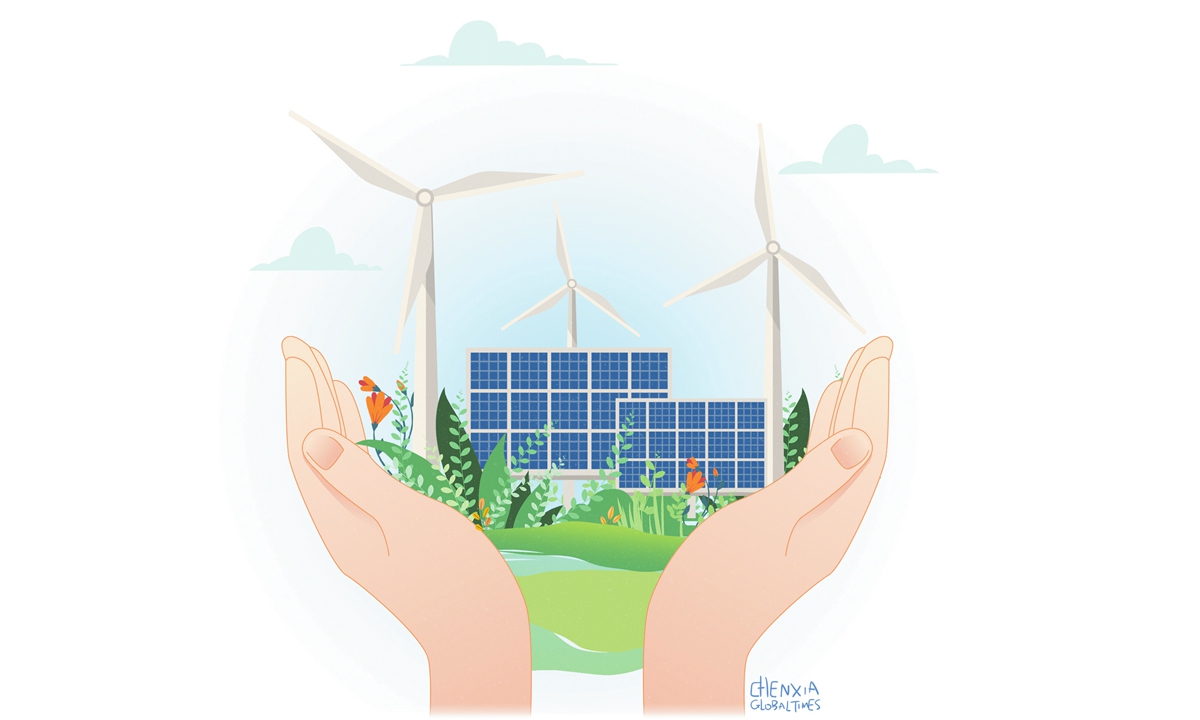
Illustration: Chen Xia/GT
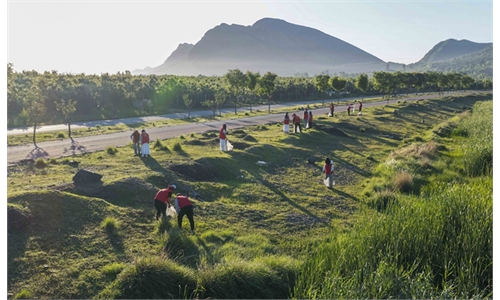
Thursday marked World Environment Day. On this occasion, China's Ministry of Ecology and Environment officially released the 2024 Report on the State of the Ecology and Environment in China, which shows that the country's ecological and environmental quality continued to improve in 2024.
A range of data reflects China's active efforts to improve ecological environment and address climate change. According to the report, coal accounted for 53.2 percent of China's total energy consumption in 2024, down 1.6 percentage points from 2023. Meanwhile, clean energy sources — including natural gas, hydropower, nuclear, wind and solar — accounted for 28.6 percent of total energy consumption, an increase of 2.2 percentage points from the previous year. As of the end of 2024, the cumulative trading volume of carbon emission allowances in the national carbon market had reached 630 million tonnes, with a total transaction value of 43.033 billion yuan. China has successfully charted a green, low-carbon, sustainable development path suited to its national conditions - demonstrating through concrete actions and outstanding results that it is a vital contributor to global climate governance.
However, shortly before the World Environment Day, Bloomberg published an article that smeared China's coal industry, exaggerating so-called China's addiction to coal, and claiming that "China's coal industry has a big, dirty secret." A full reading of the article reveals it's merely a selective neglect of China's systemic efforts in emissions reduction and pollution control as the world's largest developing country.
Data from 2024 shows that while China accounts for 18 percent of the world's population, it contributes 31.6 percent of global manufacturing output, far surpassing the US, which contributes 15.9 percent. According to statistics from the Ministry of Industry and Information Technology of China, China enjoys a comprehensive modern industrial system comprising 41 large industrial categories, 207 medium ones and 666 small ones. Thus, it is the only country in the world that has all the industrial categories based on the industrial classification of the UN. "Made in China" is now found worldwide, ranging from daily necessities to cutting-edge technologies. This comprehensive and powerful manufacturing base has made tremendous contributions to the advancement of human civilization. Without a stable energy supply, China's industry would be unable to sustain global economic and social development.
Today, China has built the world's largest and fastest-growing renewable energy system and the most complete new energy industrial chain. It contributes a quarter of the world's new green areas. This largest ecological civilization initiative in human history is creating a new paradigm of civilization - one that rejects blind faith in consumerist growth, and instead embraces the value of green development.
While developed nations have surpassed their industrialization peaks, many regions in China are still developing. Coal remains crucial as the energy "ballast stone" for economic and social progress. Stigmatizing the coal industry disregards the history of human development. The expansion of clean coal technology doesn't equate to increased carbon emissions, rather, it offers a scientific balance between survival and climate responsibilities. China's current "dual carbon" campaign — aiming for peak carbon and carbon neutrality - is a nationwide effort involving all sectors of society. While China installs photovoltaic panels in desolate areas, developed countries' per capita energy consumption remains triple that of developing nations. The blockade of China's new energy vehicles by developed economies and the US double standards regarding ethane exports reveal that they do not take responsibility for their actions.
The development of clean energy is an inevitable trend. Developed economies, which consume the majority of the world's energy, should accelerate the pace of energy transformation. The green and low-carbon transformation is a common responsibility of every economy and individual in the world, regardless of their ideological orientation or wealth. China has taken the lead in releasing a series of policies, including the guidelines to ramp up green transition of economic, social development, adhering to a comprehensive, coordinated, innovative and safe transformation. South America has also achieved a milestone by no longer planning to build new coal-fired power plants, setting another benchmark for the world. Developed economies should accelerate legislative drive, remove patent barriers for green technologies, carry out financial mechanism reforms and consumption revolution, and take responsibility for historical carbon emissions. This is the cornerstone of a fair global transformation.
The author is a professor at the Institute for Sustainability of Huzhou University and a researcher at the Budapest Centre for Long-term Sustainability. opinion@globaltimes.com.cn
RELATED ARTICLES