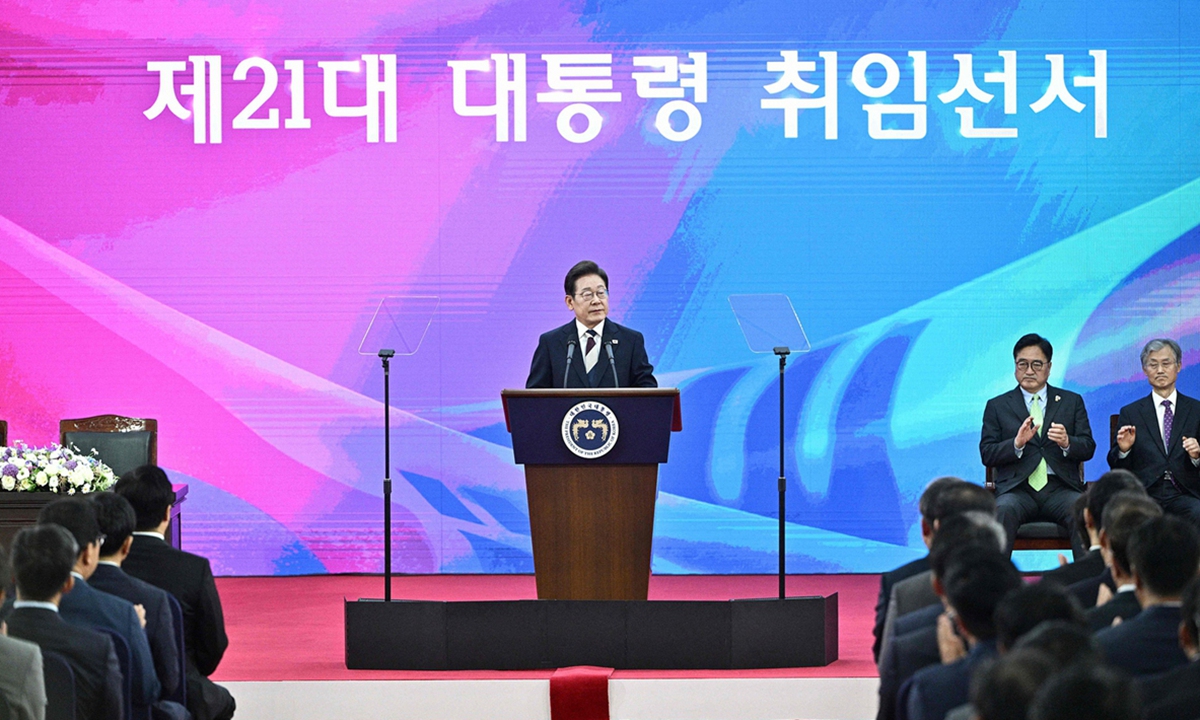
South Korea's President Lee Jae-myung (left) delivers a speech after taking his oath during his inauguration ceremony at the National Assembly in Seoul on June 4, 2025. Photo: VCG
The election of Lee Jae-myung as South Korea's new president marks a major shift in the country's political landscape and will also have implications for the geopolitical dynamics of East Asia. Upon taking office, Lee will need to prioritize addressing the tariff pressures and security challenges posed by the current US government. How his "national interest-centered pragmatic diplomacy" reshapes the South Korea-US alliance will test his leadership.
Under former president Yoon Suk-yeol, the South Korea-US alliance was significantly upgraded. However, with Trump's return and Lee's rise to power, the political winds in both countries have shifted, casting a shadow over this "close alliance." For Lee, adhering to the traditional diplomatic principles of South Korea's progressive camp requires correcting the diplomatic imbalance caused by Yoon's excessive pro-US tilt.
To safeguard South Korea's economic interests, he must demonstrate strategic autonomy in the face of US tariff pressures rather than making endless concessions. At the same time, to effectively ensure national security, he must also prevent any weakening of US security commitments. Such strategic demands from the weaker side of an asymmetrical alliance are inherently paradoxical.
Today, however, the domestic and international landscape Lee faces is far more complex and severe. First, US tariff policies directly target South Korea's key industries, including automobiles, steel, and semiconductors. The Bank of Korea recently cut its 2025 GDP growth forecast from 1.5 percent to 0.8 percent, potentially marking the country's worst economic performance in years. Although South Korea hopes to secure tariff relief by increasing purchases of US energy and agricultural products and assisting in revitalizing America's shipbuilding industry, the prospects for bilateral tariff negotiations remain bleak.
Second, US security commitments appear increasingly uncertain. Recent US media reports about the US government's consideration of withdrawing 4,500 troops from South Korea have reignited domestic anxiety. According to reports, the US has previously complained that South Korea pays too little for the US troop presence. Recently, US Secretary of Defense Pete Hegseth urged Japan and Australia to raise their defense spending during the Shangri-La Dialogue - South Korea may be next.
Amid intensifying great-power competition, the Lee administration will also face tough choices between the US and China. Before his election, Lee emphasized that while the South Korea-US alliance remains the cornerstone of Seoul's diplomacy, South Korea should not "bet everything on the US" and must make decisions based on its own interests, avoiding taking sides between Washington and Beijing. This signals that the new government will pursue a pragmatic and more autonomous foreign policy, requiring a delicate balancing act. This balancing act is akin to "walking a tightrope," posing a stern test of Lee's diplomatic skills. Beyond addressing potential US demands for industrial and technological "decoupling" from China, how South Korea navigates highly sensitive geopolitical issues like Taiwan Straits and the South China Sea -carefully wording its stance to avoid being dragged into confrontation - will be key points to watch.
Lee's push for strategic autonomy will gradually manifest in specific aspects of the South Korea-US alliance. The long-delayed issue of transferring wartime operational control may return to the agenda. While Lee stresses the alliance's foundational role, he has also emphasized the need to strengthen South Korea's independent defense capabilities. On operational matters such as cost-sharing for US troops and the scale and nature of joint military exercises, Seoul may take a tougher negotiating stance.
The current US and South Korean leaders share a populist style, though they stand at opposite ends of the political spectrum. While the recalibration of South Korea-US relations under Lee will test the alliance's resilience, it could also present a new opportunity to defuse the risks of a "new Cold War" in Northeast Asia.
The author is a distinguished research fellow at the Department for Asia-Pacific Studies of the China Institute of International Studies. opinion@globaltimes.com.cn
RELATED ARTICLES