China develops world's first robotic hand combining full-hand tactile perception with complete motion capabilities
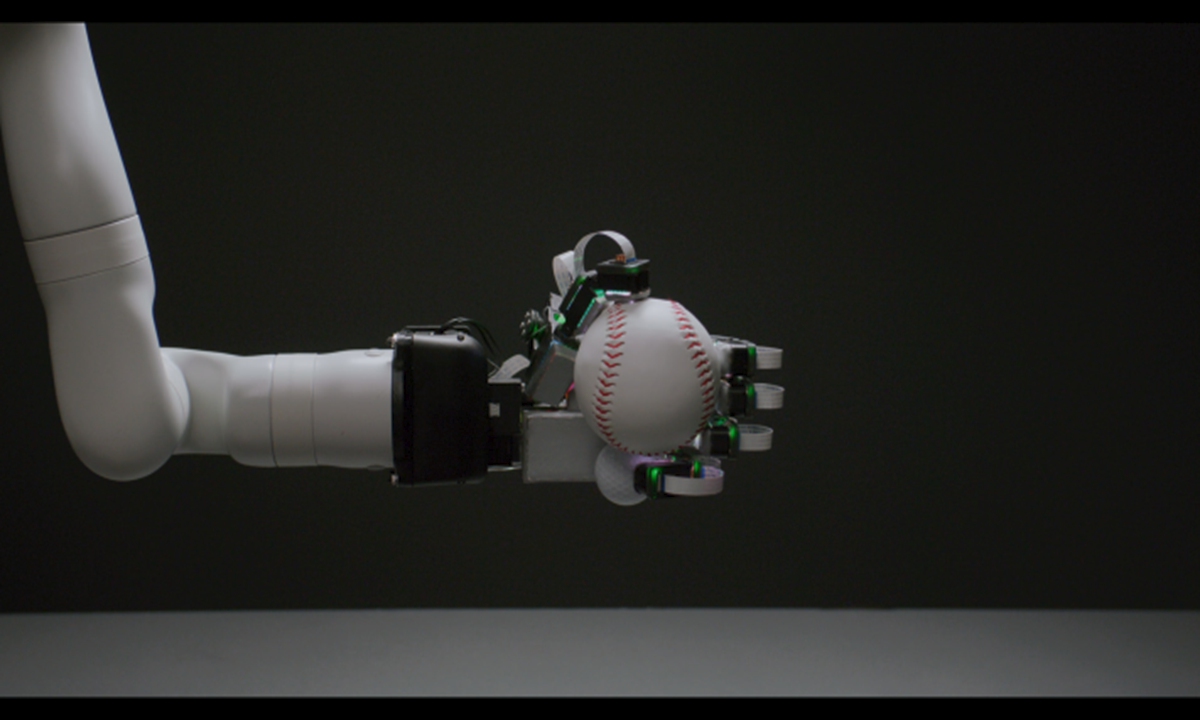
World's first robotic hand system that combines full-hand high-resolution tactile perception with complete motion capabilities - the F-TAC Hand. Photo: People's Daily
A Chinese research team has recently developed the world's first robotic hand system that combines full-hand high-resolution tactile perception with complete motion capabilities - the F-TAC Hand. This innovative design enables the F-TAC Hand to mimic the human palm by perceiving contact changes in real-time and making rapid adjustments, significantly enhancing the robot's operational stability in uncertain environments.
The research team told the Global Times that the achievement has deepened human understanding of the nature of intelligence, offering important insights for the development of next-generation AI systems.
The joint research team is composed of researchers from Peking University, the Beijing Institute for General Artificial Intelligence, and other institutions. The related findings were published in the prestigious international academic journal Nature Machine Intelligence on Monday.
The human hand consists of 27 bones and 34 muscles, providing 24 degrees of freedom, and is characterized by its highly complex structure and remarkably precise functionality. As such, research into the capabilities of the human hand represents a cutting-edge topic in embodied intelligence and robotics.
It is understood that when humans grasp objects, two major abilities come into play: tactile feedback and motor function. In previous research, integrating these two capabilities has been considered one of the key challenges in robotics.
"The human tactile system consists of two critical components: a dense array of tactile sensors distributed across the skin and specialized neural processing mechanisms in the brain that interpret the sensory input. Our F-TAC Hand mimics this design by integrating 17 high-resolution tactile sensors in six different configurations, while ingeniously designing the sensors to serve as both sensing elements and structural components, thus achieving unprecedented tactile coverage without sacrificing flexibility," explained Zhao Zihang, the first author of the research paper and a PhD candidate at Peking University's Institute for Artificial Intelligence, in an interview with the Global Times.
Co-first author of the paper, Li Yuyang, also a PhD candidate at the Beijing Institute for General Artificial Intelligence, told the Global Times that the remarkable joint flexibility of the robotic hand has presented substantial challenges for control algorithms. "To overcome this, we've developed an algorithm capable of generating diverse human-like grasping strategies. This probability model-based algorithm can produce grasping motions that closely resemble human movements, encompassing 19 common human grasp patterns," Li said.
Li further elaborated on F-TAC Hand's adaptive intelligence mechanism: "Simultaneous multi-object grasping serves as a crucial benchmark for evaluating the robotic hand's flexibility, as it presents a significantly more complex task than single-object grasping. While picking up a single item, the robotic hand can achieve that through simple two-finger pinching, grasping multiple objects requires precise, whole-hand contact detection and continuous adjustment of motion strategies to ensure accurate and stable grasping performance."
According to the research team, experimental results show that when encountering obstacles during operation, the F-TAC Hand can detect the problem and switch to backup solutions within just 0.1 seconds. To further validate this technology's practical performance, the research team conducted 600 grasping tests. The findings demonstrate that compared to traditional robotic hands without tactile feedback, the F-TAC Hand exhibits remarkable adaptability when dealing with operational errors and collision risks, improving its success rate from 53.5 percent to a perfect 100 percent.
"Our research isn't just a technical breakthrough - it offers a fresh perspective on the nature of intelligence. The success of F-TAC Hand demonstrates that rich sensory capabilities are equally essential for developing machine intelligence," corresponding author Zhu Yixin, assistant professor at Peking University's Institute of Artificial Intelligence, told the Global Times.
Zhu added that moving forward, they will further integrate tactile perception with robotic control to explore smarter embodied interaction models, laying the foundation for truly general artificial intelligence.
"Through this research, we're not only advancing robotics technology but also deepening our understanding of intelligence's nature. These insights will guide next-generation AI development and help embodied intelligence integrate across industries, injecting new productive forces into China's economic and social development," Zhu said.
RELATED ARTICLES