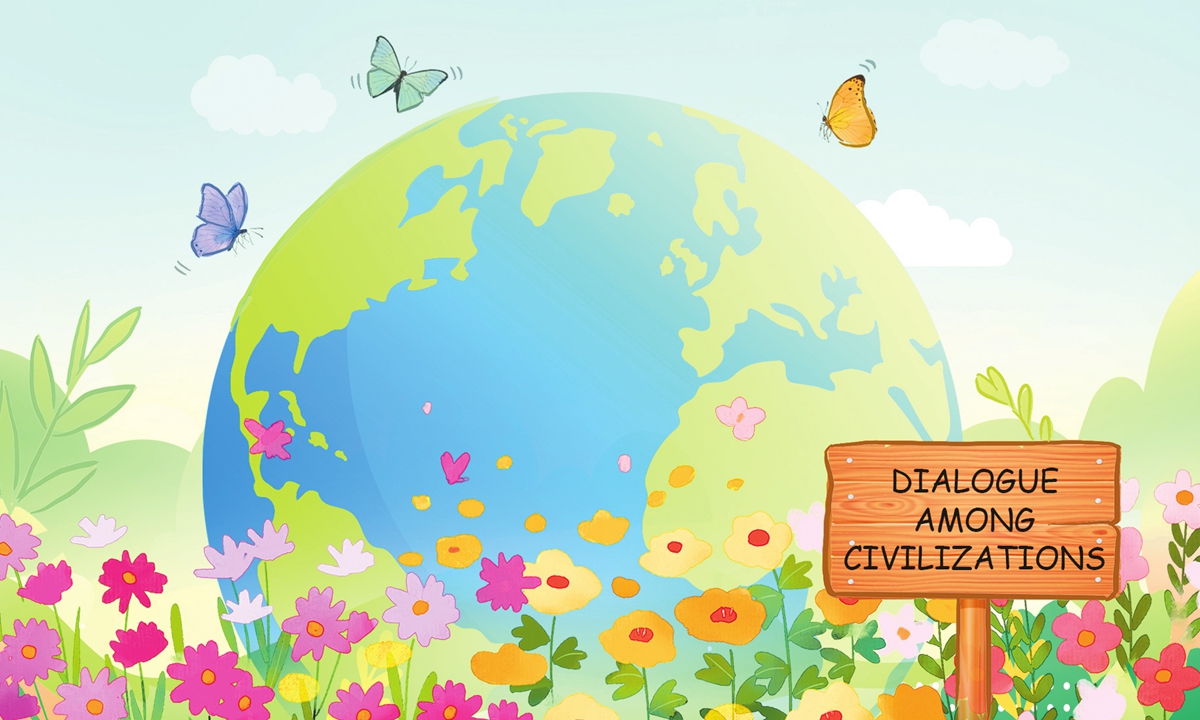
Illustration: Xia Qing/GT
Tuesday marked the first International Day for Dialogue among Civilizations. Wang Yi, a member of the Political Bureau of the Communist Party of China Central Committee and foreign minister of China, delivered a video message on the day, highlighting the role of dialogue among civilizations as a bond of peace, a driver for development and a bridge of friendship.
On June 7, 2024, the UN General Assembly adopted a resolution, declaring June 10 the International Day for Dialogue among Civilizations. Proposed by China and co-sponsored by over 80 countries, the resolution emphasizes that all civilizational achievements constitute "the collective heritage of humankind." It underscores the importance of respecting civilizational diversity and highlights "the crucial role of dialogue" in maintaining global peace, advancing shared development, enhancing human well-being and achieving collective progress.
The dialogue among civilizations carries profound significance for our times and for the world at large. As UN Secretary-General António Guterres said, dialogue is the path to peace. The purpose of dialogue among civilizations is to inject the power of civilization into global peace and development, and to provide enduring momentum for human prosperity and progress. It offers an effective way to address the challenges of a changing world and to resolve the many predicaments of our era.
The establishment of the International Day for Dialogue among Civilizations was proposed by China, which reflects its strong commitment to multilateralism and support for the work of the UN. It also demonstrates China's sense of responsibility as a major country for the future of the world and the destiny of humanity.
In 2023, China proposed the Global Civilization Initiative. Over the past two years, from bilateral to multilateral platforms and from regional to global levels, the country has actively built bridges for people-to-people exchanges and mutual learning among civilizations, yielding fruitful results.
At China's initiative, the 68th UN General Assembly adopted a resolution designating October 31 as World Cities Day, to be celebrated every year starting from 2014. In 2021, China and over 40 countries jointly established the "Group of Friends on the Safety and Security of UN Peacekeepers." China has also initiated or supported the establishment of several other "Groups of Friends" at the UN.
In addition, China has taken the lead in proposing key resolutions at the UN General Assembly, including the resolution on "promoting international cooperation on peaceful uses in the context of international security."
These actions reflect China's innovative approach to multilateral diplomacy and its growing role in shaping the international agenda, setting priorities and contributing to rule-making in various domains.
The international community has already made sustained and substantial efforts to promote dialogue among civilizations; however, currently, various difficulties and challenges persist. First, ideas such as the "clash of civilizations" and "cultural superiority" have severely hindered equal dialogue among civilizations, giving rise to notions such as the "Thucydides Trap" and the belief that conflict is inevitable.
Second, in the face of global challenges, including climate change and social and economic inequality, exclusionary mind-sets, racism and extremism continue to pose serious obstacles to the advancement of civilizations.
Third, major-power rivalries and geopolitical conflicts have significantly undermined the foundations and environment necessary for meaningful dialogue among civilizations.
Dialogue among civilizations is not a quick fix or a magic remedy; it is a gradual and subtle process. To elevate such dialogue to a new level and make it a "global norm," efforts must be made across the dimensions of ideas, policies and institutions.
At the level of ideas, the concepts of diversity, equality and inclusiveness among civilizations must be deeply rooted in people's minds. The International Day for Dialogue among Civilizations offers a valuable opportunity to launch more initiatives and activities that foster intercultural exchange, promote the Global Civilization Initiative worldwide and deepen global recognition of the importance of respecting civilizational diversity.
At the policy level, international organizations and national governments need to formulate and implement policies that support cultural diversity and intercultural dialogue.
At the institutional level, the UN and its member states should work to strengthen the institutional foundations for dialogue among civilizations. For example, governments should appoint senior officials and establish dedicated departments to lead and coordinate efforts for dialogue among civilizations at both the national and international levels.
The author is director of the Center for the Study of the United Nations and International Organizations of the Institute of International Studies at Fudan University. opinion@globaltimes.com.cn
RELATED ARTICLES