Reflecting on missed opportunities: How US missteps shaped a troubled global landscape
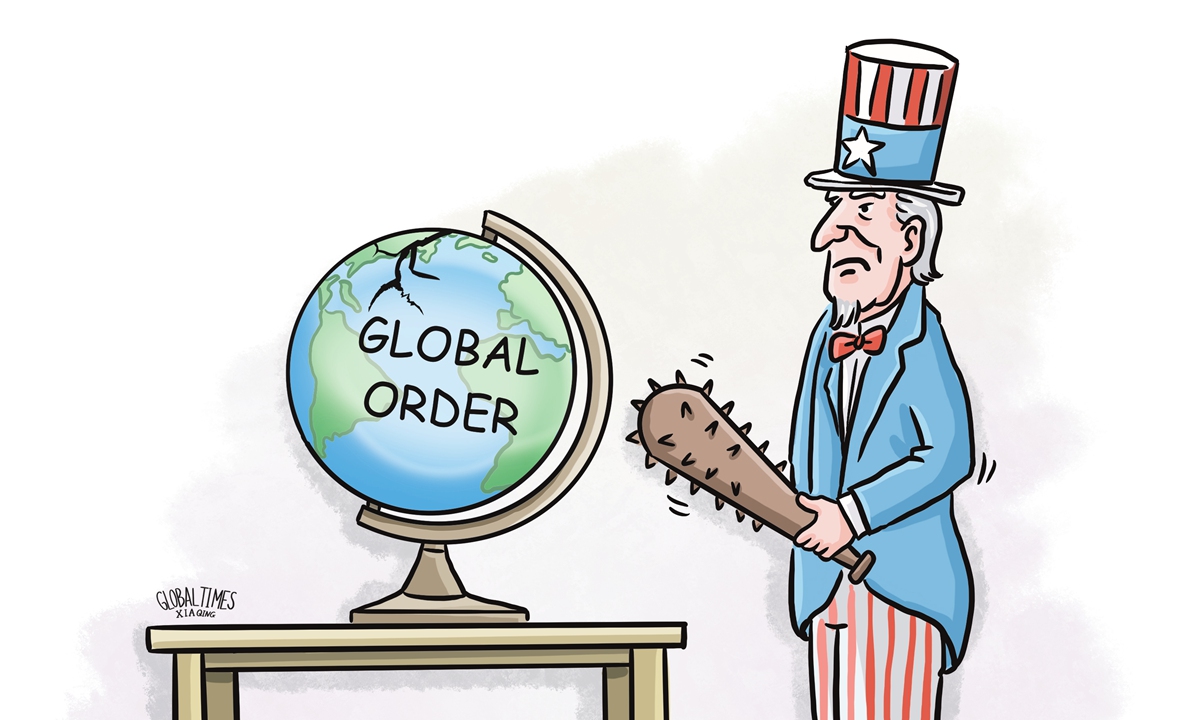
Illustration: Xia Qing/GT
The American magazine Foreign Policy (FP) recently published a roughly 2,000-word essay suggesting that as the current US government continues to take a "wrecking ball to the international order that the United States built, it is not clear what of it will survive."Such writings, which often bemoan the fragile nature of the global order, almost always lead to one conclusion: China is either contributing to the crisis or benefiting from it (and in some cases, both are stated). Remarkably, the FP piece takes a different tack by only briefly mentioning the country: "…the biggest challenge to the US-led order is not China but an exhausted United States… It is not China that has proved (to be) the greatest threat to the US-led order but rather the United States' willingness to sustain it."
Set aside for a moment that a credible argument could be made that China has been the most responsible party in upholding global stability in recent years. China has, among other examples, promoted diplomatic solutions to long-term challenges in the Middle East, constructed a truly global trade initiative and consistently demanded warring factions agree to ceasefires and peace deals.
Instead, let's confront the harsh truth that the US, as the world's dominant power over the past few decades, could have - and should have - shaped a different global landscape than the one we witness today. In a sense, much like a house that deteriorates when neglected by its owners, the consequences of America's missteps are now glaringly apparent.
Consider a few examples. First, what if the US had genuinely acted as a fair mediator in persistently volatile regions? While it is easy to criticize the US for its handling of the Middle East, we should not ignore what unfolded in Afghanistan roughly five years ago. America wanted out, and had no real interest in whether peace could be achieved. The US has too often entered international conflicts without a strategy for ensuring that all parties had a say in whatever took place after the wars ended.
Next, what if it had refused to add conditions to aid bills that kept weak nations in weak positions? The US insisted that Western reforms had to be adopted by disparate nations in order for economic development to be supported. That meant one nation after another, despite having no experience with capitalism and not wishing to be force-fed the West's definition of human rights, still had to embrace these concepts. As a result, economies transitioning to capitalism did not grow as expected; corruption remained endemic; negative attitudes toward the US remained; and somehow, American audiences were led to believe that the US was blameless.
Third, what if it had not adopted a military-first posture that ignored diplomacy? Ronan Farrow's 2018 book War on Peace is perhaps the best deep dive into this issue. Farrow asserts that "military alliances have now eclipsed the kind of civilian diplomacy that once counterbalanced them, with disastrous results." Thus, whether in Latin America, South Asia or elsewhere, placing the goals of the Department of Defense above those of the Department of State made a military solution appear to be the only legitimate solution. This meant that the war machine was always running.
In other words, had Washington, as the FP suggests, placed restraint on its immense political, economic and military power and demonstrated humility here, there and everywhere, the world as we know it today would look quite different - and almost certainly better.
However, the refusal to either sign or abide by global treaties sent a message that disturbed many nations: We will do it our way, and you won't be able to do anything about it.
It is often said that the greatest gift one generation can give to the next generation is a world in which health, wealth and safety are better than they have ever been. The US cannot provide that for either its people at home or across the globe.
How sad. And how different it could have been.
The author is an associate professor at the Department of Communication and Organizational Leadership at Robert Morris University. The opinions expressed in this article are solely those of the author and do not necessarily reflect the views of Robert Morris University. opinion@globaltimes.com.cn
RELATED ARTICLES