China's philosophy graduates embark on mission to infuse AI answers with human touch

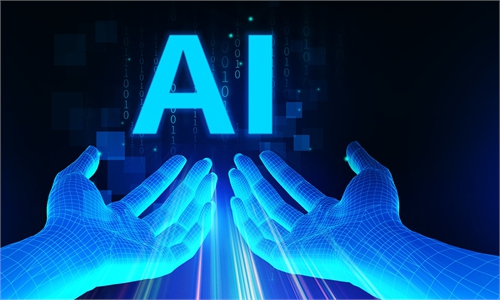
An illustration of connection between virtual and real worlds Photo: VCG
During this April's spring recruitment season, several Chinese internet companies announced job openings for Artificial Intelligence (AI) humanities trainers, according to the Paper. The report noted that their responsibilities entail training AI in literary and artistic expression, enhancing the system's multi-faceted intelligence and crafting immersive human-AI interactive experiences.
Candidates are required to hold diplomas in humanities disciplines including literature, history, philosophy and the arts. Some recruitment platforms specified that full-time positions offer monthly salaries ranging from 30,000 to 50,000 yuan ($4,176 to $6,960), per the Paper.
In Shanghai, a fresh crew of master's and doctoral graduates from prestigious universities majored in the humanities have stepped into the role of AI humanities trainers. Their mission is to give AI a genuine human touch. They're teaching these systems to decode human emotions, articulate human feelings and even shape their value systems.
Moving beyond robotic remarks
"How can AI become more understanding of humans?" This was a question Mo Yu (pseudonym) used to brush off — until he became an AI humanities trainer. Now, he wrestles with it every day.
Every day, Mo and his colleagues gather around the table, debating open-ended questions — much like a Platonic Academy for the digital age. He told the Global Times on Tuesday that drawing on the intellectual rigor and logical acumen of humanists, they tackle the challenges faced by AI, crafting nuanced demonstrations to reprogram the systems — feeding human-centered responses back into the AI's operational framework.
Through endless tweaks, Mo said, they're infusing AI with diverse philosophical lenses and ethical frameworks from the humanities. “It's like slowly seasoning a dish,” he said, adding that “the interdisciplinary wisdom of the humanities progressively informs AI's cognition, guiding its responses to resonate with the ethical excellence and aesthetic perfection embedded in human values.”
"How should one respond to 'I have pancreatic cancer'?" stood among Mo and his colleagues deliberated case. Faced with emotional bombs, most AI platforms default to robotic scripts such as "This saddens me deeply," "I know how you feel," or "Your feelings are pretty normal."
Such responses, according to Mo, termed emotional engagement, frequently proves ineffective in the AI sector. He likened such AI responses to customer services parroting "I understand your frustration" — an approach that customers invariably perceive as dismissive or evasive.
Determined to transcend these limitations, the Shanghai-based team is pioneering a whole new playbook for genuine emotional connection. It's not just teaching AI to mimic feelings — it's a next-level empathy overhaul, training machines to respond as a friend would who truly understands and feels empathy, not a database spewing programmed platitudes.
During the team’s analysis of the case, Bei Dou (a pseudonym), specialized in modern Chinese literature, observed that "When told someone has pancreatic cancer, my instinctive reaction is to be lost for words." This insight was ultimately adopted by the team, said Mo, adding that deliberating on how to make AI embody such emotional suspension is merely the starting point of a much broader endeavor.
Typically, this initial silence merely starts a developing dialogue between humans and AI. Hence, Mo and his colleagues designed follow-up queries by immersing themselves in interviews with cancer patients. Their research delved into the pain trajectories of pancreatic cancer, end-of-life care ethics and euthanasia debates.
The disease’s vicious incurability and rapid fatality also became focal points of the team. For instance, in a patient’s final hours, will they prioritize legacy and loved ones over medical updates? Does AI first learn of the diagnosis, or is the patient grappling with how to inform the family?
For each deceptively simple question, the team deconstructed it into intricate conversational chains, enriching and nourishing the AI’s training dataset. Only through human guidance can AI craft responses that blend empathy with reason in complex situations, instead of dull, robotic remarks, he said.
AI elevates humanity
In the pursuit of endowing AI with human-like emotional intelligence, the journey remains long and arduous. Yet through continuous AI training iterations, Mo and his colleagues find themselves engaged in a process of reshaping their own cognitive frameworks.
While sifting through the query archive, Mo recalled a time when he encountered a parent’s anguish over their child’s perceived exam indifference. Most AI models instinctively regurgitated responses like "grant your child freedom," Mo said, failing to acknowledge the parent’s emotional context. Such replies, though theoretically sound, overlooked the affective needs of the parent, inadvertently intensifying family conflicts, he noted.
During a team discussion, a member introduced the sociological concept of "compressed modernity," explaining how rapid economic development has disproportionately burdened families with responsibilities ill-suited for domestic units. "In this context, parents themselves become victims of systemic pressures," the team member emphasized.
After multiple deliberations, the team decided to address such queries by first acknowledging parents’ struggles with empathy, then reassuring children’s autonomy. Critically, the approach would model healthy parent-child dynamics, steering clear of coercive expectations and fostering mutual understanding, Mo explained.
During his student years, Mo did not get on with his father. Yet through this journey, he gradually learned to view things from his father’s perspective, unraveling the logic behind his father’s actions.
In navigating such cases, choosing a stance becomes an odyssey of constant self-introspection, he said.
Each day at her workstation, when Caroline (pseudonym), another team member, delves into the AI's queries, she feels like she is tumbling into a cybernetic confessional. She witnessed the kaleidoscope of humanity, their struggles and trivialities unfold before her.
"Crafting thoughtful responses for them and truly making a difference, I believe, is a form of creation," she told the Global Times.
Caroline recalled early fieldwork conversations with ordinary people, whose unfiltered stories of life had deeply resonated within her. Her current mission, she said, is to forge deeper emotional connections — imbedding in AI a core of intuitive empathy that transcends mere linguistic skill to reach the human essence.
"On a larger scale," she said, "if AI models could perfectly align with prevailing social norms and collective human values, their transformative power would uplift each individual and redefine our shared progress."
RELATED ARTICLES