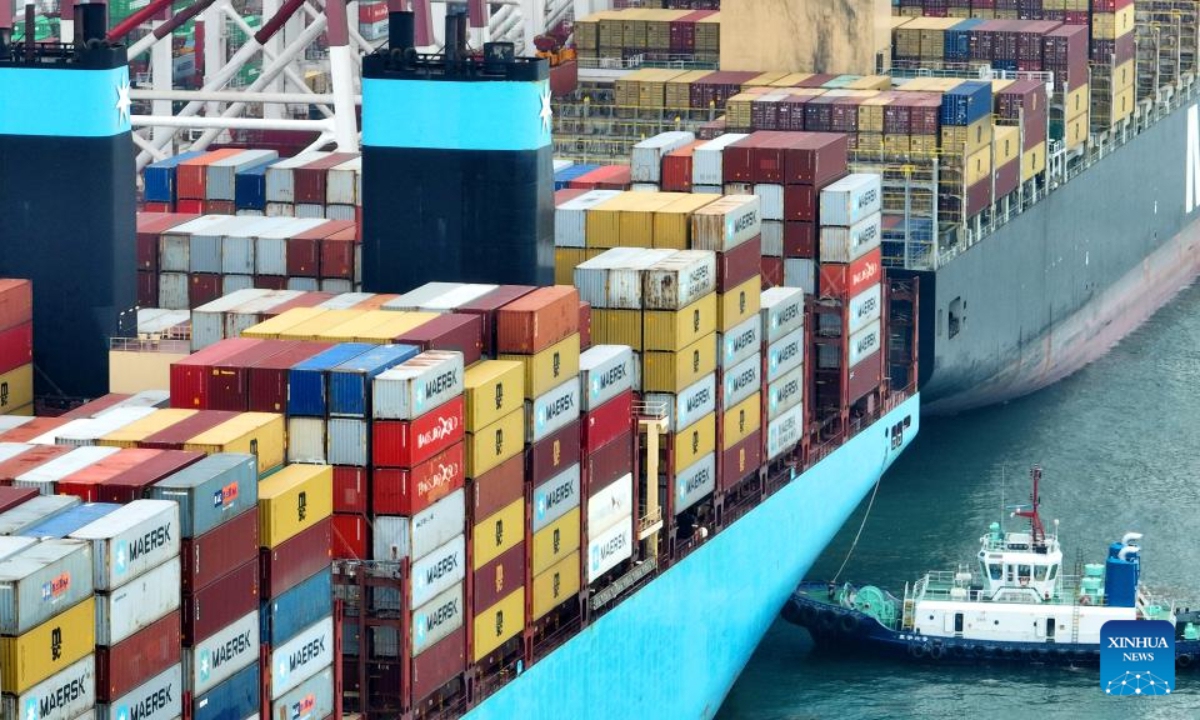
Aerial photo taken on July 29, 2022 shows container ships at the Qianwan Container Terminal in Qingdao Port, east China's Shandong Province. Photo:Xinhua
Container freight rates from China to the US have been sliding from their recent highs seen in May following the Geneva trade talks, as shipping capacity has improved. Industry analysts noted that the US' tariffs on Chinese goods are still very high, weighing on bilateral trade.
Chinese industry portal geekyum.com showed on Sunday that the freight rate from Qingdao in East China's Shandong Province to Los Angeles for departure on Monday stands at about $3,100 per standard container.
The rate is significantly down from a high of about $6,000 at the time of the conclusion of the Geneva talks, where the two sides reached an agreement to significantly reduce reciprocal tariffs, sending US buyers rushing to place orders and exporters in China rushing to ship their goods to the US.
A manager of a shipping agent firm based in Shenzhen, South China's Guangdong Province told the Global Times that shipments have been on a sharp rise since the end of May.
"Since the Geneva talks, there has been a surge in bookings to the US, but it takes time for shipping firms to get their container ships to ports where demand has piled up. Now, shipping capacity has recovered significantly at Chinese ports," the manager said.
Danish ocean shipping company Maersk said on Thursday in a customer advisory that volumes from China to the US are rising following the May 12 tariff adjustment.
Zhu Cunyong, a Ningbo-based shipping agent, told the Global Times on Sunday that with the steady recovery of shipping capacity, exporters' rush to grab ships for their containers is ebbing, and this is being reflected in the decline in freight rates.
Zhu noted that the overall tariff rates the US has placed on Chinese goods are still very high, and this has affected US importers' willingness to place orders over concerns of contracted consumer demand.
Although the US remains China's third-largest trading partner, the negative impact of Washington's tariffs has weighed on transpacific trade between the world's two largest economies.
The total value of trade between China and the US in the first five months of 2025 declined by 8.1 percent, totaling 1.72 trillion yuan ($239 billion), according to the latest customs data released on June 9.
At US ports, the impact is also being felt and industry insiders have also expressed concerns over the high tariffs on trade.
Imports at the busiest US seaport in Los Angeles dropped 9 percent year-on-year in May and could remain muted through the remainder of 2025, after companies responded to the US' high tariffs on China by canceling or putting holds on shipments, Reuters reported on Friday, citing port officials.
The Port of Los Angeles, the No.1 port for seaborne goods from China, handled the equivalent of 355,950 20-foot shipping containers of imports in May, the lowest monthly volume in more than two years, with a port official stating that high tariffs have caused US importers to halt trade, according to Reuters.
Sun Chuanwang, a professor at Xiamen University, told the Global Times on Sunday that the current tariffs still block trade of a wide variety of goods. Sun urged the US side to further cut tariffs to sustain mutually beneficial trade between China and the US, noting that China-US trade is far from its normal level amid the uncertainty over US tariff policy.
Last week, the first meeting of the China-US economic and trade consultation mechanism was held in London, where the two sides had candid and in-depth talks, and thoroughly exchanging their views on economic and trade issues of mutual concern. The meeting led to new progress in addressing each other's economic and trade concerns, according to a release by the Chinese side.
RELATED ARTICLES