China, Russia bear special responsibility for preserving historical memory of WWII: Russian scholar
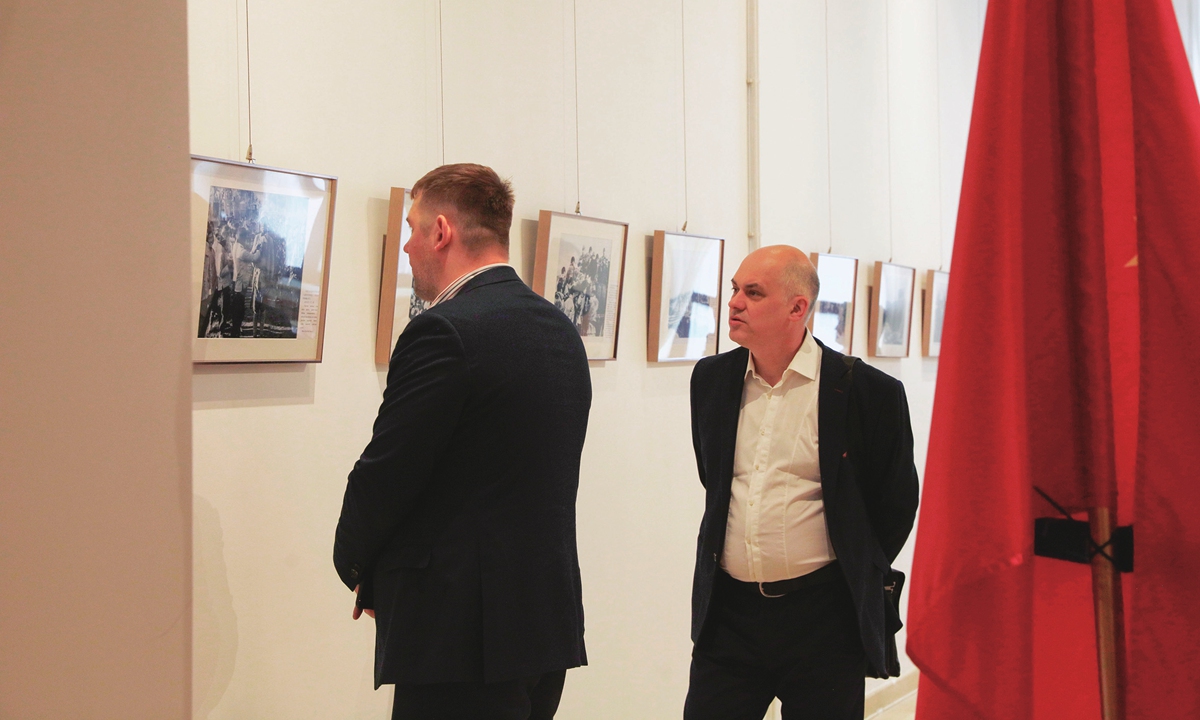
Spectators explore photos at a photo exhibition commemorating the 80th anniversary of the victory of the Chinese People's War of Resistance Against Japanese Aggression and the World Anti Fascist War in Moscow on June 5, 2025. Photo: VCG
Editor's Note:
2025 marks the 80th anniversary of the victory in the Chinese People's War of Resistance against Japanese Aggression and the World Anti-Fascist War. Eight decades have passed, yet the world once again finds itself at a crossroads. The rise of unilateralism, ongoing geopolitical turbulence and the distortion of historical truths remind us of the enduring relevance of remembering the past and safeguarding peace. Against this backdrop, the Global Times launches the column "Revisiting WWII, Defending Peace," inviting renowned scholars and peace advocates from around the world to revisit the history of World War II (WWII) through contemporary lenses. Through diverse perspectives, the series seeks to uphold historical memory, promote shared development and defend fairness and justice. Only by confronting history with honesty and clarity can humanity find the wisdom to shape a more peaceful and sustainable future.
In the third installment of this series, Global Times (GT) reporter Xia Wenxin discusses the role of China and Russia in safeguarding a correct view of WWII history with Vladimir Petrovskiy (Petrovskiy), a research fellow at the Institute of China and Contemporary Asia of the Russian Academy of Sciences.
GT: Last month, President Xi Jinping visited Russia and attended the Victory Day celebrations in Moscow. What is the significance of China and Russia jointly commemorating the victory in the World Anti-Fascist War amid today's complex international landscape?
Petrovskiy: President Xi Jinping became the main guest at the Moscow parade on May 9. The Chinese leader also invited Russian President Vladimir Putin to participate in festivities scheduled for early September, according to Russian Ambassador to China Igor Morgulov. This is an opportunity for the public of our countries and for the entire world to realize that the Soviet soldiers became the main heroes of the victory not only in Europe but also in Asia. And that China's resistance to Japanese aggression was the "second front" that the Soviet Union so badly needed.
GT: China and Russia have jointly organized events to commemorate the WWII victory and defend historical truth. What responsibilities do the two countries share in preserving this legacy, and how can historical memory help promote global peace and Asia-Europe solidarity?
Petrovskiy: China and Russia bear a special responsibility for preserving the historical memory of WWII, since the two countries were the main forces opposing German fascism in Europe and Japanese militarism in Asia, and they suffered particularly heavy losses and casualties in this war. This is especially important to remember in the year of the 80th anniversary of our common victory, which demonstrates the solidarity of the countries and peoples of Europe and Asia in confronting a common threat.
GT: The China-Russia Joint Statement emphasizes the need to "foster a correct view of WWII history." What are the dangers of revisionist narratives such as "neglecting China" or portraying Japan as a victim? Why is it important to accurately teach and remember WWII history today?
Petrovskiy: Why are we concerned today about the falsification of history? When the role of the Soviet Union in the victory in WWII is "overlooked," this is done to explain and justify certain features of the current balance of power in the world, as well as the role that America or other Western powers want to play in it. China has also been affected by attempts to falsify its role to belittle its role in the fight against militarist Japan. Russian and Chinese scholars should work together to correct the historiography of WWII, which will help us fight attempts to falsify this war.
GT: The UN system and post-war order emerged from the victory in WWII. Despite their flaws, do multilateralism and collective security mechanisms still hold relevance today? Why must we uphold the UN-centered international system and the post-war achievements?
Petrovskiy: The post-war world order formed by the countries participating in the anti-fascist coalition based on the UN was called upon to promote the formation of multilateral approaches and a system of collective security to prevent the threat of a new war. Incidentally, we must not forget that the "Big Three" - Joseph Stalin, Winston Churchill and Franklin D. Roosevelt - did not close the circle of the victorious powers in WWII, as China later also participated in the anti-fascist coalition. Already within the UN, Soviet diplomacy made considerable efforts to ensure China's proper role in the UN and ensure China's membership in the UN Security Council. China and Russia are making considerable efforts to maintain and strengthen the UN's role in world affairs.
GT: WWII cooperation transcended ideological divides, yet today ideology often fuels division. Should share interests and a sense of common destiny take precedence over ideology in preserving global peace?
Petrovskiy: The concept of a community with a shared future for mankind calls for respect for different historical and cultural traditions and stages of development, key interests and important concerns of different countries, as well as their independently chosen paths of development and political regimes. It is important to observe the "golden rule" - non-interference in the internal affairs of other states and the opposition against the imposition of one's will on other countries. In this regard, ideological, cultural and civilizational differences should not interfere with the building of a community with a shared future for mankind in the name of universal peace and prosperity.
GT: Managing relations among major powers is essential to international stability. How do you see the significance of deepening China-Russia strategic cooperation in safeguarding global order and security?
Petrovskiy: China and Russia have established a comprehensive strategic partnership and comprehensive interaction, the essence of which is that it is a targeted interaction between our countries, which is long-term, continuous, stable, based on the implementation of mutual fundamental interests, and, as a rule, is carried out in all spheres of life. Foreign policy coordination between Russia and China plays a key role in the functioning and development of the bilateral strategic partnership. Both sides strengthen interaction in multilateral mechanisms and coordinate positions on regional issues, such as the settlement of the situation on the Korean Peninsula and the Iranian nuclear issue.
GT: China has proposed global initiatives on development, security and civilization. How can China and Russia work together to promote a more equal, multipolar world and contribute constructively to reforming global governance?
Petrovskiy: The three global initiatives are closely related to each other and reflect China's long-term foreign policy vision in the new international environment of the 2020s and develop the broader foreign policy doctrine of China, proclaimed by President Xi as a community with a shared future for mankind. The Global Development Initiative focuses on the core contradictions and problems of unbalanced and inadequate development. The Global Security Initiative responds to the international community's urgent need to maintain world peace and prevent conflicts and wars. The Global Civilization Initiative builds on and integrates the first two initiatives. Security is a prerequisite for development, and development is the driving force of security. Civilization is the soil for development and security, and development and security are the paths for development and the advancement of civilization. Based on this understanding, China and Russia will be able to jointly shape a new, more just and balanced multipolar world and reform the global governance system.
RELATED ARTICLES