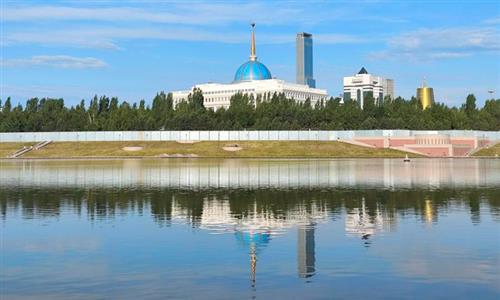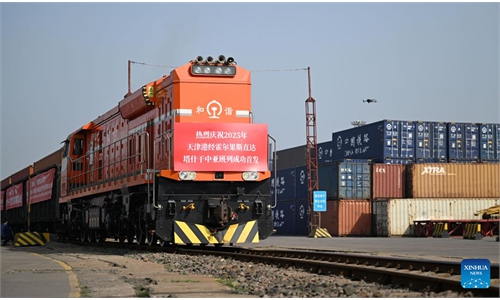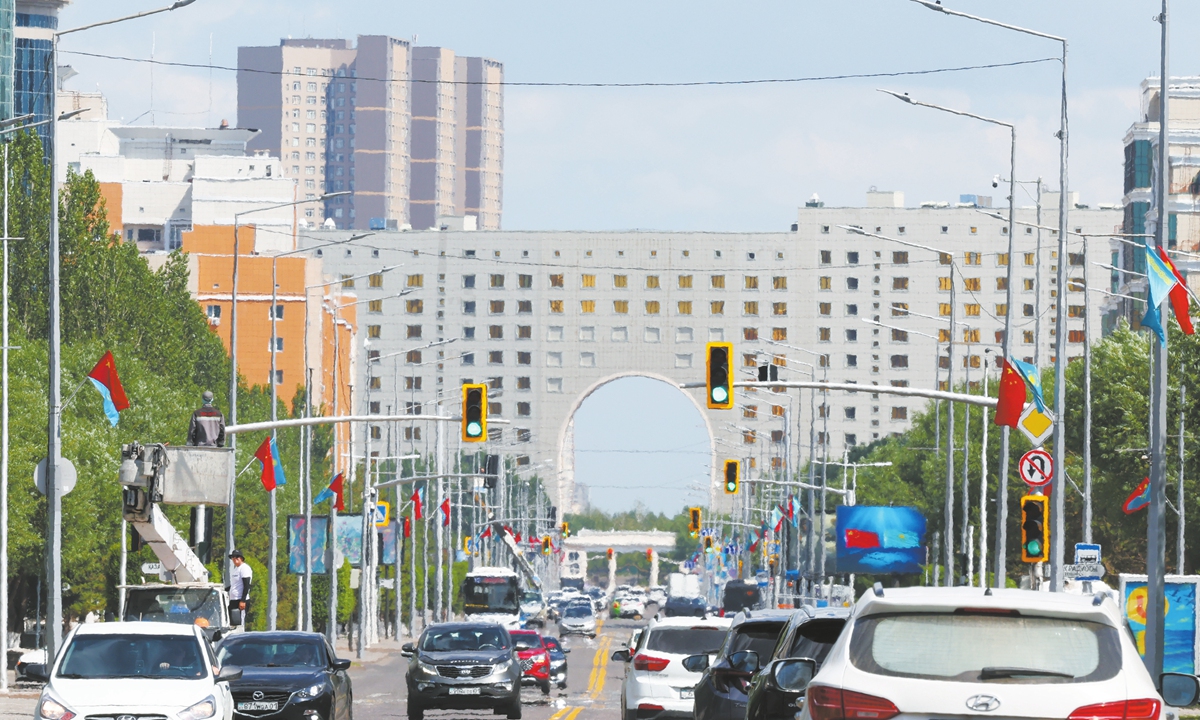
A view of Astana, capital of Kazakhstan on June 15, 2025. Photo: VCG
Editor's Note:
On Tuesday, the second China-Central Asia Summit concluded in Astana, the capital of Kazakhstan. What new momentum can this summit inject into regional connectivity and innovation? How will the second summit carry on the achievements and mission of the first which was held two years ago in China? How do Central Asian countries view their partnership with China in the face of rising unilateralism? Global Times (GT) reporter Ma Ruiqian interviewed Gulnar Shaimergenova (Shaimergenova), director of the China Studies Center in Kazakhstan, to discuss these issues.
GT: What are your expectations for the second China-Central Asia Summit, and how might this summit further enhance China-Central Asia cooperation?
Shaimergenova: The second China-Central Asia Summit is not just a diplomatic gathering - it's a symbol of deepening strategic trust and shared ambition among the six nations. Kazakhstan, under President Kassym-Jomart Tokayev's leadership, has consistently emphasized the importance of institutionalizing the China-Central Asia format to transform it from a set of bilateral partnerships into a true multilateral platform. President Xi Jinping's concept of the "community with a shared future" provides a guiding vision, and we can expect the summit to advance concrete areas such as energy cooperation, logistics connectivity, agricultural trade and green innovation. This summit is likely to accelerate flagship projects such as the expansion of China-Europe container rail corridors through Kazakhstan, the development of cross-border digital infrastructure and the rollout of clean energy initiatives, all aligned with the Belt and Road framework.
GT: At present, unilateralism and trade protectionism are on the rise, and the trend of "de-globalization" has severely impacted the global free trade system. In this context, what is the significance of holding the second China-Central Asia Summit for regional development and for the promotion of multilateralism?
Shaimergenova: In today's world, where unilateralism and protectionism increasingly undermine the multilateral system, the China-Central Asia Summit represents a regional pushback: a reaffirmation that open cooperation, mutual benefit and fair dialogue are not only possible but essential. For Central Asian countries, who value their sovereignty and multi-vector foreign policy, the summit provides a multilateral framework that resists great power rivalry and builds genuine regional solidarity. Kazakhstan supports the development of a just, balanced global order - a principle that resonates deeply in these summit dialogues. By institutionalizing this format, the six countries show that regionalism can thrive without exclusivity or confrontation, but through inclusiveness and cooperation.
GT: At the first summit, China and the Central Asian countries signed a number of cooperation agreements, including those related to infrastructure development and energy cooperation. Since the inaugural summit, how would you assess the progress of China-Central Asia cooperation, particularly in terms of the opportunities it has brought to Kazakhstan? How do you envision the future of China-Kazakhstan cooperation?
Shaimergenova: Since the inaugural summit in Xi'an, Northwest China's Shaanxi Province, cooperation has advanced impressively. In 2024, trade between China and Central Asia surpassed $94.82 billion, with Kazakhstan accounting for over $43.82 billion - a record high. The automotive sector saw the launch of joint China-Kazakhstan assembly lines; in data circulation, Astana and Beijing piloted new cross-border data governance mechanisms; in energy, new joint investments have been made in green hydrogen and renewables. For Kazakhstan, these opportunities are not just economic - they enhance its role as a logistics and innovation hub connecting China to Europe. Looking ahead, I envision an even deeper partnership: Kazakhstan can position itself as a center for Central Asian green transformation, digital Silk Road experimentation and cross-cultural connectivity.
GT: In April, Chinese Foreign Minister Wang Yi put forward five points of proposal for deepening China-Central Asia cooperation - upholding friendly and harmonious relations featuring mutual trust, boosting mutually beneficial cooperation, enhancing institutional development, pursuing fairness and justice, and aiming for everlasting friendship. How do you view the significance of these proposals?
Shaimergenova: Wang Yi's five points are more than diplomatic slogans - they outline a framework for sustained, meaningful cooperation. Mutual trust ensures that regional security remains stable, particularly amid global tensions. Mutually beneficial cooperation expands Kazakhstan's export potential, especially in green agricultural products and renewable energy, sectors where China is willing to increase imports and investment. Institutional development is key: with the new secretariat fully operational, Kazakhstan can help shape the region's policy agenda proactively, moving from ad hoc projects to long-term coordination. Fairness and justice underscore a shared historical consciousness - both China and Central Asia suffered under imperialism and value safeguarding the UN-centered order. Everlasting friendship goes beyond economics: youth exchanges, educational cooperation and cultural initiatives will ensure that this partnership endures across generations. These five points, if properly implemented, will not only strengthen China-Central Asia ties but will create a replicable model for how major powers and smaller nations can cooperate equitably.
GT: In 2019, China and Kazakhstan decided to upgrade their relationship to a permanent comprehensive strategic partnership. How do you interpret the meaning of this permanent comprehensive strategic partnership between the two countries? In your view, how can China-Kazakhstan cooperation serve as a model for the region and even the world?
Shaimergenova: The upgrade of China-Kazakhstan relations to a permanent comprehensive strategic partnership in 2019 signals more than political goodwill - it formalizes an enduring, all-weather commitment. What makes this relationship unique is its breadth: from energy to connectivity to innovation. Moreover, Kazakhstan's multi-vector diplomacy complements China's "win-win" approach, avoiding exclusive alignments and ensuring balanced engagement. This relationship serves as a regional model because it shows that cooperation can respect sovereignty, balance interests and deliver shared development, offering a blueprint for other parts of the world.
GT: For years, some Western narratives have portrayed China's cooperation with Central Asian countries as a form of "debt trap," often smearing the Belt and Road Initiative. Do such Western claims overlook the agency and sovereignty of Central Asian countries in making their own choices?
Shaimergenova: The "debt trap" narrative overlooks a critical reality: Central Asian countries, including Kazakhstan, are sovereign actors with agency in choosing their partnerships. Kazakhstan has repeatedly emphasized that its cooperation with China is based on national interest, strategic alignment and mutual benefit. Kazakhstan independently determines its foreign economic relations and welcomes investments that support our national development goals. Western critiques often fail to recognize the diversity of local needs, the positive infrastructure transformations already underway and the fact that China has restructured or forgiven loans in cases of hardship, debunking the debt-trap narrative. Ultimately, the China-Central Asia relationship is about co-creation, not domination, and should be evaluated on its tangible outcomes, not on external narratives.
RELATED ARTICLES