IN-DEPTH / IN-DEPTH
China leverages regional strengths, technology and policy tools to address soybean supply and demand challenges
Seeds of solution
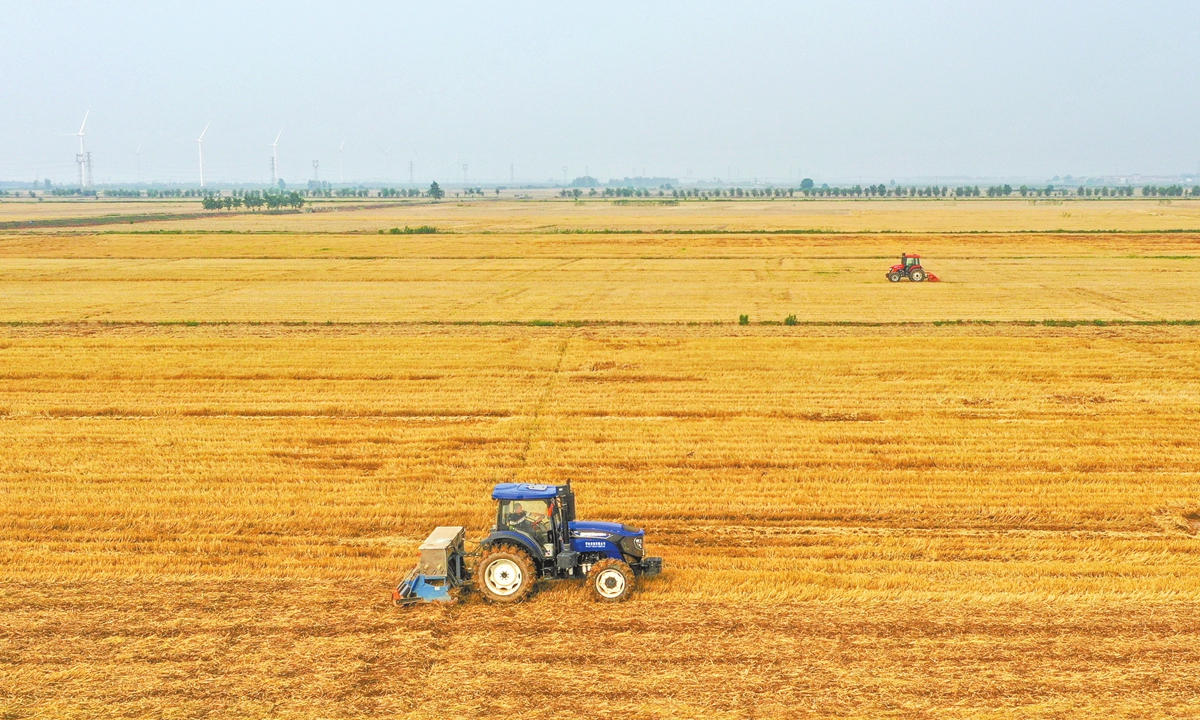
Tractors plough land to prepare for soybean sowing in Anqing, East China's Anhui Province, on May 24, 2025. Photo: VCG
Editor's Note:
As the world's largest consumer and importer of soybeans, China's soybean industry dynamics have always attracted external attention. After the US initiated a trade war, Global Times reporters visited the Oilseed Crops Research Institute at the Chinese Academy of Agricultural Sciences (referred to as the Oilseed institute) in Wuhan, Central China's Hubei Province. During a dialogue with the southern soybean breeding team, several key members calmly revealed, "We realized the soybean supply and demand issue a long time ago, and we have been preparing to tackle the challenges for many years." Traditionally, the country's soybean production areas are divided into the northern, Huanghuai, and southern regions. In Heilongjiang Province, known as the "ballast stone" of national food security, breeding enterprises have conducted preliminary explorations and made new attempts in the field of artificial intelligence (AI). In recent interviews, experts and scholars from the aforementioned major soybean production areas expressed that since 2018, when the Trump administration first imposed tariffs upon taking office, to present-day, the goal of accelerating the realization of technological self-reliance and independent control of seed sources in the domestic seed industry has not changed.
An increase of 5 million tons
In the evening, a Global Times reporter entered a soybean greenhouse at the Oilseed institute. Upon entering, the interior was bright as day, as if the sun were hanging directly overhead, and the temperature was about 5 C higher than outside. After a moment of adjustment, the reporter could see that the less than 10-square-meter greenhouse resembled a small field, filled with lush green soybean plants, some of which had already formed green pods. The ceiling simulated natural light, covered with dotted light strips. Additionally, some shorter soybean varieties were on shelves against the wall, receiving light primarily from blue light lamps, which are said to promote soybean growth.
"I have trimmed off a lot of side branches; otherwise, it [the plant] would grow too many [pods]," said Zhang Chanjuan, the greenhouse manager, while communicating with the team's chief, Chen Haifeng. A few team members quickly gathered around, carefully lifting leaves one by one, like uncovering a baby blanket, to check on the growth of the soybeans.
Chen told the Global Times that these soybean varieties are the "high-yield soybeans" cultivated by the team over the years, including "Zhongdou 57," "Zhongdou 63," and "Zhongdou 68," among others. Notably, "Zhongdou 63" set a new high-yield record for southern soybeans in 2024.
"Under natural conditions, we can only hybridize soybeans once or twice a year. Here (in the greenhouse), we can hybridize four generations a year, ensuring at least three generations are problem-free," said Yang Zhonglu, the executive chief of the southern soybean genetic breeding innovation team at the Oilseed Crops Research Institute. After successfully cultivating a new soybean variety, it must be approved by national or provincial authorities. Subsequently, the rights to cultivate the variety will be transferred to a company, which will then promote and market it. The team will continue to track user feedback on the promoted variety and make timely improvements. "To put it more vividly, it's like our own daughter getting married to someone else; we still have to take care of her and be responsible for her," added team researcher Huang Yi.
The southern region is the main production area and an advantageous region for high-protein soybeans, ensuring the safety of edible soybeans in the country. Xu Shiwei, secretary-general of the market early warning expert committee of the Ministry of Agriculture and Rural Affairs, previously said that China's soybean consumption mainly consists of two markets: One is the edible soybean market, with an annual demand of about 13 million tons, which can be fully sourced domestically; the other is the market for feed and oil, with an annual demand exceeding 100 million tons, which mainly relies on imports. The soybean meal produced after oil extraction is used as a raw material for animal feed.
Chen told the Global Times that in previous years, China's annual soybean production was around 15 million tons, and in recent years, it has stabilized at over 20 million tons.
"China is completely self-sufficient in edible soybeans, and domestic soybeans are mainly used to ensure food supply, which is sufficient to meet domestic demand. In the past, there were also some high-protein varieties exported, and currently, China's fresh soybeans are also exported to the US," Chen told the Global Times. He noted that although production has increased by 5 million tons compared to previous years, this still does not fundamentally solve the market's issues.
The Southern soybean genetic breeding innovation team has primarily focused on overcoming challenges in breeding high-protein edible soybeans. Every July, these soybeans are harvested earlier than those in other regions, giving them strong market competitiveness. When factory inventories run low, companies rush to purchase directly from local farmers.
"We have focused on three main tasks," Chen told the Global Times. "First, cultivating high-yield soybeans to boost production in South China; second, developing high-quality, high-protein varieties to provide people with better soy-based products; and third, promoting the development of the entire soybean industry chain to form a virtuous cycle."
After the US initiated a tariff war this year, agricultural products including soybeans were caught in the crossfire.
According to Chen, both domestic soybean growers and enterprises have noted that the additional tariffs would inevitably cause fluctuations across the entire industry chain. For instance, reduced imports could lead to rising domestic soybean prices, encouraging farmers to plant more. Against this backdrop, the profitability of soybean cultivation has improved, prompting domestic enterprises to invest more in high-quality seeds, while breeding institutions are accelerating the development of new varieties to meet market demand.
'World's most advanced agricultural machines'
Hu Xiping began working in the field of soybean breeding in 1995. He is now the chief breeding expert at the Soybean Research Institute at the Beidahuang Kenfeng Seed Co Ltd, and has served as a living witness to three decades of transformation in Northeast China's soybean industry.
When Hu first started his carrer, senior experts told him: "With a ruler and a scale, bite and stare." He explained to the Global Times, "It meant feeling the seeds by hand, biting them with your teeth, and then using your eyes to estimate the seed weight and predict the future height of the plant. Back then, breeding was entirely based on experience."
In Hu's view, China's soybean industry has undergone a sweeping transformation. Take soybeans in Northeast China's Heilongjiang Province, as an example. When he began working, the most advanced machinery he saw was a three-row cultivator that could loosen soil, fertilize, and sow simultaneously. However, it was incapable of precision planting - the seeds simply fell wherever they happened to land.
Today's seeders, known as vacuum or pneumatic planters, extract seeds and plant them with high precision based on preset distances programmed by computers. The number of seeds per row, total quantity, depth, and any planting gaps are all accurately tracked and displayed digitally.
"The Beidahuang Group started early in building unmanned smart farms, applying technologies such as BeiDou satellite navigation, remote control of agricultural machinery, and sensor-based data collection. Nowadays, you can farm while sitting indoors," Hu said.
"The world's most advanced agricultural machines can be seen in Beidahuang," he noted.
In breeding, progress is made in five-year leaps. By 2000, Hu had discovered that some in China were already conducting molecular marker-assisted breeding, and some institutions had begun exploring gene mapping. By 2005, state-owned farms in northern and eastern Heilongjiang had begun introducing high-yield soybean cultivation techniques. The newly developed varieties were more suited to mechanized sowing and showed significantly improved disease resistance, raising the overall cultivation level well beyond that of the mid-1990s.
It is widely acknowledged in the industry that the US has entered the "Breeding 4.0" era of soybean breeding, while China is still striving within the "Breading 3.0" era, according to Hu.
"3.0 means combining biotechnology with conventional breeding, moving entirely away from the traditional bite-and-touch methods. We can now test soybean leaves to evaluate variety quality and identify desirable genes. Over the past 30 years, we have progressed from 1.0 to 3.0, and some research institutions are already working toward 4.0. We are getting closer to the world's most advanced breeding levels," Hu said.
However, Hu also acknowledged that the leap from 3.0 to 4.0 is a qualitative one and not easy to achieve. According to his analysis, breeding 4.0 in other countries primarily involves the application of big data and AI, using large datasets to build breeding models and analyzing breeding materials through AI. "A single gene may yield over a dozen predicted traits abroad, but we are not yet at that level domestically," he said.
Hu is optimistic about the potential for upgrading China's soybean industry. "China now boasts a deep talent pool in AI, and cutting-edge technologies are emerging rapidly," he told the Global Times. "AI-driven solutions will be pivotal in elevating our soybean breeding efficiency."
Turn switch back on
"The tariff war initiated by the US is like turning off a light switch, but the Chinese people always find a way to turn the switch back on and light the lamp again," Huang said. He noted that the same principle applies to soybeans. In the face of the soybean challenges, China is increasing yields, reducing costs, and expanding resources, gradually addressing the supply and demand issues linked to soybeans.
Tang Qijun, the executive president of the China Soybean Industry Association, told the Global Times that to fill the soybean supply-demand gap, China is implementing systematic solutions from multiple dimensions: First, increasing soybean production by continuously expanding planting areas under policy guidance; second, diversifying imports by stabilizing and improving the reliability of major soybean import sources, while also increasing imports from other sources; third, establishing a precise regulatory mechanism that differentiates subsidies for edible and oilseed soybeans, encouraging farmers to grow high-yield oilseed soybeans while stabilizing the production of edible soybeans; and fourth, developing soybean alternatives by exploring other protein-rich crops or products to replace some of the uses of soybeans.
Chen said that China is shifting its market focus to countries like Brazil, but the global soybean trade pattern has not fundamentally changed. For China's soybean industry, there are several key strategies: First, it is essential to increase yields through various measures such as innovation in germplasm resources, collaborative breeding, and optimization of cultivation techniques. Second, the planting area should be expanded. Third is to seek alternatives to soybean meal, such as partially replacing soybeans with high-protein corn through high-protein tissue improvement, or reducing reliance on meat by developing plant-based meat and other means.
During the interviews, several experts repeatedly mentioned the issue of high soybean loss rates during harvesting with domestic agricultural machinery. Huang noted that developing efficient, low-loss domestic harvesting equipment is one of the solutions.
After making this point, he gestured toward the buildings outside and said, "With China's capabilities and determination, we can find more ways to meet domestic market demands."
RELATED ARTICLES