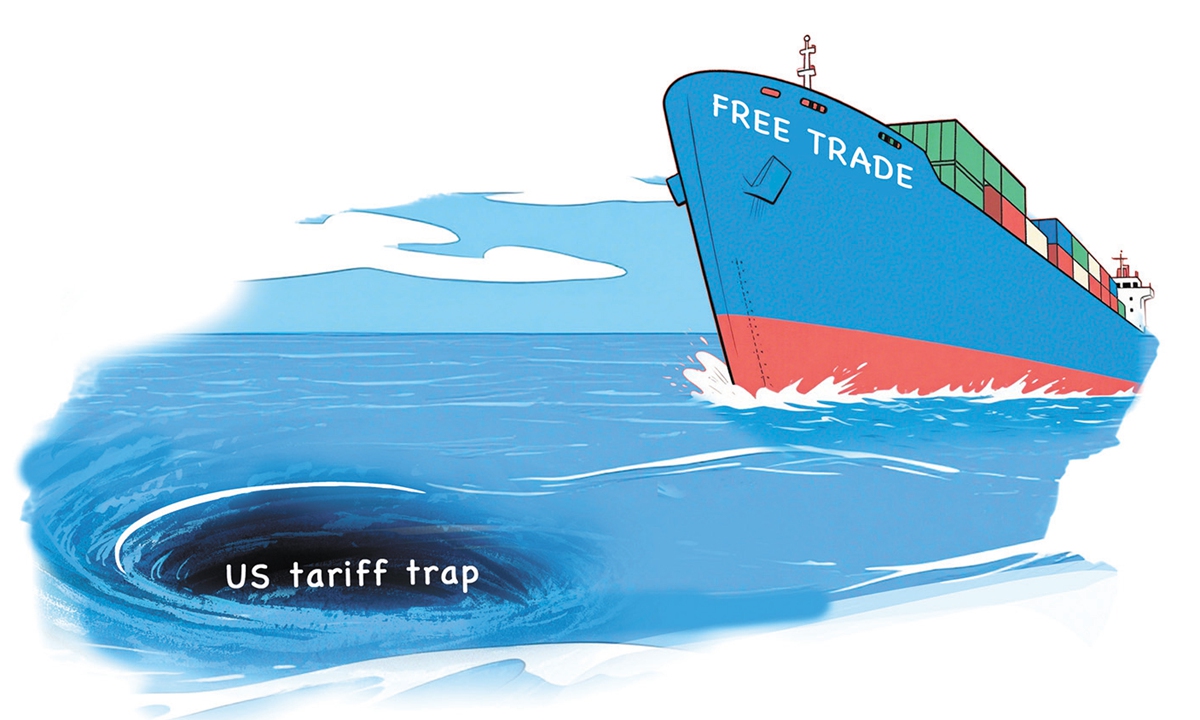
Illustration: Liu Xiangya/GT
Recently, reports have shown that the US is pressuring Vietnam during tariff talks to reduce the use of Chinese technology in devices assembled in the country before being exported to the US. Reuters cited unnamed sources as saying that the US has asked Vietnam "to reduce its dependency on Chinese high-tech." Another source told Reuters that the ultimate objective is to speed up US decoupling from Chinese high-tech. Evidently, "reducing dependency on China" has likely become a key bargaining chip in US tariff negotiations with other countries, and an important tool for exerting pressure and extracting greater benefits.
Since the US began wielding its "reciprocal tariff" stick in April, demanding most of its trading partners bow to American unilateralism, the global trade system has come under serious strain, and export-oriented economies are facing mounting developmental pressure. When confronted with the threat of the so-called "reciprocal tariffs" from the US, some countries have decided not to push back or publicly object, hoping this would shield them from impact - or even benefit if other countries end up facing higher tariffs instead.
However, this logic is unlikely to hold - and more importantly, no party should strike a deal at the expense of another's interests.
First, the Pandora's box of US tariffs will not be closed through appeasement. While unilateral concessions by US trading partners may offer temporary satisfaction to Washington, they will only fuel US appetite for more. Such concessions are likely to be perceived as weakness, encouraging the US to further wield its tariff power for greater advantage. Additional tariffs on steel, autos, and potentially more under the guise of "national emergency" are likely to follow.
Second, unilateral concessions from trading partners will not lead to prosperity for the US economy. High tariffs hurt both supply and demand. US importers are unable to source goods from lower-tariff countries, while domestic production cannot quickly fill the gap. As a result, American suppliers are left with two tough choices: raise prices or scale back their operations.
In today's highly globalized economy, US manufacturing, which the US government seeks to resurrect, depends heavily on imported raw materials and intermediate products. But whether it's the "fentanyl tariffs" on Canada and Mexico or the so-called "reciprocal tariffs" on other countries, these measures will inevitably drive up the cost of imports, and will also increase the costs of US export products, thereby weakening the global competitiveness of US products.
Finally, conceding to the US would severely weaken the multilateral trading system's foundation. As the most important trade governance mechanism in the 80 years since World War II, the WTO has established an institutional framework based on mutual respect, equality, and reciprocity among its members. This has fostered a trade environment built on trust and created the essential conditions for the effective functioning of market-based resource allocation.
It is on the basis of fundamental principles such as the Most-Favored-Nation (MFN) treatment that international trade costs have continued to decline, allowing all parties to focus more on improving resource efficiency and promoting social development. If certain parties make unilateral concessions to the US at the expense of their multilateral commitments, it would not only undermine trust with other key trading partners, but could also trigger more serious chain reactions.
Upholding rules demands courage and responsibility. Although the process is not easy, it can significantly reduce the operating costs of the firms. In contrast, rule-breaking inevitably lead to long-term negative impacts on market order and market expectations.
Nowadays, maintaining a good international order and enhancing the resilience of supply chains have become high-priority policy goals for most countries around the world. For export-oriented economies like Vietnam, the US market may be important, but it is not the only or irreplaceable one. Enterprises need to consider both benefits and risks in their development, and those with strategic vision will look even further ahead.
In recent years, South-South cooperation has developed rapidly, and various regional and sub-regional economic and trade cooperation mechanisms and free trade agreements have been continuously promoted. Infrastructure connectivity has significantly enhanced the ability of all parties to coordinate, and promoted the effective use of resources and the benign connection between supply and demand. As industrialization and urbanization have progressed, developing countries have built stronger foundations for sustainable growth. This gives them both the ability and the conditions to explore new development opportunities when faced with the challenges of trade protectionism and unilateralism.
The author is a senior research fellow at the Chinese Academy of International Trade and Economic Cooperation. opinion@globaltimes.com.cn
RELATED ARTICLES