Illustration: Chen Xia/GT
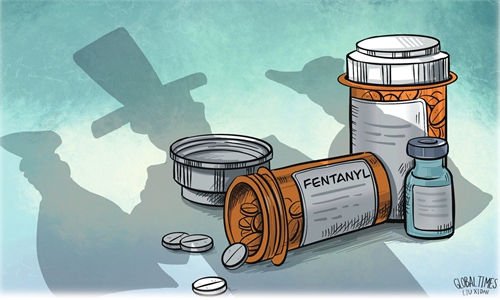
On the eve of the International Day Against Drug Abuse and Illicit Trafficking, China released the "China Drug Situation in 2024" report which shows the national drug situation continued to improve steadily. In particular, it noted that there was "no evidence of significant abuse of fentanyl-type substances" in the country. On the same day, the Office of China National Narcotics Control Commission said at a press conference that China has included all nitazenes and 12 other kinds of new psychoactive substances on its list of controlled drugs.Nitazenes are new synthetic opioids with potency exceeding that of fentanyl, making their illicit use extremely lethal. Fentanyl itself is a synthetic opioid analgesic approximately 100 times stronger than morphine, used medically to treat severe pain but deadly when abused.
Since 2018, synthetic opioids, primarily fentanyl, have claimed hundreds of thousands of American lives, according to data from US Centers for Disease Control and Prevention. The agency also reported that in 2023 alone, over 105,000 Americans died from drug overdoses, with synthetic opioids accounting for almost 73,000 deaths - approximately 69 percent of the total. While nitazenes are less prevalent than fentanyl in the US, their potency and lethality have driven an upward trend in related cases and deaths, triggering high alerts among law enforcement and healthcare professionals in the US.
As the US government continues to attribute its fentanyl crisis largely to external supply chains, China's report offers a different perspective. The stark contrast in drug control effectiveness between the two countries deserves serious consideration. The Chinese government treats drug control as a critical health and security matter directly impacting public safety.
When China decided to include all fentanyl-related substances in its supplementary list of controlled narcotic drugs and psychotropic substances with non-medical use in 2019, various government agencies immediately coordinated action. Police, customs and postal systems nationwide simultaneously upgraded monitoring systems. The entire process - from legal amendments to implementation - was completed in a short period of time, demonstrating remarkable commitment and resource allocation.
Traditional drug control typically follows a "substance-by-substance" approach, identifying and scheduling specific harmful chemicals individually - essentially a "point-based" strategy. By contrast, a "full control" model regulates entire categories of substances with similar chemical structures or pharmacological effects - a "surface-based" approach.
This strategy breaks free from the reactive "discover one type of drug and control it" model, shifting to a proactive defense that fundamentally blocks traffickers from evading legal control through minor chemical structure modifications. Simultaneously, China has strengthened export controls on these substances. Overall, China has seen a decline in the number of drug users for seven consecutive years. As new drugs emerge, Chinese agencies respond with increasingly precise and forward-looking enforcement measures.
China's "full control" model demonstrates foresight and powerful implementation capabilities in addressing new psychoactive substances - a global challenge. This approach provides an important "China solution" and "Chinese wisdom" for the international community. This proactive, innovative approach is a significant regulatory advancement in international drug control. China's experience isn't based on mysterious technology - the key is the political will to implement effective measures.
Does the US face objective challenges? Certainly. The federal system creates policy inconsistency across states, with some legalizing marijuana while others impose strict penalties, making nationwide coordination difficult. However, these objective factors shouldn't serve as excuses.
The forceful approach the US demonstrates in immigration enforcement proves the government's implementation capacity. The US government could mobilize thousands of law enforcement officers within 24 hours for immigration raids, deploy military support for border control, establish large temporary detention centers, force coordination with state and local governments, and pursue policies despite tensions with allies. Why can't this implementation and resource mobilization level be applied to fentanyl control?
In 2025, the US is expected to spend nearly $34 billion on immigration and border enforcement, while the Drug Enforcement Administration budget is just over $3 billion. This comparison speaks volumes - the US government invests several times more in immigration enforcement than drug control.
If the US government prioritized the fentanyl crisis with the same resources and determination as the immigration crisis, today, the former might not exist. Ultimately, this isn't a technical issue, funding problem or systemic challenge - it's a matter of political will. Immigration issues translate into votes and mobilize political bases, so the government willingly invests enormous resources. Although fentanyl abuse kills tens of thousands of Americans annually, it carries insufficient political weight in the US government.
The critical question remains: Is the US government truly willing, like China, to treat drug control as a national security issue directly impacting its citizens' lives? If it merely pays lip service while shifting blame to other countries, this problem will never be solved.
The fentanyl crisis claims tens of thousands of American lives annually - a more direct and deadly threat than any external danger. As one of the world's wealthiest nations, the US' struggle to protect its citizens from drug harm deserves weighty introspection.
RELATED ARTICLES