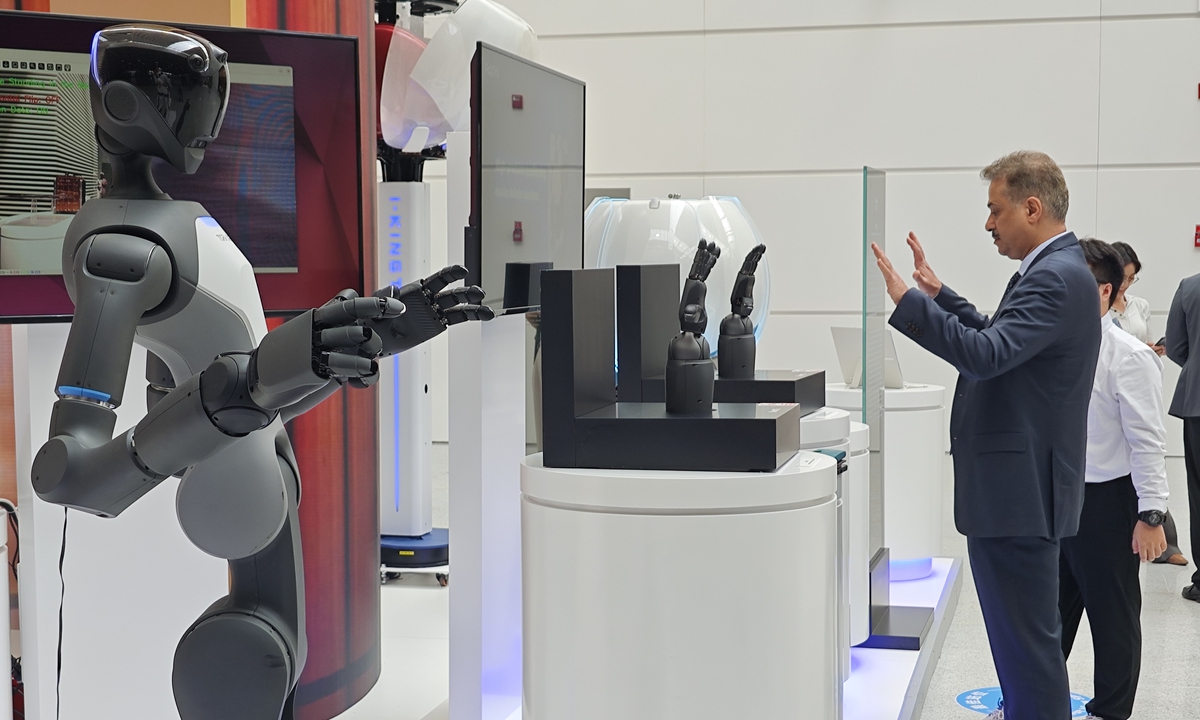
A person interacts with a robot at the 16th Annual Meeting of the New Champions of the World Economic Forum in North China's Tianjin on June 24, 2025. Photo: Yin Yeping/GT
Industry representatives and experts from around the world showed strong interest in the booming opportunities within China's rapidly advancing technology industries during the ongoing Summer Davos in North China's Tianjin, especially in areas like artificial intelligence (AI) and new-energy vehicles (NEVs).
Officially known as the 16th Annual Meeting of the New Champions of the World Economic Forum (WEF), this year's Summer Davos, which is being held from Tuesday to Thursday, focuses on a broad range of topics, with high-tech industries in the spotlight.
"China's rapid advancements in the (tech) areas are poised to fundamentally reshape the global industrial landscape... By accelerating smart manufacturing and green energy adoption, China will drive down costs, set new efficiency benchmarks, and redirect supply chains toward tech-integrated production," Norbert Meyring, head of Automotive and Industrial Manufacturing, ASPAC Region of KPMG, told the Global Times on the sidelines of the Summer Davos on Tuesday.
In an interview with the Global Times, Azeem Azhar, an investor and founder of Exponential View, which focuses on AI and technology convergence, said that he thinks China has done really well, pointing to the rise of Chinese AI firms.
"The most interesting thing was what DeepSeek did, and how they have taken these highly efficient, very optimized language models and made them open-source… It's a really interesting moment, and DeepSeek is now very heavily used around the world and observed by companies, so people can learn from it," said Azhar.
Yin Zheng, executive vice-president of China and East Asia Operations at Schneider Electric, said in a statement sent to the Global Times that the company is optimistic about the Chinese market, particularly under the drive of the new quality productive forces.
"As a key engine of global economic growth, China offers a vast market and a strong industrial foundation. The development of the new quality productive forces is accelerating the creation of innovation-driven digital and green productivity, providing broader growth opportunities for global industrial technology leaders like Schneider Electric," Yin said.
One such example is the company's "End-to-End Lighthouse Factory" recognition by the WEF in Shanghai's Putuo District, which has used AI-powered digital solutions to cut make-to-order time by 67 percent and boost production efficiency by 82 percent.
Schneider Electric vowed to continue to promote the deep integration of cutting-edge technologies such as AI with industrial applications, and work with Chinese industries to jointly shape a future driven by new quality productive forces, the company said.
Technology is not only a key topic of discussion at the forum - high-tech gadgets are also visible almost everywhere at the venue.
At the open zone showcasing the future of interactive technology, a multi-dimensional tactile humanoid robot captivated observers by mirroring their gestures in real time. This immersive experience was provided by TORA-ONE, one of the latest innovations from PaXini Tech, a Shenzhen-based company specializing in cutting-edge haptic technology and humanoid robotics.
Meanwhile, outside the National Convention and Exhibition Center (Tianjin), the event venue, NEV shuttles lined up to drop off attendees, creating an iconic scene that captures the event's emphasis on offering "participants the opportunity to explore how entrepreneurship and emerging technologies can unlock more dynamic and resilient economies."
It's very encouraging to see the fast development of the living examples of Chinese technologies, said Pushpahas Joshi, executive vice president and member of the Executive Board at KPIT Technologies, an Indian multinational corporation that provides engineering research and development services to automotive companies.
"China is at the forefront of electric vehicle technology development. So (I am) here to learn how China is able to achieve such a high speed of technological advancement," Joshi told the Global Times at the forum on Tuesday, adding that the rapid development of China's NEV industry impressed him the most and is something countries like India can adopt and learn from.
RELATED ARTICLES