China firmly opposes tariff deals reached at expense of China's interests as US 'reciprocal tariffs' deadline approaches
China hopes trade partners will abide by multilateral trade rules: expert
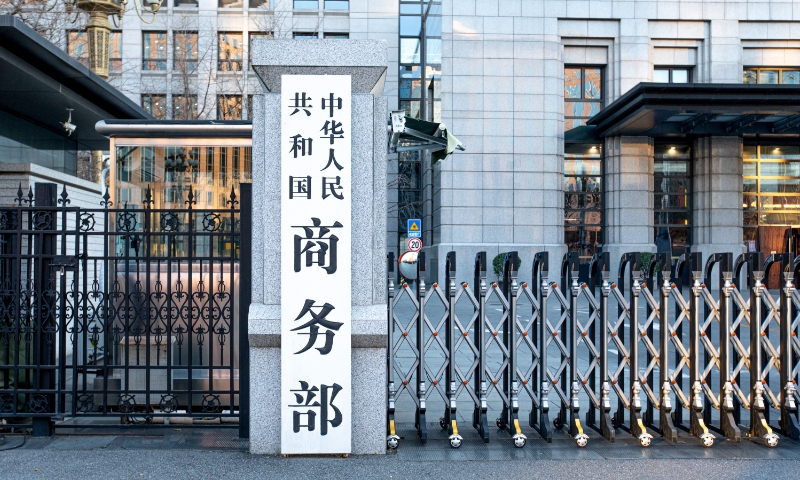
The Ministry of Commerce of China File photo: VCG
China firmly opposes any deal reached at the expense of its interests for so-called tariff relief; if that happens, China will never accept it and will resolutely counter to safeguard its legitimate rights and interests, a spokesperson from China's Ministry of Commerce (MOFCOM) warned on Saturday.
The remarks came in response to a media question as US officials said that they are stepping up negotiations with relevant economies and hope to reach trade agreements with some countries before the 90-day suspension period of "reciprocal tariffs" ends on July 9, according to a statement posted on MOFCOM's website. For countries with which no agreement has been reached, tariff rates may be set unilaterally.
US Commerce Secretary Howard Lutnick said that US President Trump was prepared to finalize a slate of trade deals in the coming two weeks in connection with his July 9 deadline to reinstate higher tariffs he paused in April, Bloomberg reported on Friday.
Lutnick claimed that the US president has also said that he will ultimately send "letters" to countries dictating trade terms if agreements aren't reached in time. Countries will be sorted into "proper buckets" on July 9, according to the Bloomberg report.
China welcomes all parties to resolve economic and trade differences with the US through equal consultations. At the same time, China calls on all parties to stand on the side of fairness, justice and historical correctness, firmly upholding international economic and trade rules and the multilateral trading system, the MOFCOM spokesperson said in the statement.
China consistently upholds the principle of addressing economic and trade issues between countries within a multilateral framework, which includes adopting an equal and mutually beneficial approach toward all nations. Therefore, if certain countries fail to adhere to multilateral principles in trade negotiations, causing losses to China, the Chinese side will certainly not endorse such practices, Zhou Mi, a senior researcher at the Chinese Academy of International Trade and Economic Cooperation, told the Global Times on Sunday.
The MOFCOM statement once again clearly signals that for countries and trading partners seeking to establish normal economic and trade relations with China, that the Chinese side hopes they will abide by multilateral trade rules and refrain from actions that harm others without benefiting themselves.
Previously, European Commission President Ursula von der Leyen encouraged the US president to join forces with his allies to address China's trade imbalances, rather than impose tariffs on his allies at the G7 summit, which took place in Canada in mid-June, according to a Politico report. Brussels has tried for months to convince the US not to target the EU in the trade war, arguing that cooperation on China's industrial policy is the best way to secure an even trade playing field, while attempting to flatter and cajole the American president into withdrawing his punishing levies, per the Politico report.
Nikkei Asia reported on June 5 that Japan would present the US with a cooperation package focusing on supply chains for Chinese rare earths and American liquefied natural gas (LNG) that have been disrupted by the tensions, under a report named "Japan to propose 'China countermeasure package' at next US tariff talks."
Brussels' claims violate WTO rules, which are non-discriminatory, and its claim is tantamount to targeting China specifically while not targeting the US, He Weiwen, a senior fellow at the Center for China and Globalization, told the Global Times on Sunday.
Speaking on whether countries sacrificing China's interests to gain US tariff exemptions could truly secure exemptions, Zhou said that when these countries do that, they will face opposition from China, which could adversely affect their development interests, future market opportunities and credibility.
In April, a MOFCOM spokesperson said that appeasement does not bring peace, compromise does not lead to respect, and attempts to trade the interests of others for tariff exemptions are doomed to fail and will ultimately harm all parties involved. The remarks came when responding to reports that the US is preparing to pressure other countries to restrict trade ties with China in exchange for tariff exemptions.
Tariffs disrupt intl trade order
As the July 9 deadline is approaching, foreign media reports reveal that the talks are just ongoing without specific deals inked for some of Washington's major trading partners.
Lutnick said that the White House has imminent plans to reach agreements with a set of 10 major trading partners, without specifying the nations, Bloomberg reported.
Asked about Lutnick's remarks on 10 possible deals and the current state of US-Japan trade talks at a regular press conference on Friday morning in Tokyo, Japan's Chief Cabinet Secretary Yoshimasa Hayashi said he was aware of the report but declined to comment. He said that Japan and the US are currently discussing the series of US tariff measures, per the report.
Also on Friday, the US president cut off trade talks with Canada over its tax targeting US technology firms, saying that it was a "blatant attack" and that he would set a new tariff rate on Canadian goods within the next week, Reuters reported.
The Reuters report said that the action comes ahead of Canada's plans to begin collecting on Monday a previously enacted digital services tax on US technology firms. The tax is 3 percent of the digital services revenue a firm takes in from Canadian users above $20 million in a calendar year, and payments will be retroactive to 2022.
As for the trade talks between the EU and the US, the EU has proposed eliminating tariffs on industrial goods on both sides - a move that has met with a lukewarm response from Washington, the Xinhua News Agency reported on Saturday.
The EU also hopes to narrow the trade imbalance by increasing imports of US LNGs, arms and agricultural products, and by considering reducing auto tariffs. However, US negotiators continue to press for sweeping EU concessions on value-added tax rules, digital regulation, food safety and environmental standards, according to Xinhua.
The MOFCOM spokesperson noted in the Saturday statement that since April, the US has imposed the so-called "reciprocal tariffs" on its global trading partners. This is a typical example of unilateral bullying that has severely undermined the multilateral trading system and disrupted the normal international trade order. China has always firmly opposed such actions, the spokesperson said.
Over the nearly three months, tariffs have significantly impacted countries, including the US, by increasing costs and disrupting supply chains, posing greater challenges to trade and economic activities, Zhou said.
If the US continues to pressure other nations to make adjustments without considering their interests, these countries will likely revise their approaches and seek alternative development opportunities, he added.
On Friday, MOFCOM said in a statement that the Chinese and US economic and trade teams have recently further confirmed the details on the framework for implementing the Geneva trade talks consensus. China will review and approve compliant export applications for controlled items in accordance with the law and regulations. The US will correspondingly remove a series of restrictive measures taken against China.
He Weiwen stressed the importance for the US to take further steps to meet China halfway, with practical actions by removing tariffs that do not align with regulations as well as lifting restrictions targeting China's high-tech sector.
RELATED ARTICLES