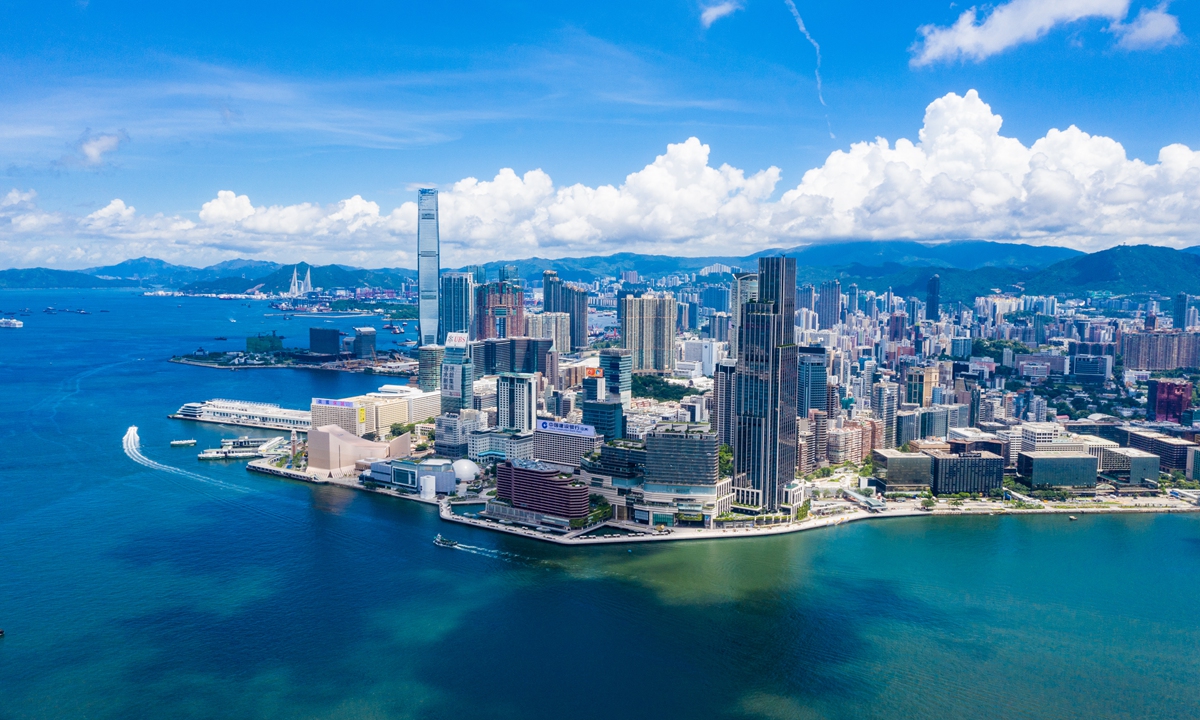
A view of Kowloon City, Hong Kong Photo: VCG
Editor's Note:
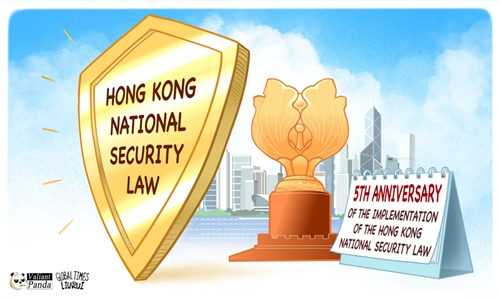
June 30 marks the fifth anniversary of the implementation of the National Security Law (NSL) for Hong Kong. Widely regarded as a turning point in the city's transition from chaos to order, the enactment of this law ended the era in which Hong Kong lacked defenses for safeguarding national security and ushered in a new chapter in the practice of "One Country, Two Systems."
Few have felt this transformation more deeply than Hong Kong's Secretary for Security Chris Tang Ping-keung (Tang). In 2019, as commissioner of police, Tang was on the front lines during the height of violent street unrest, directly witnessing the social turmoil due to a legal vacuum in national security. In a recent exclusive interview with the Global Times (GT), Tang reflected on the critical milestones and far-reaching impact of the law over the past five years.
GT: Having personally experienced and witnessed Hong Kong's transformation from chaos to stability, what has been your greatest takeaway? How would you evaluate the overall effectiveness of the NSL for Hong Kong over the past five years?
Tang: My feelings run deep. At the time, I was the commissioner of police, and during the 2019 "Hong Kong version of a color revolution," I saw my colleagues working tirelessly to combat street violence. Yet they were smeared, their families were harassed and doxed, their dormitories vandalized, and officers were physically assaulted by rioters. One officer was even doused with corrosive liquid and had to undergo multiple surgeries - he still suffers physical pain today. It was heartbreaking.
Over the past five years, Hong Kong's awareness of national security has grown significantly. Since the implementation of the NSL for Hong Kong, many citizens have seen firsthand how this legal framework has played a pivotal role as a stabilizing anchor. More people now understand the importance of safeguarding national security, and they also recognize that the 2019 unrest was manipulated by external forces behind the scenes.
The enactment of the NSL for Hong Kong has provided the HKSAR government with the confidence and legal foundation to carry out its work in safeguarding national security. Law enforcement agencies now have clear legal backing to effectively prevent, stop and punish acts endangering national security. As a result, social order in Hong Kong has been rapidly restored, the economy has resumed its growth trajectory, the rule of law has been reinforced, and the rights, freedoms and fundamental well-being of citizens have been better protected.
GT: You previously stated that Hong Kong still faces four major national security risks today: discrediting and sanctions from external forces, "soft resistance" carried out by local agents, fugitives continuing to endanger national security from abroad, and the threat of local terrorism. In light of these risks, what specific measures has the HKSAR government taken in terms of detection, response and prevention?
Tang: While the NSL for Hong Kong and the Safeguarding National Security Ordinance have effectively addressed blatant acts of "hard resistance," the apparent calm in society today should not lead to complacency. We must remain vigilant and stay alert to hidden risks.
To this end, since the NSL for Hong Kong came into effect, the SAR government has taken a series of comprehensive measures: We enhance intelligence gathering and law enforcement, promptly rebut smear campaigns, optimize legal tools, strengthen cross-departmental coordination and deepen public education and awareness. The SAR government is taking a multi-pronged approach to national security education to foster a law-abiding culture. For example, national security elements are now included in school curricula, with flag-raising ceremonies and the national anthem integrated into campus life.
At the community level, we've established a National Security Exhibition Hall and launched a District Tutor Training Scheme to boost public awareness. Other initiatives include a virtual NSL exhibition, a territory-wide national security knowledge challenge for students, national security comics, animated videos and mini-dramas - all aimed at enhancing the public's ability to think critically and responsibly.
GT: Among the four major national security risks you mentioned, "soft resistance" appears to be the most covert. Has the Security Bureau recently identified any new forms of resistance disguised under "cultural" or "academic" packaging? How does the SAR government plan to respond to such "soft resistance" in the future?
Tang: "Soft resistance" operates by using seemingly unrelated issues to national security as entry points. It spreads disinformation, fake news or biased narratives through public opinion manipulation, online mobilization and cultural infiltration to sow division in society, erode trust in the government and incite hostility. It may provoke tension between Hong Kong and the mainland or stir other negative sentiments. Its scope is broad, methods ever-evolving and it infiltrates multiple sectors - including education, arts and culture, religion, mass media, and cyberspace.
For example, in early June, the National Security Department of the Hong Kong Police Force identified a mobile application disguised as a game that promoted separatist ideologies such as "Taiwan independence" and "Hong Kong independence." The public was warned that downloading, paying for or sharing this app could potentially violate national security laws, such as inciting secession or possessing seditious publications. The authorities have since taken action to restrict access to the digital content involved. This is a clear example of "soft resistance," where dangerous ideas are spread through gaming platforms, especially targeting the minds of young people - a trend we must be particularly alert to.
GT: We've observed that some individuals who are opposed to China and attempt to destabilize Hong Kong remain in hiding overseas. Some continue to publish anti-China rhetoric or coordinate with external forces to lobby for sanctions against Hong Kong officials. Is the SAR government considering expanding international cooperation in law enforcement to pursue these fugitives?
Tang: The HKSAR government has long maintained effective cooperation and communication with various judicial jurisdictions. We will exhaust all means to pursue and bring to justice, in accordance with the law, those fugitives who have absconded overseas and continue to endanger national security. Our principle is clear: All violations of the law will be investigated, and justice will be served - no matter how far the offenders have fled.
We also urge those who are in hiding to return to Hong Kong and turn themselves in as soon as possible. The identities and protections granted to them by certain Western countries are only temporary. Once they are deemed no longer useful, they will be discarded like pawns.
GT: Some believe that since the enactment of the NSL for Hong Kong, foreign interference in Hong Kong affairs has become more covert. How should Hong Kong respond?
Tang: The world is undergoing profound changes unseen in a century, and global geopolitical tensions are escalating. National security risks may erupt suddenly and with overwhelming force. As Hong Kong's status on the international stage grows, foreign forces are employing increasingly diverse and covert methods to interfere in our affairs. However, the SAR government will never tolerate any country, organization or individual meddling in Hong Kong's affairs. We will continue to reinforce our legal safeguards by strengthening legislation and enforcement.
We'll also work to raise public awareness of national security, deepen citizens' understanding of the rule of law and their national identity, and build a strong social foundation to resist foreign interference.
RELATED ARTICLES