Illustration: Liu Xiangya/GT
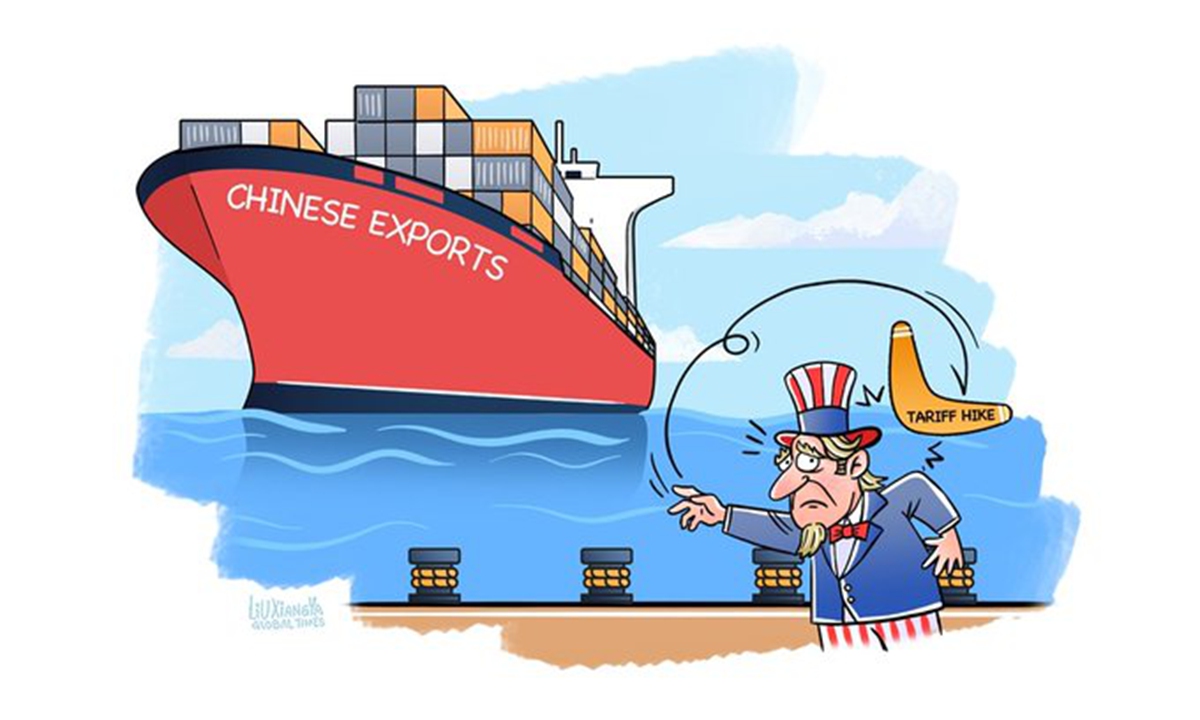
The US claims that the reason for launching a tariff war against China is that China sells far more to the US than the other way around. It also claims China's "overcapacity" has caused unemployment among American workers. Is this really the case? Facts suggest otherwise.
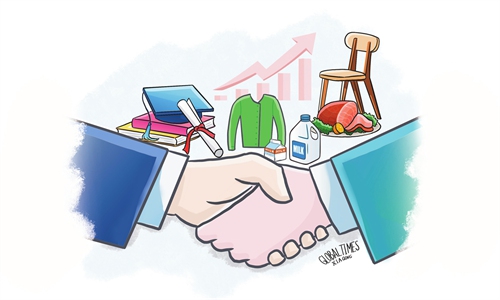
Trade deficits aren't someone else's fault. The essence of trade has always been equivalent exchange. From the ancient times, when people exchanged pottery for salt, transactions have been based on the willingness of both parties.
Those with land grow food, those with mines produce energy, and those with labor make clothes and shoes. This is the underlying logic of global trade and economy.
Economic globalization is one of the defining features of today's world. It is the result of technological advancement and propels the development of productive forces. It is not artificially created, nor can it be artificially severed.
China has a surplus in its trade in goods with the US precisely because it has comparative advantages in manufacturing and stronger competitiveness, and American consumers do like Chinese products. Having the ability to produce high-quality and affordable products is not a weakness.
The hidden US surpluses lie in trade in services. For a long time, the US has consistently one-sidedly emphasized its deficit in trade in goods, while deliberately avoiding mention of its huge surplus in service trade. The US is the largest source of China's service trade deficit, and that deficit has been continuously growing.
According to statistics from the US Department of Commerce, from 2001 to 2023, US service exports to China expanded from $5.63 billion to $46.71 billion, achieving an 8.3-fold increase. In 2023, China was the biggest contributor to the US service trade surplus, representing roughly 9.5 percent of the total.
Following US logic, does this mean the US is taking advantage of China?
The truth is, the US enjoys service trade surplus not only with China. Ngozi Okonjo-Iweala, director general of the WTO, pointed out that the US exported over $1 trillion in services in 2023, accounting for 13 percent of the global total service trade value, and it maintained trade surpluses with most economies. Its total service trade surplus reached nearly $300 billion in 2024.
Following US logic, should the whole world impose taxes on it, the world's largest exporter of services?
China-US economic ties benefit both sides. When China and the US established diplomatic relations, their bilateral goods trade value was less than $2.5 billion. By 2024, this figure reached nearly $688.3 billion, a 275-fold increase in just over 40 years.
Today, more than 70,000 US enterprises operate in China. Apple alone earned net profits of over $20 billion in China. Obviously, US companies do not engage in unprofitable business.
Goods made in China also support comfortable lives led by Americans. From iPhones to Christmas tree decorations, many items are inseparable from Chinese manufactured goods.
In other words, high-efficiency and low-cost goods from China have helped Americans maintain a lifestyle of "high consumption with low inflation."
The US benefits most from international trade. After WWII, the US and its allies established today's international economic order. In 1944, the US took the lead in convening the Bretton Woods Conference and proposed the creation of the World Bank, the International Monetary Fund and the International Trade Organization to form an institutional framework for the post-war global economy. Although the last one was ultimately not established, the World Trade Organization later filled the void. Through these three institutions, the US firmly controlled the post-war global economic order.
The US eventually approved China's WTO accession in 2001, but it was far from the high-sounding claim of promoting free trade. Economically, the US needed a larger market to export American goods; politically, many US politicians at the time were under the illusion that they could change the nature of Chinese society. However, China not only avoided the traps but also forged its own path to success.
American oligarchs deprive ordinary Americans of their right to work. American people's jobs were not "stolen" by China. Rather, they were sold out by American oligarchs - an inevitable consequence of capital's inherent nature of profit-seeking.
In the second half of the 20th century, driven by the pursuit of higher value-added service industries and rising labor costs, the US began outsourcing manufacturing. Many American companies relocated factories to China and other emerging economies.
American workers lost their jobs, and even white-collar workers in the service sectors are not much better off. The US financial capital has formed a high degree of monopoly, benefiting itself while exacerbating wealth polarization by cutting employees' wages and benefits.
All these led to one inevitable phenomenon: Most of the economic gains in the US are monopolized by the top 1 percent or even 0.1 percent of its population. Who should be blamed for this?
The author is a commentator on international affairs, writing regularly for Xinhua News, CGTN, Global Times, China Daily. opinion@globaltimes.com.cn
RELATED ARTICLES