'Jichao' gains popularity; people are looking beyond just the excitement: Global Times editorial
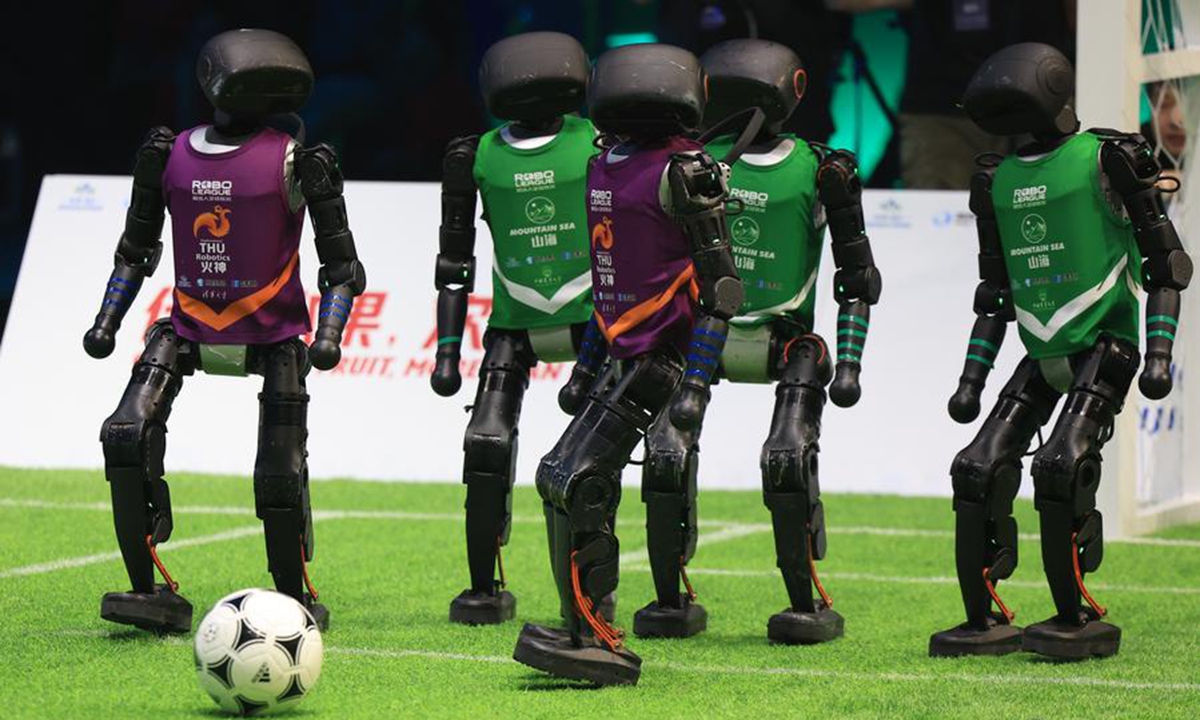
Robot players of the THU Robotics team from Tsinghua University compete with their counterparts of the Mountain Sea team from China Agricultural University during an AI-powered robot football match in Beijing, capital of China, June 28, 2025. Photo: Xinhua
Following the popularity of Village Super League (Cunchao) and Jiangsu Football City League (Suchao), another sensational event - Jichao has emerged. 2025 World Humanoid Robot Games will be held from August 14 to 17 at the National Speed Skating Oval, also known as the Ice Ribbon. This will be the world's first multi-sport competition for humanoid robots, featuring events in athletics, football, martial arts, free gymnastics and more. So far, robot teams from countries and regions including the US, Brazil, Germany and the Netherlands have completed pre-registration. From the humanoid robot half marathon in April, to Unitree's first-ever humanoid robot fighting tournament in May, and the upcoming World Humanoid Robot Games, China has seen a surge of major robotics-related events this year, drawing wide attention both at home and abroad.
Judging from earlier competitions, the atmosphere at these events has been electric, with tickets hard to come by. Highlight clips and behind-the-scenes moments have repeatedly gone viral on social media. It's easy to imagine that the more internationalized World Humanoid Robot Sports Games will spark yet another wave of excitement. It reflects the high attention and strong support of Chinese society for technological innovation.
The first test match of the 2025 World Humanoid Robot Sports Games - a 3v3 AI robot football final - was recently held in Beijing. One of its landmark breakthroughs was that all participating robots could autonomously get back up after falling, without the need for human handlers.
NBC described it as "an impressive breakthrough" - "While the play was absurd, the tech powering it was anything but." Many still remember earlier scenes from similar competitions where two programmers had to run alongside a single robot, a moment widely shared online. Yet amid the amusement and curiosity of netizens, China's humanoid robot technology has been quietly advancing.
A robot requires the precise coordination of multiple components, including control systems, sensors, information storage, and information transmission, to perform various actions. Sports competitions, however, place high demands on participants' reaction speed, precision of movement, and judgment ability. As a result, a robot's strengths and weaknesses can be exposed in an instant. Industry insiders have noted that sports competitions are a "testing ground for humanoid robots." Through different types of contests, a virtuous cycle of "R&D - production - testing - feedback - improvement" can be formed. Rapidly identifying and solving technical problems is one of the key purposes of organizing robot soccer matches and sports events.
Robots competing on the field are not just about winning or losing; they are also about discovering their own shortcomings, and this is precisely the key to technological progress. China's development is rooted in continuous striving and self-challenge, and robot competitions vividly illustrate this logic. Many American media outlets closely watch China's advances in AI and other fields, expressing anxiety over the possibility of the US being "overtaken by China." However, if they paid more attention to China's Jichao and focused on what truly matters beyond "you win, I lose," they might gain new insights into the technological competition between China and the US, and better understand why export restrictions cannot defeat China.
Holding the Jichao could not only test the comprehensive capabilities of robots and promote technological advancement but also showcase the current boundaries of technology to the public. It serves as a window for China's technological development and an important bridge for international scientific exchange.
Such openness helps advance global robotics technology and promotes the deep integration of science, technology, and innovation. Some foreign media have playfully remarked that, based on the current level of performance displayed by robots in the Jichao, there is still no sign of a "Little Messi" or "Little Mbappé."
However, no one can deny that hosting the Jichao has sparked public interest and enthusiasm for technology, creating a positive social atmosphere for global technological innovation. The future inventor of a "Messi" robot may very well be watching the Jichao today.
Humanoid robots are hailed as the "crown jewel of the robotics industry," with their rapid development driven by the empowerment of large models and advancements in digital simulation technology. Whether in industrial manufacturing, commercial services, or home companionship, the market potential is vast.
According to Goldman Sachs, under ideal conditions with revolutionary technological breakthroughs, humanoid robots could see a compound annual growth rate of 94 percent between 2025 and 2035, with the market size expected to reach $154 billion by 2035. The maturity of China's industrial chain will significantly lower the global application threshold.
When hospitals in Africa start using Chinese intelligent robots and factories in Southeast Asia introduce Chinese logistics systems, China's technological achievements will spread worldwide through product exports and open-source technologies, allowing countries around the globe to enjoy the dividends of China's technological development. The concepts of "technology for good" and "win-win cooperation" will become even more tangible.
From drones to artificial intelligence, from humanoid robots to quantum technology, and from new energy vehicles to domestically produced large aircraft, China's technological development is making steady progress and new quality productive forces are accelerating in their formation. We look forward to humanoid robots playing an important role in more fields in the near future, contributing more to the development of human society.
RELATED ARTICLES