Merkel calls on EU to stand united against US tariffs, among others voicing opposition: reports

Containers are seen in the process of logistics operations at Port Newark Container Terminal and Maher Terminal owned by the Port Authority of New York and New Jersey in Bayonne, New Jersey, the US. File photo: Xinhua
In an activity in Athens on Wednesday, former German chancellor Angela Merkel called on the European Union (EU) to stand united and not be intimidated when the US imposes more tariffs on the bloc, but instead should retaliate with US tariffs, Greek media reported.
"US President Donald Trump will be affected if his tariffs lead to citizens in America paying more for goods," said Merkel, when interviewed by Kathimerini, a Greek media.
The EU must stand united and not be intimidated when Trump imposes more tariffs on the bloc, but should retaliate with tariffs of its own. "I'm not saying we should to break off our relations with the US, but we must enter into negotiations," said Merkel, according to the report.
Since the Trump administration suspended those sky-high "Liberation Day" tariffs, the July 9 deadline has once again become the focus of attention in recent weeks. Yet, many voiced opposition to US tariffs.
According to euronews, the EU and the US are moving toward an agreement that would take the form of a headline "political understanding" to resolve their tariff dispute before the 9 July deadline, rather than a comprehensive deal, according to several diplomats and an EU official.
The US currently imposes a 50 percent tariff on steel and aluminum imported from the EU, a 25 percent tariff on automobiles, and a 10 percent tariff on all EU imports.
The euronews reported that "it now appears to be coming to terms with a deal that would maintain a baseline 10% tariff on EU imports."
However, some member states remained skeptical of the baseline 10 percent tariff.
For example, French President Emmanuel Macron stated on June 26 after an EU summit that "if the US maintains 10 percent tariffs, there will have to be compensation on goods and products imported from the US. The levy must be the same - 10 percent for 10 percent, or the equivalent of 10 percent."
Meanwhile, US trade negotiations had been stuck with some countries.
Earlier this week, Trump said negotiations with Japan had soured, according to media reports. Japan was one of the first countries to begin trade negotiations with the US after the pause was announced.
According to the New York Times, in monthslong negotiations with their counterparts in the US, the biggest buyer of Japan's exports, Japanese officials have extended a number of offers they expected to be well received. They pledged to purchase more American energy products and defense equipment, and to help the US in areas like shipbuilding.
Yet none of those overtures convinced the US to back down on across-the-board reciprocal tariffs - initially set at 24 percent on Japan - or to remove a separate 25 percent tariff on cars that has hammered Japanese automakers.
According to a Kyodo News report in mid-June, another hike in US tariffs on cars would further hurt Japan's mainstay automotive industry.
Japan has called for the removal of other additional sector-based tariffs as well as reciprocal tariffs, while the US is seeking to reduce its massive trade deficit with Japan, read the Kyodo News report.
Apart from oppositions from other countries, US analysis reports also suggested that tariffs could add billions in new costs for domestic midsize firms.
The implementation of full universal tariffs announced on April 2 could add up to $187.7 billion in direct import costs for midsize firms - more than six times the cost of earlier tariffs in place at the start of 2025, according to a report by JPMorganChase released on Wednesday.
Though some reductions were announced following negotiations, current policy still leaves midsize firms facing $82.3 billion in costs, read the report, exploring how recent changes to US tariff policy can affect midsize businesses across the country.
In another JPMorganChase report also released on Wednesday, it pointed out that midsize businesses are overexposed to potential high-tariff countries, with the wholesale and retail sectors having the highest exposure, read the reports.
"In trade negotiations with the US, some countries resist while others make concessions. I want to emphasize that the US has consistently pursued a unilateral 'America First' policy, prioritizing its own interests above those of other nations, which has severely disrupted the international trade order and damaged its global image and credibility, Gao Lingyun, a research fellow at the Institute of World Economics and Politics of the Chinese Academy of Social Sciences, told the Global Times on Thursday.
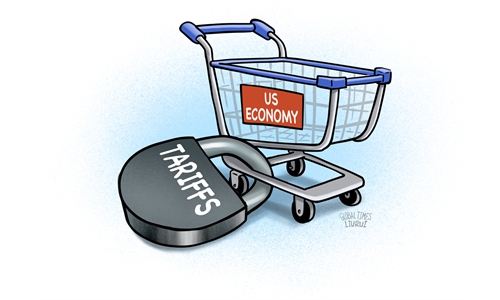
Since the implementation of US tariffs, while the US has gained short-term benefits, its domestic production costs have risen, and these costs have been passed on to consumers, negatively impacting its own economy. If the US persists in wielding the tariff stick on July 9, it will further disrupt international investment and supply chains, increasing uncertainty in the global trade environment, Gao warned.
Global Times
RELATED ARTICLES