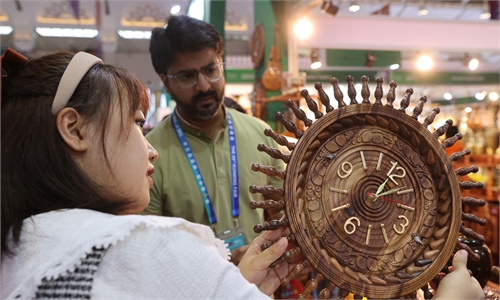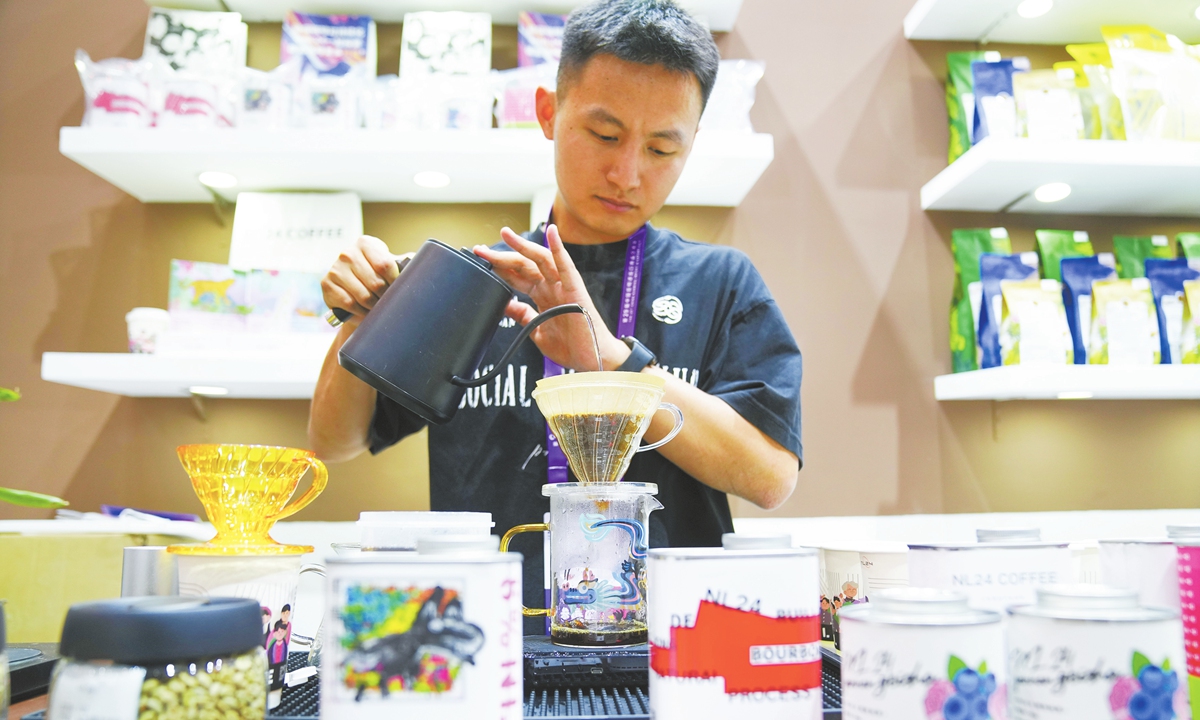
A barista makes co ffee at the 9th China-South Asia Expo in Kunming, Southwest China’s Yunnan Province on June 19, 2025. Photo: VCG
On a crisp morning at the bustling 9th China-South Asia Expo held in Southwest China's Yunnan Province, the aroma of freshly brewed coffee fills the air. Aamir Mustafa, a young entrepreneur from Pakistani coffee exporter Wagera Pvt Ltd quietly sips a cup of Yunnan's signature small-bean coffee. He has traveled here in search of something new for Poppy Bugger, a coffee chain run by his mother that boasts 14 outlets across Pakistan.
Backed by the Overseas Representative Office of Yunnan Commerce in Pakistan, Mustafa came in search of new coffee flavors and business opportunities, hoping to explore the potential of Yunnan coffee first-hand.
"I had heard that Chinese coffee was really good, with a unique taste and rich aroma you don't find in other countries. For me, this was a completely new experience. After tasting it, I was truly impressed. The coffee has a great flavor, and many distinct varieties stand out," Mustafa told the Global Times.
"Right now, we're considering both options—importing raw beans or importing roasted coffee. We'll decide based on which way turns out to be more feasible for us."
This distinctive flavor that captivated Mustafa's palate reflects a quiet yet profound transformation now under way in Yunnan's coffee industry.

Aamir Mustafa, a Pakistani coffee exporter from Wagera Pvt Ltd, signs a letter of intent with a local coffee trader Dehong Yinuo Pure Coffee Co for the purchase of Yunnan green coffee beans during the 9th China-South Asia Expo in Southwest China's Yunnan Province on June 21, 2025. Photo: Chen Qingrui/GT
An industry insider told the Global Times at the expo that Yunnan's small-bean coffee accounts for over 98 percent of China's total coffee cultivation area, output, and production value, making the place the country's undisputed coffee heartland.Yet with national annual consumption reaching around 400,000 tons and Yunnan producing only about 100,000 tons, the region has long faced a pressing question: how can this limited but distinctly "Chinese-flavored" resource be fully leveraged for market potential? As the market is now witnessing, Mustafa's recognition offers a glimpse into how this unique Chinese taste is beginning to reshape the coffee landscape.
At the China-South Asia Expo, amid bustling crowds, the refined taste of Yunnan coffee has truly won over many visitors.
The best taste
"We are undergoing a full transformation toward premiumization—of cultivation to processing," Yang Qinghong, a representative from Yunnan Bowein Technology Industry Co, a local coffee planting and trading company, told the Global Times.
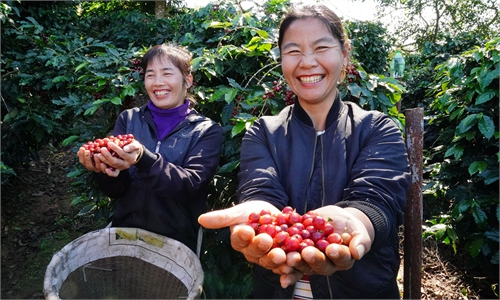
The transformation begins in the soil. For years, more than 90 percent of Yunnan's coffee farms were planted with Catimor, a high-yield, disease-resistant variety, Yang said. Now, the company is actively introducing and testing premium varieties such as the DRC series, Yunkaxinhao, and Sarchimor — renowned for their richer flavor profiles and higher cupping scores, as part of a gradual shift away from the dominant cultivar, he said.
Advanced processing is just as crucial. "Good beans require good craftsmanship. From coffee cherries to high-quality green and roasted beans, every step of the deep processing chain plays a vital role," the representative noted.
Through improved cultivation and enhanced processing techniques, Yunnan coffee is refining its limited resources into premium products—delivering greater value for the farmers and a richer, more distinctive "Chinese flavor" for consumers.
Industry reports show that Yunnan's four major coffee-producing regions are driving the shift toward premiumization. Among them, Pu'er has emerged as China's largest coffee production and trading hub in terms of planting area, output, and quality. It is also a key sourcing region for global coffee giants such as Nestlé, Starbucks, and Luckin Coffee, according to a report by Pacific Securities. In 2024, Pu'er's coffee sector recorded a total output value of 8.508 billion yuan, the report said.
As Chinese consumers place greater emphasis on coffee quality and diversity, Yunnan coffee has increasingly attracted the attention of major brands. This recognition has not come easily, as Yunnan's production scale still lags behind global coffee giants.
Driving Yunnan's coffee upgrade are provincial targets to increase the share of premium beans and deep processing. Equally crucial are private companies' relentless efforts to expand overseas — transforming Yunnan coffee from a behind-the-scenes raw material supplier into a visible player in global markets.
Tap international markets
Yunnan coffee's journey goes well beyond winning over new partners like Mustafa. Wang Yu'e, a veteran with nearly two decades in the industry, has witnessed its transformation first-hand—from relative obscurity to a rising presence in the international market.
"Yunnan coffee was once little known internationally, with many consumer markets having never tasted our beans. In recent years, we've taken part in numerous trade fairs and promotional events to raise awareness so that more global consumers can discover, appreciate, and ultimately choose Yunnan coffee," Wang, general manager of Yunnan Liangmu Coffee Co, a Yunnan-based coffee exporter, told the Global Times.
Her experience in the international division of a well-known coffee company, beginning in 2008, gave her valuable insight into Yunnan's local coffee farms and processing facilities. When she started her own business in 2015, green bean trading became the natural starting point of her entrepreneurial journey.
"My aim is to help growers overcome sales challenges by connecting them with trust-worthy, high-quality buyers, while also supporting roasters with a stable supply of green beans, consistent quality, and solutions to supply chain issues," Wang said.
Liangmu Coffee has actively pursued overseas markets through field visits and participation in trade fairs in countries including the UAE, Japan, South Korea, Vietnam, and Uganda, Wang said. The company currently exports to markets such as Malaysia, Japan, South Korea, and Vietnam, where most clients express strong interest in Yunnan's green coffee beans.
Driven by rising global demand for high-quality coffee, Yunnan's coffee exports have surged in recent years.
Yunnan exported 32,500 tons of coffee in 2024, marking a 358 percent year-on-year increase, according to data from Kunming Customs cited by Xinhua News Agency. Major destinations included the Netherlands, Germany, the US, Vietnam, and 25 other countries and regions.
In the first quarter of 2025, Yunnan's exports of coffee and coffee products reached 310 million yuan, up 122.1 percent year-on-year, customs data showed.
Behind these figures lies the vast potential of Yunnan's coffee industry and a shifting dynamic in the global coffee market. With over 130 years of cultivation history, Yunnan coffee is gradually earning recognition for its quality and production capacity, paving the way for broader international access, an insider told the Global Times during the expo.
During the expo, 93 coffee buyers from 12 countries visited the Baoshan coffee production area in the province, reaching 20 preliminary purchase agreements. The deals involved 35 containers, about 700 tons of coffee beans, with an estimated transaction value of 40 million yuan.
China's coffee consumption market is expanding rapidly. Yunnan coffee has responded by shifting its focus from quantity to quality, aligning with the country's broader consumption upgrade, Wang Peng, an associate research fellow at the Beijing Academy of Social Sciences, told the Global Times on Thursday.
This progress reflects China's effort to enhance the global value of its coffee brands by improving cultivation and processing to ensure consistent, premium quality—winning recognition from international consumers, Wang said.
When asked whether they would consider blending Yunnan coffee with beans from other countries, Mustafa said: "We won't mix it with coffee from other countries. It has its own unique flavor and aroma, and we want to use it in its original form."
RELATED ARTICLES