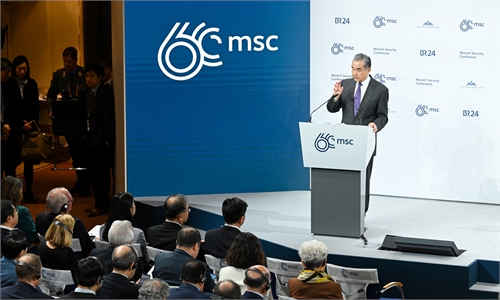
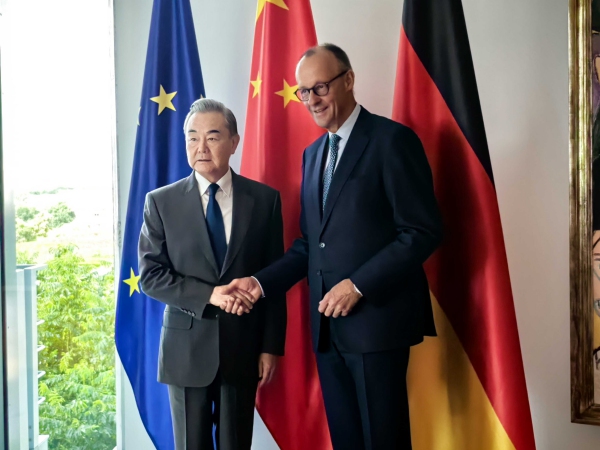
German Chancellor Friedrich Merz meets with visiting Chinese Foreign Minister Wang Yi in Berlin on July 4, 2025. Photo: website of Chinese Foreign Ministry
German Chancellor Friedrich Merz met with visiting Chinese Foreign Minister Wang Yi on Friday in Berlin, according to a statement from Chinese Foreign Ministry.
According to the statement, Merz told Wang Yi that the German side is willing to work with the Chinese side to maintain openness and mutual benefit, promote fair trade, and jointly address crises and challenges, which is in the interests of both sides. The new German government adheres to the one-China policy.
During the meeting with Merz, Wang said China stands ready to work with Germany to maintain close high-level exchanges, utilize consultation mechanisms in various fields, and promote the sustained, healthy, and stable development of China-Germany relations, which will not only be conducive to both sides but also benefit Europe and the world.
Wang, also a member of the Political Bureau of the Communist Party of China Central Committee, is on a trip to Europe with France as his next stop after Germany.
During the meeting, Wang said that the Chinese side appreciates the new German government's willingness to promote the further development of China-Germany relations with a constructive attitude and pragmatic spirit, according to a release from Chinese Foreign Ministry.
Wang stated that China welcomes Germany's development and prosperity, as well as its greater role in Europe and the world. He said he believes that the new German government will view China's development positively, adhere to a rational and pragmatic policy toward China, genuinely respect China's core interests, support China's national reunification just as China unconditionally supported German reunification, and continue to uphold the one-China principle.
China is committed to building a higher-level open economic system, with its doors of openness only widening further, and is willing to share market opportunities with Germany to create new prospects for development, Wang said.
Wang has also met with Günter Sautter, Foreign & Security Policy Advisor to the Federal Chancellor on Friday in Beilin, according to the Chinese Foreign Ministry.
On Thursday, Wang co-chaired the eighth round of China-Germany Strategic Dialogue on Diplomacy and Security with German Foreign Minister Johann Wadephul.
Wang said that this year marks the 50th anniversary of the establishment of China-EU diplomatic relations, and the China-Germany all-round strategic partnership has also embarked on a new decade, Xinhua reported.
Facing the current turbulent international situation, particularly the prevalence of protectionism, anti-globalization, and unilateral bullying, China and Germany must strengthen strategic communication and coordination, Wang stressed.
This marks Wang's first visit to Germany after the new German government was formed, and China has higher expectations for the stability of Germany's China policy, Cui Hongjian, director of the Department of European Studies, China Institute of International Studies, told the Global Times on Friday.
"This is because the Merz government positions itself as 'more stable and efficient,' making this strategic dialogue an important opportunity for Germany to showcase the stability and effectiveness of its policies," Cui noted.
The two sides need to engage in strategic dialogue to "align" their positions—mutually identifying concerns, clarifying stances, and exploring to what extent they can move forward together, Cui noted.
Analysts believe that Wang's trip to Europe lays a solid foundation for strengthening exchanges across all areas in the future, but also for future high-level interactions between China and Europe, demonstrating a sincere and concerted effort to address mutual concerns. They noted that in the long run, maintaining institutionalized and regular strategic communication between China and Europe reflects the resilience of the relationship, indicating that both sides still have strong mutual needs.
China-EU relations in focus
According to the AFP, Wadephul voiced concerns over China's export restrictions on rare earths.
Addressing the issue, Wang told a press conference alongside the dialogue that rare earth exports have never been, and should not become, an issue between China and Europe, emphasizing that as long as export control regulations are followed and necessary procedures are fulfilled, the legitimate needs of European companies will be guaranteed.
"This meeting fully demonstrated China's foreign policy toward Germany and Europe: we approach Germany and Europe with a sincere and open attitude, not avoiding any sensitive issues, including the Ukraine and rare earths issues," Dong Yifan, an associate research fellow at the Belt and Road Academy of Beijing Language and Culture University, told the Global Times on Friday.
China has always regarded Europe as a strategic partner and actively takes a constructive approach to strengthening communication with European countries, reducing misunderstandings and conflicts, and promoting cooperation, with a focus on solving problems, Dong noted.
Wang said that China's position on the Ukraine crisis has been open and consistent, which includes insisting on peace talks, not providing lethal weapons to the parties in the conflict, and controlling the export of (civilian/military) dual-use items, including drones, according to Xinhua.
China has not only fulfilled its international responsibilities, but also established the "Friends of Peace" group with Brazil and other Global South countries at the UN, mobilizing greater efforts for a ceasefire and an end to the conflict, Wang said, adding that China's objective and fair position has been widely recognized by the international community.
China-German relations hold a significant position in the broader China-Europe relationship, and many issues involving Europe could be addressed more easily if China and Germany reach a consensus, such as the recent hot topics in Europe regarding electric vehicles and rare earths, Cui noted.
Following the visit to Germany, Wang is scheduled to visit France for talks with the French Foreign Minister and the meeting of the China-France high-level dialogue mechanism on people-to-people exchanges, according to an earlier announcement from the Chinese Foreign Ministry.
In France, Wang will meet minister for Europe and foreign affairs Jean-Noel Barrot, who visited China in March, according to AFP.
Although this visit will mainly focus on cultural exchanges, it is clear that during his time in France, Wang will engage in extensive contacts with various sectors of the French government, including not only diplomatic counterparts but also potentially higher-level French leaders, Cui noted.
"China has always valued strategic communication and coordination with France. Currently, France, and Europe as a whole, face a core question: do they have a clear and defined strategic goal?" Cui said, noting that as relationships with major powers like the US, Russia, and China undergo profound changes, it is even more important for China and France to reaffirm certain fundamental consensuses.
In the current international landscape of major power relations, China-France and China-Europe relations should be among the most stable, with the greatest potential to contribute positively to global stability and certainty, the expert said.