China Australia photo: VCG
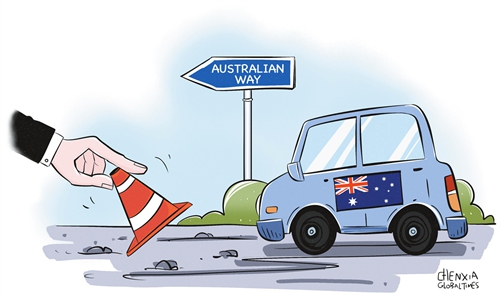
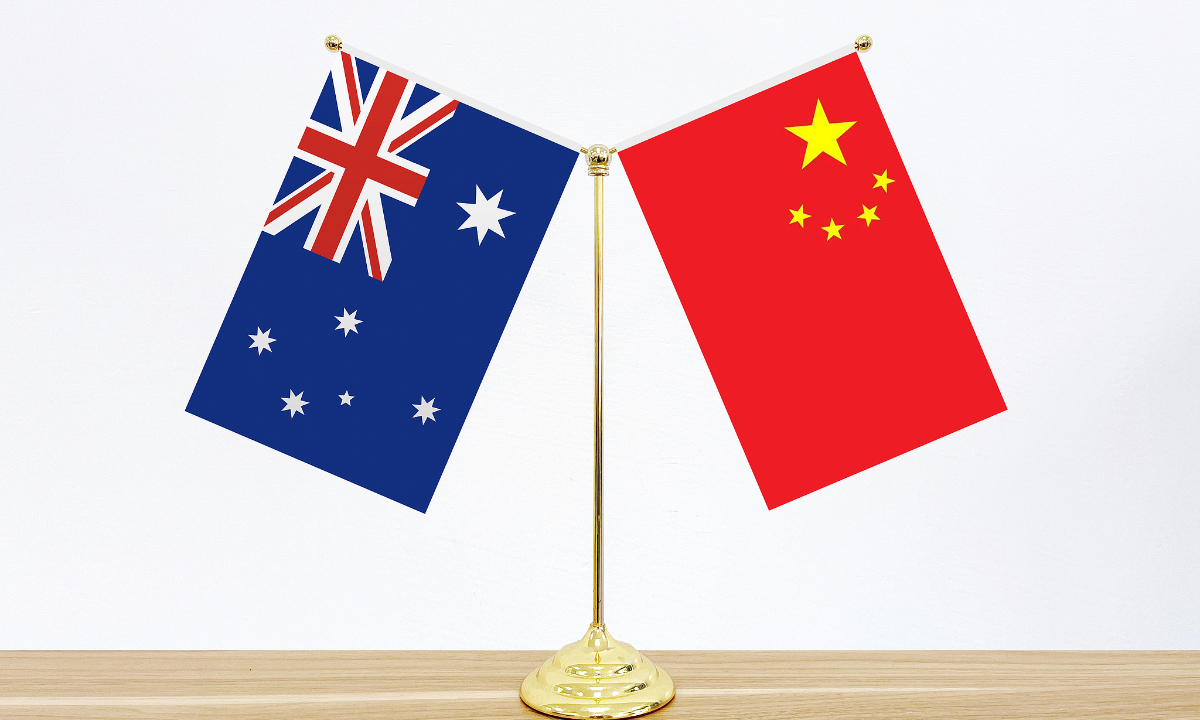
The landslide re-election of the Labor Party this year has injected new momentum into the warming of China-Australia relations. Although in recent years, under the influence of politicians, the media and the security establishment, public discourse on China had grown increasingly hostile, recent polls now indicate a gradual reversal of this trend.
The latest Lowy Institute Poll shows that the proportion of Australians who view China as an economic partner rather than a security threat has shifted slightly in favor of China, rising from 44 percent to 50 percent. In terms of overall sentiment, 37 percent of Australians now view China positively - a modest increase of three percentage points. These figures indicate a gradual warming of attitudes toward China. However, there is still some distance to go before relations return to the halcyon days of a decade ago, especially considering that 58 percent of Australians held positive views of China in 2019.
Despite this gradual thaw, Australian military planning continues to treat China as the country's primary security threat. The defense and security establishment in Australia is overwhelmingly shaped by US interests. This is evident in the 2023 Defence Strategic Review, led by Peter Dean, from the US Studies Centre at the University of Sydney, with the subsequent review of Australia's navy, conducted by retired US Vice Admiral William H Hilarides. The influence of the vehemently anti-China Australian Strategic Policy Institute runs deep in the security and intelligence sector.
Much discourse around defense and security for Australia is framed around AUKUS, under which Australia will spend A$368 billion ($239 billion) to acquire nuclear powered, though not armed, submarines.
According to the agreement, Australia is to receive three SSN-Virginia class submarines from the US in the 2030s, followed by SSN-AUKUS class submarines, currently being developed in the US. Growing doubts suggest the AUKUS project will never happen. The US is producing insufficient Virginia class submarines, even for its own needs, while UK shipyards are bogged down constructing their current Dreadnought class.
The justification offered for AUKUS is that Australia must protect its sea lanes from so-called "Chinese aggression." However, an increasing number of voices are questioning this strategic posture that casts China as Australia's principal threat. Considering that China is one of the biggest beneficiaries of bilateral trade, it is worth asking: why would China disrupt its own trading routes, supposedly to sink ships that are carrying its own flag?
These submarines, said to be for the defense of Australia, are clearly designed to fit with US aggression toward China in the South China Sea. Australia has been exaggerating China's activities on islands and reefs in the South China Sea, accusing Beijing of illegally militarizing the region, while turning a blind eye to the US strategy of containing China through encirclement. Much is made of the status of the Taiwan region. Australia has held a one-China policy since 1972, it has at times echoed the US in suggesting that it might also go to war over the island. Only 42 percent of Australians, however, support this move.
Wariness toward China is usually justified by "China's military build-up," as a threat to Australia and the wider region. However, this ignores the percentage of China's GDP spent on defense, currently less than 1.5 percent, lower than that both of the US and Australia. As percentage of GDP, China's defense spending has been constant for two decades.
Despite the enduring influence of hawkish voices, there are encouraging signs of improvement in the bilateral relationship. In warming relations, the positive face of China presented by the current Chinese Ambassador to Australia Xiao Qian has been important. This has increased tourism between the countries: 580,500 Australians visited China in 2024, up 85 percent, while over 800,000 Chinese tourists reciprocated, an 83 percent annual increase. The lifting of trade restrictions by China on Australian goods obviously has also helped greatly.
The current Australian government is making small steps to rapprochement with China, but is still constrained by its strong commitment to the US military alliance. While much needs to be done, as an old Chinese proverb says, "a journey of a thousand miles begins with a single step."
The author is a writer, historian, and social commentator based in Newcastle, Australia. opinion@globaltimes.com.cn
RELATED ARTICLES