International Deep Space Exploration Association inaugurated in China, marking milestone in global space collaboration
By in Hefei Published: Jul 07, 2025 07:44 PM

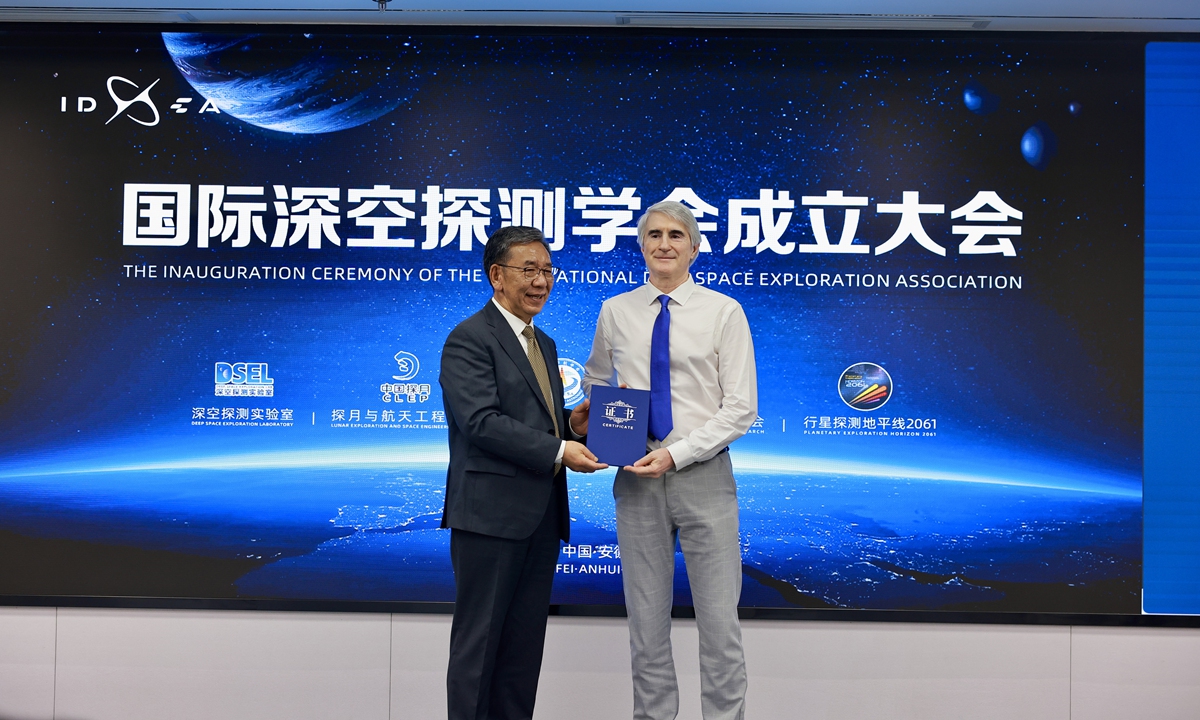
Wu Weiren (left), chief designer of China's lunar exploration program and newly elected president of the International Deep Space Exploration Association (IDSEA), presents certificate of membership of the IDSEA to Simone Dell'Agnello, executive technologist at Italy's National Institute for Nuclear Physics, on July 7, 2025, in Hefei, East China's Anhui Province. Photo: Deng Xiaoci/GT
The inauguration ceremony of the International Deep Space Exploration Association (IDSEA) was held in Hefei, capital of East China's Anhui Province, on Monday. The founding of the IDSEA was hailed by international space experts and astronomers as a significant step in China's international cooperation and a major milestone in global space innovation.They said it carries far-reaching significance for mobilizing global strength, advancing scientific progress, promoting mutual learning among civilizations, and building a community with a shared future for humanity in outer space.
The IDSEA is the first international organization dedicated to deep space exploration and first of its kind initiated by China, per the founding members of the association. It includes China's Deep Space Exploration Laboratory, Lunar Exploration and Space Engineering Center, Chinese Society of Astronautics, as well as France's Planetary Exploration, Horizon 2061.
At the Monday ceremony, the association's charter was adopted and its first council was elected. Chinese academician Wu Weiren, who is also chief designer of China's lunar exploration program, was elected as the association's first president.
The new organization was approved by the Chinese government and initiated by China's scientific community
Sixteen international organizations, including the United Nations Office for Outer Space Affairs (UNOOSA) and the International Astronautical Federation, along with over 70 government departments, space agencies, research institutions, and universities worldwide, sent congratulatory letters and messages to mark the occasion.
More than 100 representatives attended the founding event, including officials from the China National Space Administration (CNSA), the Chinese Ministry of Civil Affairs, the People's Government of Anhui Province, the China Association for Science and Technology, diplomatic missions in China, scientists, and representatives from relevant organizations.
Wu told the Global Times on Monday that the association will focus on lunar exploration, interplanetary missions, and asteroid defense. It will study global trends in deep space exploration, define scientific directions and technological roadmaps for space exploration, and host high-level international academic events.
It aims to build a broad platform for global collaboration and knowledge exchange, pool the wisdom of scientists around the world, and promote the application of deep space science and technology to support economic and social development, Wu added.
The association will organize science outreach exhibitions, international education and training programs to cultivate global space science talent, publish academic journals, and oversee major scientific projects and awards for outstanding scientists, thereby inspiring scientific discovery and technological innovation worldwide, according to Wu.
It will also participate in the development of outer space standards and norms to promote the peaceful use and long-term sustainable development of outer space, he added.
Ahmet Hamdi Takan, a Turkish expert in Deep Space Science and Technology, and a member of the newly founded association, told the Global Times on Monday that he appreciates China's sincere and friendly approach to promoting international collaboration in deep space exploration.
China consistently provides opportunities for international cooperation, inviting global partners to get onboard its visionary projects from Chang'e-6, -7 and -8 lunar exploration missions to Tianwen-3, -4 interplanetary projects, and even future asteroid defense project. Based on such collaboration, we can contribute our capabilities to benefit all of humanity as a whole," Hamdi noted.
In fact, China completes the most difficult part of the work and then invites others to participate in its visionary projects, Hamdi said. "In our country, we say that if it is working with China, it will be a 100 percent success," he added.
Hamdi said thanks to China's remarkable advancements, dedication, and peaceful invitation to collaborate on lunar and deep space exploration projects, we will be able to deploy the world's first AI-driven Smart Lunar Exploration Robots on the Moon in 2029 as part of the Chang'e-8 mission.
Simone Dell'Agnello, executive technologist at Italy's National Institute for Nuclear Physics, told the Global Times on the sidelines of the Monday ceremony that deep space exploration is a very challenging endeavor for any nation and the results are not always guaranteed.
To balance cost and outcomes, international collaboration is essential. Some countries specialize in instrument development, others in lander design, and still others in optical technologies. The founding of the association, therefore, is of great modern significance for that purpose and to encourage extensive collaboration, said Dell'Agnello.
RELATED ARTICLES