India should view China with greater rationality, less politicization and sensationalism
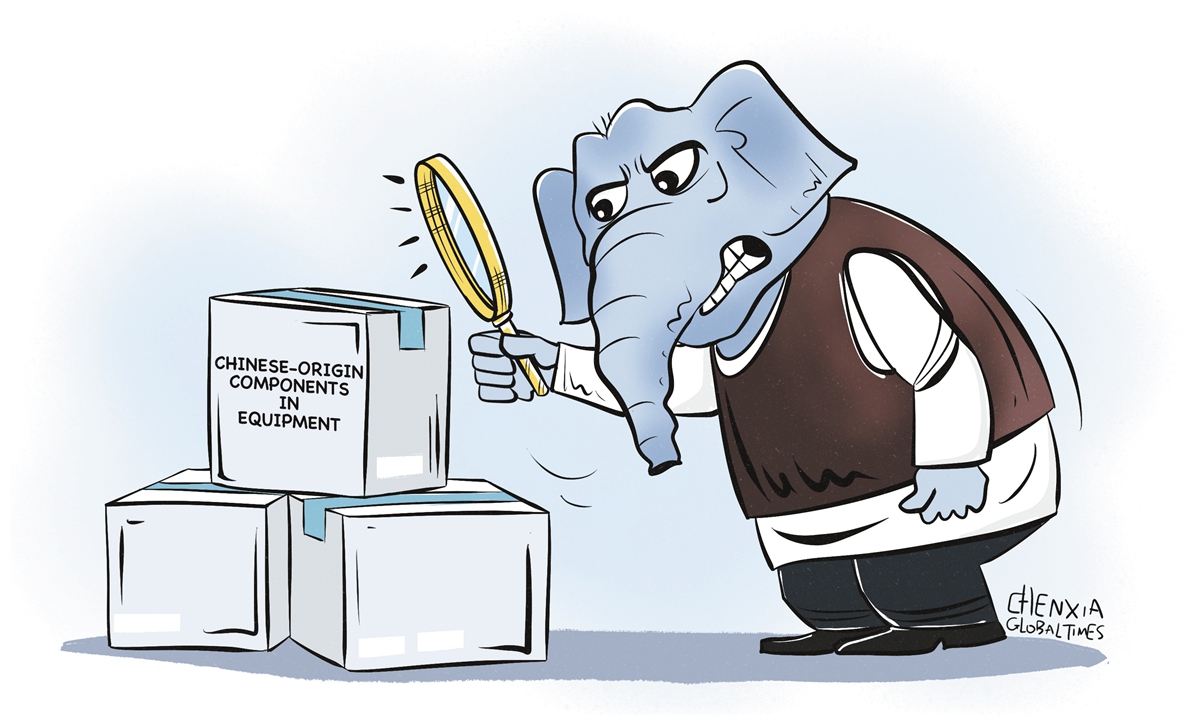
Illustration: Chen Xia/GT
The Indian military's recent remarks regarding China have been unsettling. Deputy Chief of Army Staff Lt Gen. Rahul R Singh said on July 4 that China used the four-day India-Pakistan conflict in May like a "live lab" to test various weapon systems and was providing all possible support to Islamabad, in line with its ancient military strategy of killing the adversary with a "borrowed knife." Meanwhile, according to Indian media reports, India's Ministry of Defense is set to launch a comprehensive review of military procurement to identify Chinese-origin components in equipment supplied to the armed forces and to assess vulnerabilities within the defense supply chain.
These two seemingly separate incidents together outline the sensational and irrational tendencies of some Indian political forces in their perception of China, which seem inappropriate at this critical stage when China and India are endeavoring to improve bilateral relations.
For a long time, due to the border dispute between China and India as well as the hype created by some political forces in India, the "China threat" rhetoric has prevailed. Some Indian politicians view China as the primary imaginary enemy, and the military strategy of a "two-and-a-half" front war circulates within the Indian army - considering China and Pakistan as the main military opponents while regarding domestic anti-government forces as secondary threats. India's proposed ban on the use of Chinese-made parts in military weapons and equipment is, on one hand, driven by concerns about the safety of these components, as there are unwarranted fears that China may remotely control or interfere with the use of weapons through them. On the other hand, India worries that excessive reliance on Chinese parts could give China leverage in wartime.
Completely excluding Chinese-made components not only violates the principles of the international production and supply chain, but also carries the risks of reduced production efficiency, increased production costs, and even jeopardizes the normal production of Indian companies.
The weapons and equipment India imports from other countries may also include Chinese-origin parts. The Indian army's advanced equipment is primarily imported from Russia, the US, Israel and France, while China maintains an important position in the global manufacturing supply chain. Even American-made weapons cannot be entirely separated from Chinese-made parts.
The economic and trade cooperation between China and India has reached a historical high. The fact that Chinese-made goods and parts occupy an important position in the Indian market is the result of market choice and an inevitable trend of supply chain cooperation in the era of globalization. Excessively politicizing and securitizing a normal market phenomenon not only harms India's own economic interests, but also creates unnecessary obstacles to bilateral cooperation. Currently, China-India relations are at a critical juncture for improvement and stability. Over a recent period of time, China and India have kept close communication through diplomatic and military channels on issues related to the China-India border.
At the same time, the two sides maintain communication and coordination within multilateral mechanisms such as the UN, WTO, BRICS, G20, the Shanghai Cooperation Organization, and the trilateral Russia-India-China format. These tangible cooperation achievements demonstrate that China and India can accomplish much through communication, coordination, and mutually beneficial cooperation. India should recognize that viewing China objectively and rationally while avoiding the politicization and militarization of bilateral relations is the path that truly aligns with its national interests.
Long Xingchun is a professor from the School of International Relations at Sichuan International Studies University. Wang Yiyao is a postgraduate student from the same school. opinion@globaltimes.com.cn
RELATED ARTICLES