This report from French Parliament is worth close reading by Europeans: Global Times editorial
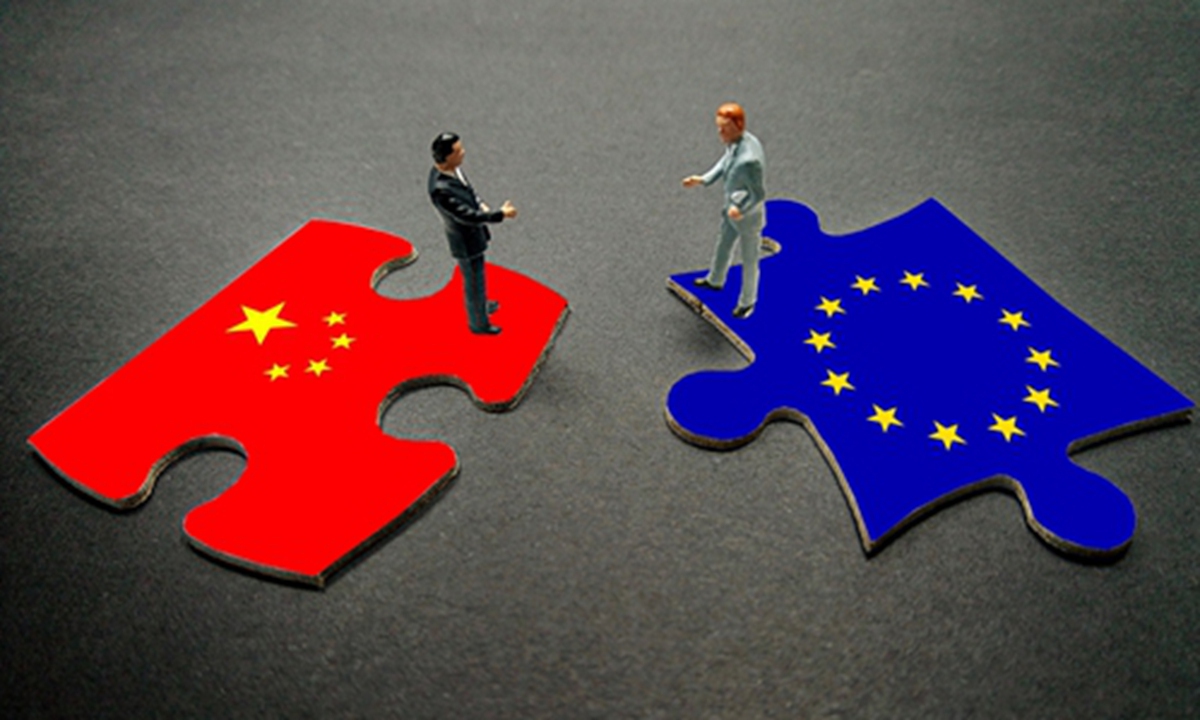
China-EU relationship Photo: VCG
A recent report by Le Monde has drawn wide attention: Last month, the European Affairs Committee of the French Parliament adopted a 153-page report on China-EU relations. The report bluntly criticizes the EU's China policy as being "too often aligned with American policy," leading to "a kind of trade war," which is more harmful than beneficial to Europe. It calls on France and the EU to adopt a more independent stance and seek closer cooperation with China. Amid the noise of "de-risking," a "new Cold War," and framing China as a "systemic rival," this report voices truths that many European countries and media outlets shy away from, representing a rational and pragmatic perspective on China that continues to exist within Europe.
The report was authored by Sophia Chikirou, a member of Jean-Luc Mélenchon's La France Insoumise party. The left-wing political force represented by Mélenchon has had a long-standing influence in both French and European politics. Mélenchon himself has consistently argued that Europe should break away from blind allegiance to the US. He has called for France to "leave NATO," criticized EU sanctions against China, and publicly stated that "Taiwan is a fully-fledged component of China." This report can be seen as a reflection of his and his party's long-held positions.
Interestingly, French media noted that this document "takes positions markedly at odds with those of the French government" and deviates from the EU's official line, yet it described it as "substantial and well-documented." From the way the media framed it, one can easily imagine the stir this report has caused in French political circles: a "substantial and well-documented" report is now questioning the rationality and credibility of France's - and even Europe's - China policy, and calls for a reassessment of cooperation with China. It is a report worth close reading by Europeans.
One of the report's core points is that the EU should recognize the enormous value of cooperating with China. This view is strongly backed by data: In 2024, total China-EU trade reached $785.82 billion, up 0.4 percent year-on-year, with China and the EU remaining each other's second-largest trading partners. In 2024, EU's new investment in China totaled $6.79 billion, while China's new investment in the EU amounted to $7.09 billion.
Recently, a series of events, including the Sino-European Entrepreneurs Summit, the China-EU Business Forum, the China-Europe (France) Cross-border E-commerce Forum, and the Sino-European Corporate ESG Best Practice Conference, have been held in quick succession, highlighting the tremendous economic complementarity between the two sides and revealing a strong mutual willingness to engage in cooperation. The potential for win-win cooperation between China and Europe is clear to both sides, and both want to seize it. This is the most genuine "fundamental reality" of China-EU relations.
In today's world, the rise of trade protectionism and the imposition of unilateral tariffs are casting a shadow over global economic recovery. Following the US in imposing high tariffs on China and enforcing high-tech restrictions has already cost Europe dearly. From 5G networks to electric vehicles, European consumers have been forced to miss out on China's cutting-edge technologies and affordable energy transitions. From semiconductor chips to lithography machines, European manufacturers have suffered a loss of market share in China and their competitive edge in global supply chains. In recent years, European leaders, including French President Emmanuel Macron, have frequently mentioned European "strategic autonomy," which aligns with the report's assertions. This report provides a realistic perspective on "strategic autonomy," emphasizing that maintaining an independent and pragmatic policy toward China is of great significance for the EU.
Recently, China and Europe reached a consensus on the issue of European brandy dumping in China, avoiding an escalation of disputes and providing a vivid example of how dialogue can resolve differences. This also offers helpful insights for addressing issues such as the export of Chinese electric vehicles to Europe. Voltaire once said, "Truth is a fruit that can only be picked when it is very ripe." China has consistently supported and respected Europe's independence and autonomy, places a high value on China-Europe relations, and has always maintained strategic patience.
Chinese Foreign Minister Wang Yi has just concluded a visit to Europe, engaging in in-depth discussions with leaders from multiple countries and reaching broad consensus. The facts demonstrate that there are no fundamental conflicts between China and Europe, and their cooperation is never aimed at third parties. Together, China and Europe uphold multilateralism, oppose unilateral bullying, and resist group confrontation, which will inject more certainty and predictability into a changing and turbulent world.
There is an expression in English: "on a slow boat to China," which metaphorically refers to a distant and lengthy journey. Today, the distance between China and Europe is no longer insurmountable, and misunderstandings and prejudices should not serve as barriers to mutual understanding. This month, the China-EU summit is set to take place. The recent "leak" of the French parliament's report is not coincidental; it represents a spontaneous desire within Europe to correct misconceptions about China and to strengthen engagement with it. Coinciding with the 50th anniversary of diplomatic relations between China and EU, both sides should adhere to the principles of mutual respect and equality, using dialogue to resolve differences and collaboration to address challenges, in order to create a brighter future for the comprehensive strategic partnership between China and EU.
RELATED ARTICLES