China EU relations
Member of the Political Bureau of the CPC Central Committee and Minister of Foreign Affairs Wang Yi traveled to Europe from June 30 to July 6 to attend the new round of China-EU High-level Strategic Dialogue, and visit Germany and France for a series of dialogues. Wang's trip came at the historical juncture of the 50th anniversary of the establishment of diplomatic relations between China and the EU. It is also a critical stage in the preparations for the upcoming China-EU leaders' meeting, and all parties are paying close attention. Wang noted that, as two major powers and two major economies, China and Europe adhering to dialogue and cooperation prevents the formation of bloc confrontations; China and Europe choosing openness and mutual benefit ensures that the tide of economic globalization will not be reversed, Xinhua reported.
Wang's remarks point out the core issue of the current China-EU relations: Against the backdrop of profound adjustments in the global geopolitical landscape and Europe's deep predicament of security anxiety, suspicion toward allies and concerns of its future, how can Europe move beyond its concerns about China's development and build a shared understanding of the opportunities it presents, helping bilateral relations advance from a phase of strategic adjustment to one of maturity and stability?
Europe's current strategic mentality presents a complex "three fears": a real fear of security threats from Russia, deep anxiety about the US' possible pullback of security commitments, and China's continued development and catch-up in the economic and technological fields. Objectively speaking, Europe's anxiety stems from the deterioration of the external security environment, and Europe is also constrained by its internal comprehensive strength and decision-making mechanism. The anxiety reflects the deep impact of the change in the power structure in the process of globalization.
The strategic adjustment in China-EU relations is essentially a redefinition of role positioning, interest boundaries and cooperation rules by both sides. When meeting with European Council President António Costa, Wang pointed out that China regards Europe as an important pole in a multipolar worldand maintains continuity and stability in its policy toward Europe. This statement provides a direction for resolving the cognitive dilemma - only by rebuilding the consensus that the two sides are partners at the strategic level can we lay the foundation for pragmatic cooperation.
Accurately grasping the boundaries of "non-confrontational competition" is the premise for resolving the EU's anxiety over China's catch-up. The EU positions China as a partner for cooperation, an economic competitor and a systemic rival, which is often simplified into a "security" narrative in practice, politicizing economic issues such as 5G technology cooperation and trade of electric vehicles. In fact, China-EU competition should be "running side by side on the innovation track" rather than "zero-sum confrontation." The complementarity of the two sides in the green industrial chain is also far greater than the competition.
Shaping the narrative of "a community of development opportunities" is the core of transforming the threat perception. Europe's "sense of threat" toward China is largely due to its misunderstanding of "differences in development paths" - viewing China's industrial upgrading as an "institutional challenge" and the China-proposed Belt and Road Initiative as an opponent to its Global Gateway strategy. In fact, China's huge market of nearly 1.4 billion people and the country's consumption upgrade of 400 million middle-income people provide broad space for European companies. More importantly, China and Europe have common interests on global issues such as climate change, AI governance and public health.
Looking back at the past 50 years, the development of bilateral relations has proved that cooperation is the only correct choice and win-win is the inevitable development trend. The "three fears" of Europe are essentially the "growing pains" during the transition period of globalization, rather than the "systemic challenges" brought about by China's development.
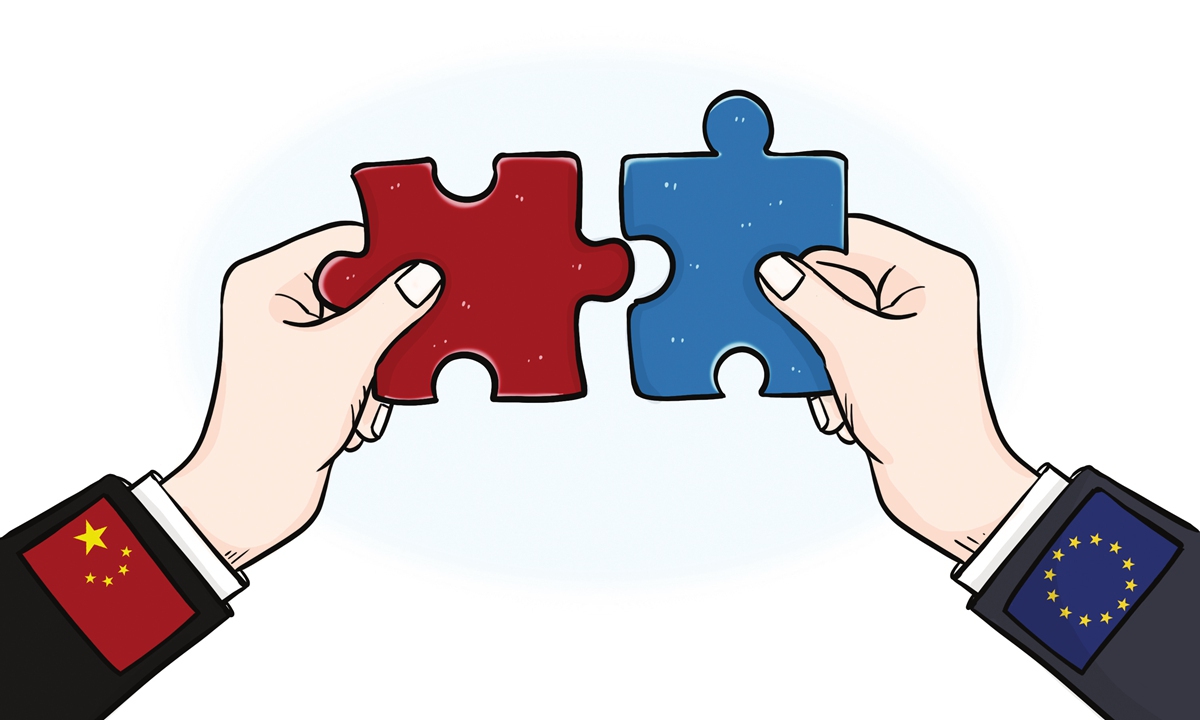
Looking to the future, as long as China and Europe position each other as partners and stick to the bottom line of "win-win cooperation," they will be able to build a more mature, stable and balanced comprehensive strategic partnership, thus enabling China-Europe relations to move forward steadily amid strategic adjustments and inject "China-Europe wisdom" and "China-Europe strength" into the progress of human civilization and world peace and development.
The author is a research fellow at the Shanghai International Studies University. opinion@globaltimes.com.cn
RELATED ARTICLES