From farmland to coffee chain, will the US ever stop its ‘national security’ hysteria?

Illustration: Liu Rui/GT
On Tuesday, the US administration announced plans to ban sales of farmland nationwide to buyers linked to China and other "foreign adversaries," citing "national security" concerns. Agriculture Secretary Brooke Rollins said US President Donald Trump was anticipated to sign another executive order "very soon" to respond to the "foreign encroachment," reported the New York Post. This new round of hype around the "Chinese threat" underscores a familiar trend in US politics - the ongoing theatrical performance of national security paranoia, which is becoming increasingly absurd.
But such panic over Chinese-purchased farmland is untenable. To begin with, China's share of farmland ownership in the US is minuscule. According to The Washington Post, the percentage of total US farmland owned by Chinese investors amounts to just 0.0003 percent and has declined sharply in recent years. To portray this tiny fraction as a threat of any kind of "encroachment" is nothing short of alarmist overreaction.
The US claimed that some of these Chinese-held properties are near military bases, thereby posing a "potential risk of spying." But this is classic US-style paranoia - linking normal civilian land ownership with so-called security concerns while hyping the alleged threats to cultivate a climate of fear. For years, some US forces have been creating a hysterical "thriller" about "foreign threats" that have caused domestic challenges in economic and social governance. This politically motivated "anti-China" paranoia is a projection of their anxiety about their inability to address the US deep-rooted problems.
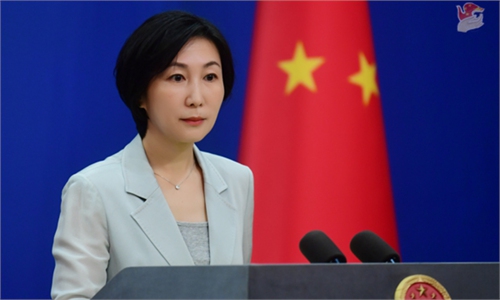
When asked about the new announcement from Washington, Chinese Foreign Ministry spokesperson Mao Ning said on Wednesday that the US overstretches the concept of national security and deprives the right of institutions and citizens of particular countries to purchase farmland. This is typically discriminatory and violates the principle of market economy and international trade rules, and will eventually hurt the US' own interests, Mao said, adding that "we urge the US to immediately stop politicizing trade and investment issues."
Noticeably, this is not an isolate case exposing how the US is politicizing irrelevant issues. The recent opening of the Chinese coffee chain Luckin Coffee in the US has also triggered outlandish reactions. Some media professionals in the US have labeled the coffee chain as China's "newest front on US soil," even trying to imply that the mobile ordering app poses a "security concern." From farmland to coffee chain, the wild imagination fueling the "Chinese threat" narrative is spinning out of control. Using "security" as a catch-all excuse is not making the US safer - it is pushing it deeper into prejudice, irrationality and isolation.
Li Haidong, a professor at China Foreign Affairs University, notes that the trend of overstretching the concept of national security to encompass everything related to China will have far-reaching consequences. First, it distorts the public's perception, making it difficult for ordinary US citizens to view Chinese investment realistically and objectively, which breeds unnecessary social tension and division. Second, it undermines the openness, competitiveness and vitality of the US economy. Over time, it will hinder innovation and damage the US own long-term development prospects - a self-inflicted wound, Li added.
So, who benefits from this "national security" hysteria? Clearly, it is the politicians and those who manipulate such narratives for personal gain - using fear and division to secure political interests or clout. However, the victims are the US public at large, including local interest groups, and rational voices around the world that seek a stable and sustainable relationship between the world's two major powers.
Security should not be an endlessly expandable, arbitrarily used excuse, nor should it serve as a fig leaf for xenophobia and protectionism. In the end, the US must stop scripting and starring in its own "national security thriller" and return to the path of rationality, openness and adherence to rules. Otherwise, what truly encroaches the US is not any "foreign adversary" - but its own swelling anxiety, a self-staged display of paranoia and erratic political calculations.
RELATED ARTICLES