What’s behind China’s continuously rising ‘perception score’?: Global Times editorial
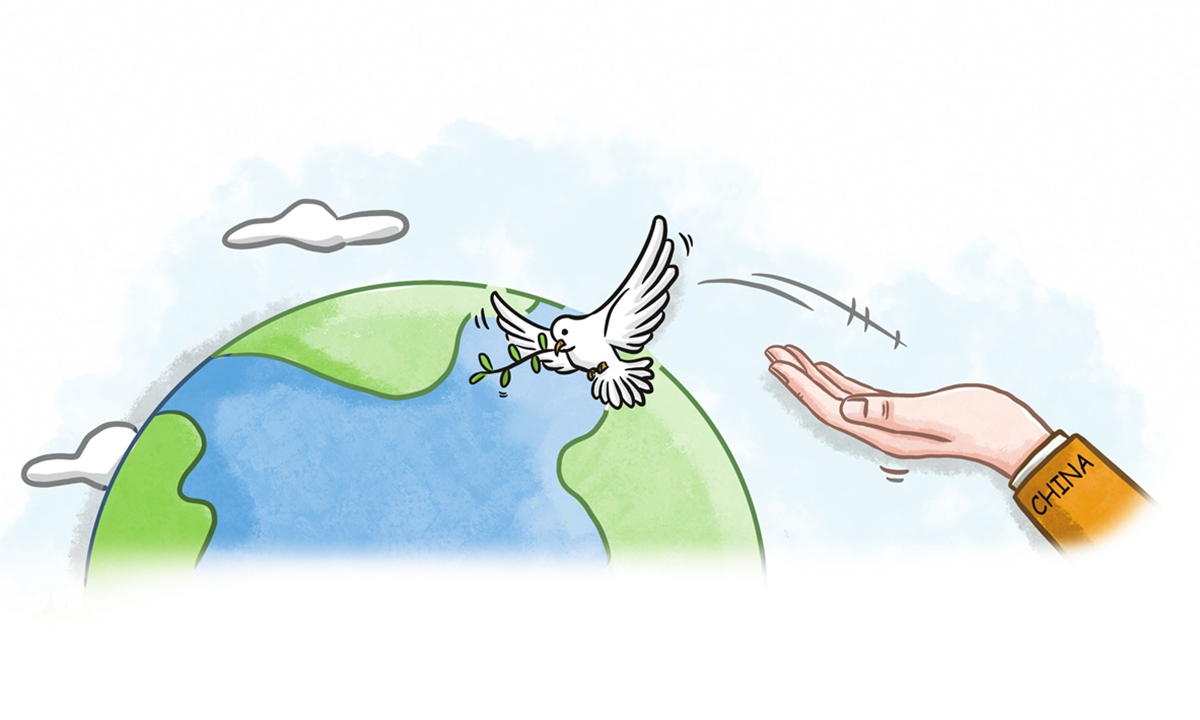
Illustration: Xia Qing/GT
On July 8, the 59th session of the United Nations Human Rights Council (UNHRC) adopted by consensus a resolution titled "The contribution of development to the enjoyment of all human rights." Co-sponsored by China and more than 40 other countries, the resolution marked another step forward for the UN's human rights agenda. Countries including members of the EU, Russia, and Brazil extended congratulations to China, and the international community widely praised China's sense of responsibility.
Not long ago, foreign media reported that some foreign merchant ships were flying the Chinese flag while transiting the Strait of Hormuz. Many interpreted this as a sign of trust in China's role as a peacemaker amid ongoing geopolitical tensions. As a spokesperson for China's Ministry of National Defense said on July 8, "justice resides in people's hearts." What China has done right can be confidently left for the world to judge.
Why has a Chinese flag in the turbulent Middle East come to be seen as a "safe passage pass"? The answer lies in the positive and just image China has built in the region - a country that speaks out and actively works for peace. This image has been reinforced through China's efforts in facilitating reconciliation between Saudi Arabia and Iran, as well as promoting internal unity among Palestinian factions. On a broader level, China has long served as a stable, constructive, and forward-looking force in the international community. Take its role at the Human Rights Council, for example. China has introduced resolutions such as "Promoting and protecting economic, social and cultural rights within the context of addressing inequalities" and delivered statements on themes like "Artificial Intelligence for Promoting Accessibility," contributing constructively to global human rights governance, and continuously enhancing people's positive perception of China.
This achievement is not accidental. The accumulation of trust comes from warm and tangible practices. Taking the people's pursuit of a better life as the fundamental driving force for development, and continuously solving problems to advance that development - this fundamental approach ensures that China is destined to be a principled, peaceful, and friendly major power. Today, China is the main trading partner of over 150 countries and regions around the world. The Belt and Road Initiative has truly become a "path of prosperity" that benefits all countries and brings shared gains to the world. People clearly see that cooperating with China does not involve ideological lines or political preconditions; instead, it delivers concrete progress quickly. Recently, a survey conducted by AtlasIntel and Bloomberg showed that public favorability toward China has continued to rise in Latin America's six largest economies, precisely because trade with China brings real, tangible benefits to the region. For this reason, China's "good reputation" will only grow louder and stronger.
The deeper meaning behind "confidence in China" and "trust in China" is that the international community recognizes that China has overturned the Western narrative of "might makes right" and achieved a peaceful rise. Today's China increasingly integrates its own development with the pursuit of the common well-being of all humankind. What the world feels from this is the warmth of shared development built on equality and mutual respect. At the press conference on Wednesday on China's high-quality fulfillment of targets set for the 14th Five-Year Plan period (2021-2025), a series of economic and social accomplishments powerfully demonstrated this, such as "continuing to contribute about 30 percent of global economic growth annually," "cutting carbon emissions by around 1.1 billion tons," and "remaining the world's largest manufacturing country for 15 consecutive years."
"When the interests of the entire humanity are at stake, China must step forward, take action, and get the job done." This is China's self-positioning and a solemn commitment to the international community. This year marks the 80th anniversary of the founding of the United Nations, and it has been nearly 54 years since China resumed its legitimate seat in the UN. If 54 years ago was a victory for the forces of justice in the world, then in the past 54 years, China has never failed to live up to this expectation. China has shouldered the responsibilities of a permanent member of the UN Security Council and worked alongside the world's peace-loving and just forces to promote the international order toward a more just and reasonable direction. This is why the Chinese proposals continue to receive lasting applause at the UN. In the face of rising unilateralism and protectionism, China has remained committed to the concept of a community with a shared future for mankind, standing on the right side of history, on the side of human civilization's progress, and on the side of the common interests of the vast majority of countries, serving as a "stabilizing anchor" that the world can trust.
Nobel Laureate in Economics Angus Deaton previously said that the concept of a shared future for mankind is a great vision and China is doing what it can to make it happen. Such voices are widely representative today. They not only reflect appreciation for China but also echo the world's desire for peace and development. Whether it's the five-star red flag flying on merchant ships in the Strait of Hormuz, the steadfast presence of escort fleets in the Gulf of Aden, the resolute figures of peacekeeping forces, or the firm voices in multilateral settings, China's image as a responsible, accountable, and trustworthy major power is increasingly welcomed. The world has reason to believe that China can continue to play a key role as a builder of world peace, a contributor to global development, and a maintainer of international order.
RELATED ARTICLES