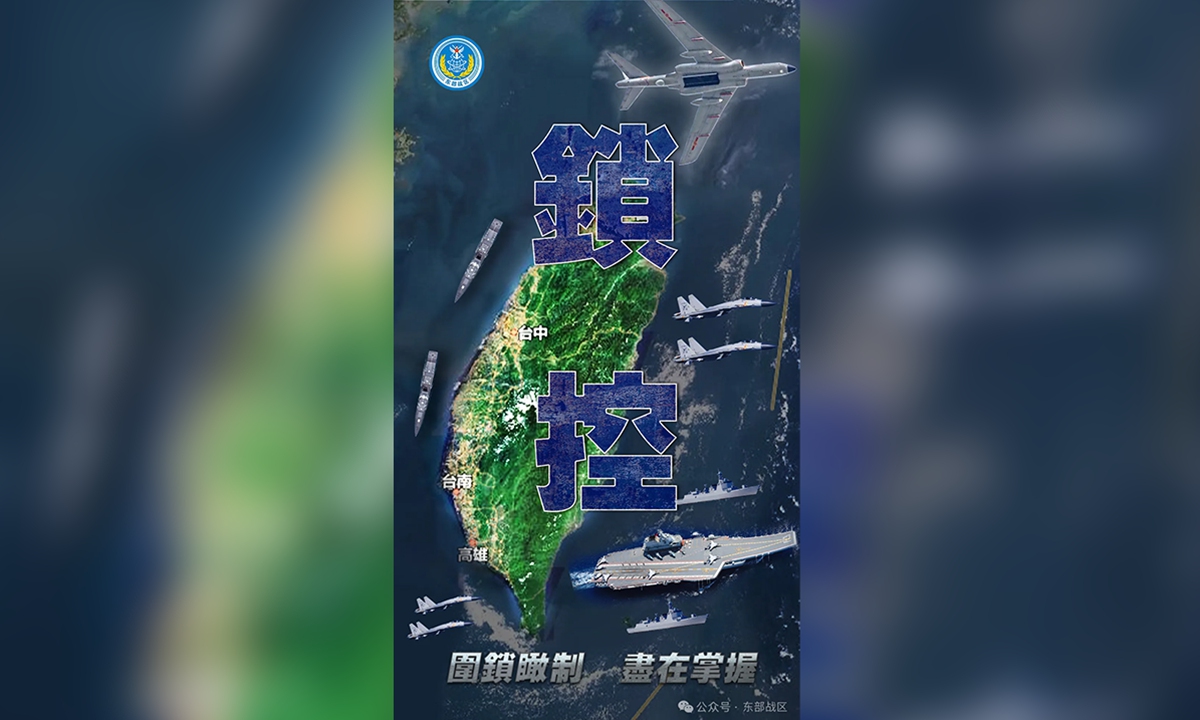
Theme Poster "Overwhelming Grip" Released by PLA Eastern Theater Command
The island of Taiwan is holding its annual Han Kuang Exercise, which began Wednesday and will run until July 18. Compared to past years, this year's drills focus more on real-life scenarios and are conducted more openly. However, in the face of the Chinese mainland's absolute strength and resolve, the Taiwan authorities' attempt to use the exercise to enhance their pursuit of "seeking independence through force" and "resistance to reunification" capabilities will inevitably fail. More concerning is that the provocative actions of the Taiwan authorities and possible strategic misjudgments could further escalate tensions in the Taiwan Straits.
This year's Han Kuang-41 Exercise features several new aspects. First, it emphasizes the diversity of threats. For the first time, the exercise began with a stage simulating the mainland's "gray zone harassment" against Taiwan island in six types. The training session for this part will last three days, longer than many usual drill subjects, demonstrating the importance the authorities place on this aspect.
Second, the Han Kuang-41 Exercise emphasizes "practicality." This year's exercise is taking place with "real soldiers, real sites, real time and real equipment" with a duration of 10 days and nine nights, double that of previous years. According to Taiwan's "defense" authorities, the drills are being conducted without scripts or fixed timelines to mimic battlefield unpredictability.
Third, the Han Kuang-41 Exercise emphasizes "coordination" between the military and civilians. Alongside this year's Han Kuang, Taiwan will also hold "Urban Resilience Exercises," as well as the "Tzu Chiang Exercise" and the "Tong Hsing (Unity) Exercise." These exercises, according to Taiwan regional leader Lai Ching-te, aim to enhance the island's "whole-of-society defense resilience" through "civil-military cooperation."
Fourth, this year's Hang Kuang highlights the "visibility" of the training results. To attract public attention, Taiwan authorities have decided to involve the newly acquired HIMARS rocket system in the exercise, showcase weapons such as the land-based version of the Sky Sword II missile and drones, and plan to live-stream a round of live-fire training sessions featuring its newly delivered M1A2T Abrams tanks.
The Han Kuang-41 Exercise appears to have all the flashy elements designed to impress and grab attention; yet, it is fundamentally incapable of changing the reality that the military power of the mainland is stronger than that of the Taiwan region. Furthermore, it cannot achieve the goal of "deterrence through asymmetric warfare" against the mainland.
In recent years, the Taiwan authorities have made large-scale arms purchases from the US, extended mandatory military service, and strengthened reserve forces and key material reserves. Ukraine's experience in fighting "asymmetric warfare" has also given Taiwan's military some false hopes. However, these technical measures cannot fundamentally change the enormous strength disparity between the two sides of the Straits.
Moreover, the Chinese mainland's determination and will to achieve reunification are not affected by Taiwan's so-called deterrence. The Taiwan authorities' attempts to use military exercises to resist reunification or "seeking independence through force" are nothing short of wishful thinking.
More importantly, such exercises will only heighten tensions across the Taiwan Straits, endangering peace and stability in the region. The vast majority of people in Taiwan have a clear understanding that "seeking independence through force" is not feasible. However, there are still some "Taiwan independence" supporters and misguided individuals who harbor unrealistic fantasies. Military exercises on the island could easily increase their impulse to seek "independence" and provoke further tensions, thus heightening the risk of unexpected conflict between the two sides of the Taiwan Straits. When they make such provocations, they completely disregard the interests of the residents on the Taiwan island.
The author is a research fellow of the Institute of Taiwan Studies at the Chinese Academy of Social Sciences. opinion@globaltimes.com.cn
RELATED ARTICLES