Illustration: Liu Xidan/GT
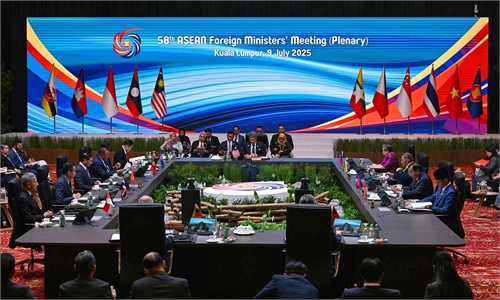
The 58th ASEAN Foreign Ministers' Meeting is being held in Kuala Lumpur, Malaysia, from Tuesday to Friday. US Secretary of State Marco Rubio, making his first trip to the region, is also attending to highlight US commitment and the strength of US Comprehensive Strategic Partnership with ASEAN "in delivering results for the American people and the people of Southeast Asia," according to US State Department spokesperson.
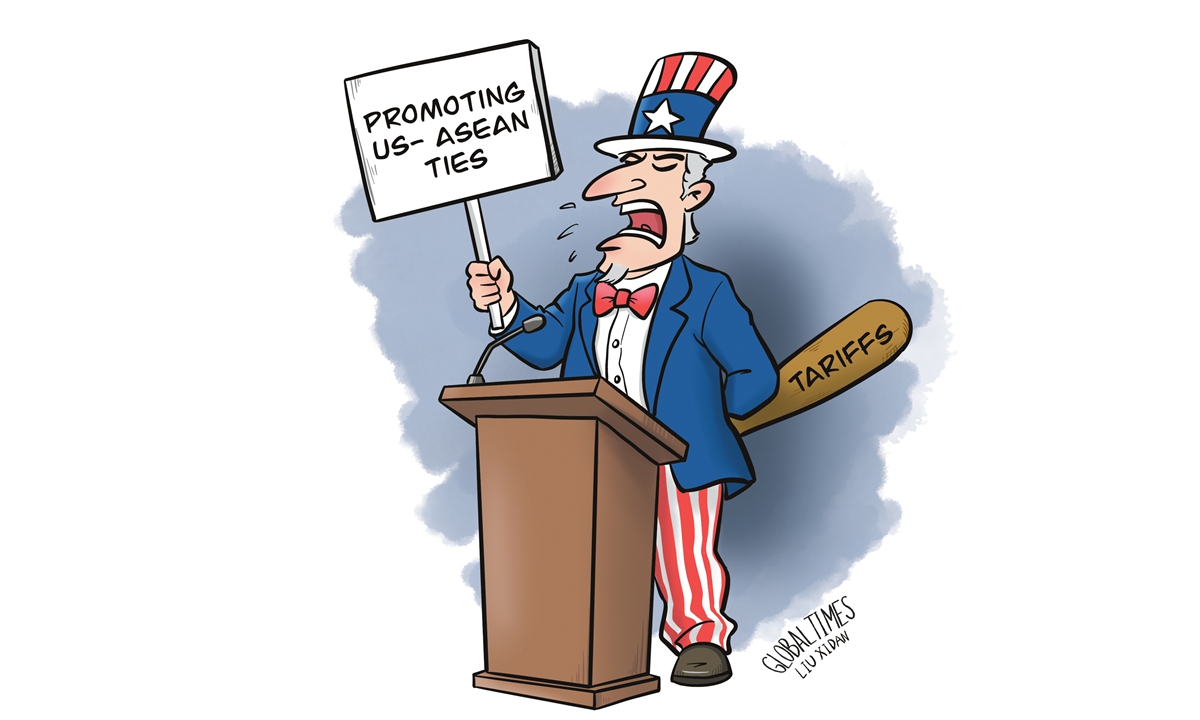
The meeting is held when the whole region is rattled by the US government's tariff policy. The US on Monday announced hefty levies, of between 25 percent and 40 percent on six Southeast Asian countries, including Malaysia, Laos, Myanmar, Cambodia, Thailand and Indonesia.
Southeast Asian countries had expected Rubio to make some contributions to the restoration and development of relations between the US and ASEAN, but the US, unsurprisingly, continues to behave as a manipulator of geopolitics, trying to control the fate of Southeast Asian countries. This will further erode ASEAN's trust toward the US, as it is becoming less and less committed to the region.
During Trump's first term, the US government employed Section 301 of the Trade Act of 1974 primarily against China, but it also had impacts on Southeast Asian economies such as Vietnam, Indonesia and Malaysia. The current US administration's "Liberation Day" tariffs announcement hit Southeast Asia hard. The 49 percent tariff on Cambodia was far from fair trade. It was a trade blockade. Then, the US began to impose tariffs of up to 3,521 percent on imports of solar panels from four Southeast Asian countries including Cambodia, Thailand, Malaysia and Vietnam. Products from Cambodia faced the highest tariffs, because the US alleged that its companies did not cooperate with US investigation. Last year, Cambodia assumed the role of Country Coordinator for the ASEAN-US dialogue relations under a three-year cycle (2024-27). By imposing such outrageous tariffs, the US seems to be telling ASEAN that it does not care about ASEAN's feelings or its relations with ASEAN.
Although some Southeast Asian countries have reached tariff agreements with the US facing US tariff threats, it is clear that they are suffering humiliation at the hands of the US. The US will place a lower-than-promised 20 percent tariff on many Vietnamese exports, while trans-shipments from third countries through Vietnam will still face a 40 percent levy. In return, Vietnam could import US products with a zero percent tariff. These practices are far from being fair to Vietnam.
The current partial compromise is more a result of power dynamics. The US economic coercion policy seems to have achieved its goal in the short term. However, if the US market becomes less attractive to Southeast Asian countries and when Southeast Asian countries are increasingly difficult to obtain the expected trade profits and US investment, the trade closeness between the two sides could be greatly reduced.
Recent US administrations have primarily sought to extract benefits from ASEAN countries while being unwilling to provide resources or public goods, leading the rapidly developing ASEAN countries to feel disappointed and dissatisfied.
Given the US status as a superpower and its hegemonic tendencies, these countries may not have fully expressed their true sentiments. Nevertheless, the US appears to lack any meaningful self-reflection on the matter.
Southeast Asian countries are increasingly becoming more independent and self-reliant. With their economic growth trajectory, they are poised to emerge as the world's fourth-largest economy in the coming decades. These nations do not require the US to act as their so-called savior, and they are increasingly resistant to unilateral, high-pressure measures imposed by the US under questionable justifications to compel them into compromise. This hegemonic and overbearing behavior from the US could worsen its predicament in Southeast Asia, leading to more embarrassments.
The author is director of the Institute for Foreign Policy Studies at the Shanghai Institute for International Studies. opinion@globaltimes.com.cn
RELATED ARTICLES