Space trips: teens' latest craze
New trend ignites passion for science, brings new momentum for industry in China
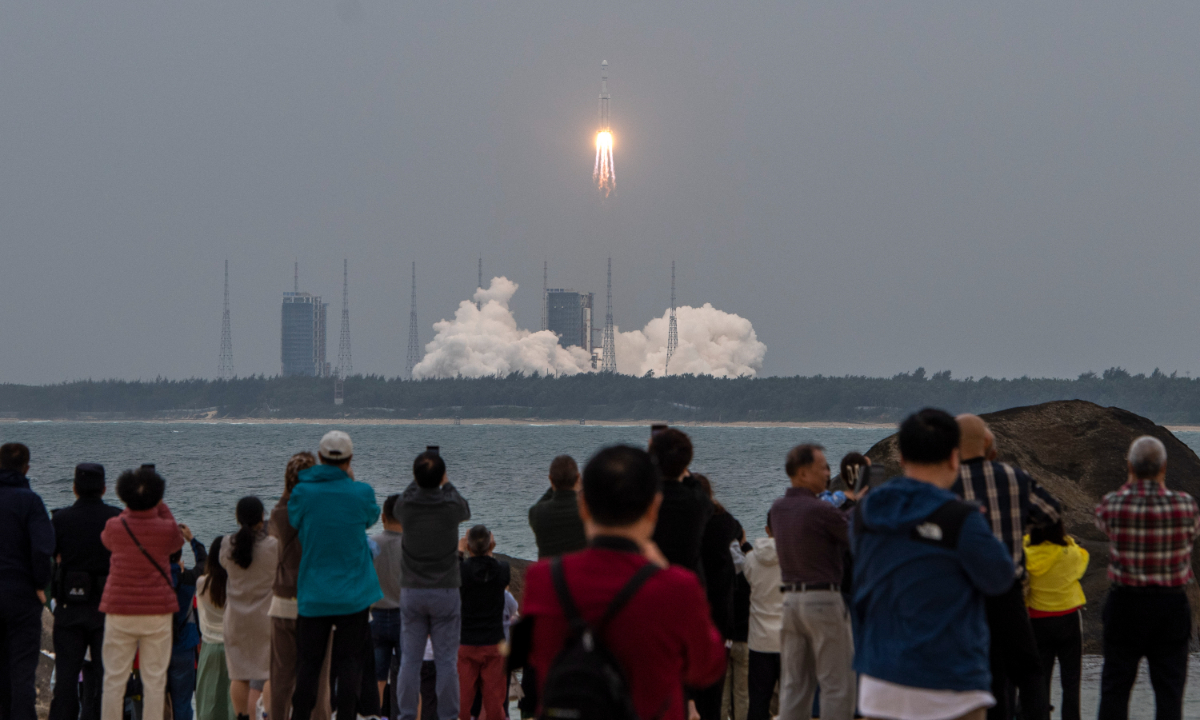
Crowds gather at the Wenchang Space Launch Site in South China's Hainan Province to witness the ignition and liftoff of the Long March-8 Y3 carrier rocket on March 20, 2024. Photo: VCG
As the scorching summer arrives, with college entrance exams all wrapped up, and final weeks drawing to a close, Chinese teens are pouring into China's vibrant travel market in recent weeks. According to several online travel agency (OTA) data, bookings for flights, hotels, attraction tickets and car rentals have all surged significantly compared to last year, with long-distance trips making up a larger share, rising by seven percentage points year-on-year.This summer, "technology" and "hands-on experiences" have become the hottest new buzzwords in travel offerings, China Central Television reported. Data from Qunar, one of the largest OTAs in China, shows that tourists are shifting from quick, superficial visits to deeper, immersive experiences - driving scenic spots to see their income from experience-based programs more than double year-on-year, far outpacing ticket revenue growth.
Meanwhile, China's remarkable scientific and technological achievements in recent years -from the crewed spaceflights and deep space exploration to the "artificial sun" fusion project - have further ignited public interest in technological innovation. More and more people are opting for unique, exciting tech-themed trips.
One of the trending themes for teenagers across the country is "chasing rockets." This summer, kids on vacation are perfectly timed to witness a major launch at the Wenchang Space Launch Site in the tropical island of South China's Hainan Province.
A notable increase
Cai Yun, Vice President of a Chinese commercial aerospace company FutureSpace, told the Global Times that their rocket viewing tours have become a favorite way for families and enthusiasts alike to get close to China's soaring aerospace industry.
The Global Times learned that these rocket tours not only offer prime viewing spots to watch launches up close, but also include a number of space related experiences and lectures, such as VR space experience sessions, behind-the-scenes visits to China's supercomputing center, access to the core launch tower area, as well as space seed labs, where the public can see how microgravity shapes the growth of space tomatoes, pumpkins, and more.
Cai told the Global Times that public awareness of space has seen a notable increase. "When we first started offering space-related tours seven years ago, most visitors were space enthusiasts. Now it's clearly moving toward the mainstream. Families especially value what aerospace represents in terms of cutting-edge technology and China's push to become a science and tech powerhouse," she said.
With rising public interest and more frequent launches, booking numbers of FutureSpace rocket launch tours have grown by over 50 percent annually, with family groups accounting for about 60 to70 percent, Cai said.
Simply watching rocket launches can no longer satisfy tourists' curiosity. The Mars Base 1 in Northwest China's Gansu Province has lately emerged as a social media sensation, captivating visitors with its striking 1:1 simulation of the Martian surface with the facility's rust-colored sandstone formations and models of Mars rovers, space probes, starlight domes and 3D-printed Martian habitats.
At the Mars Interstellar Exploration Center, visitors pass through a dazzling cosmic tunnel to encounter scale models of China's space achievements, including the Beidou satellite constellation, Dongfanghong-1 satellite, Mars rover and a life-size semi-section model of the Tiangong-2 space station.
The base has developed over 30 immersive programs across three core experience zones. One such program demonstrates how hydroponic plants like peppers and potatoes grow in simulated Martian conditions - offering visitors hands-on insight into future space agriculture.
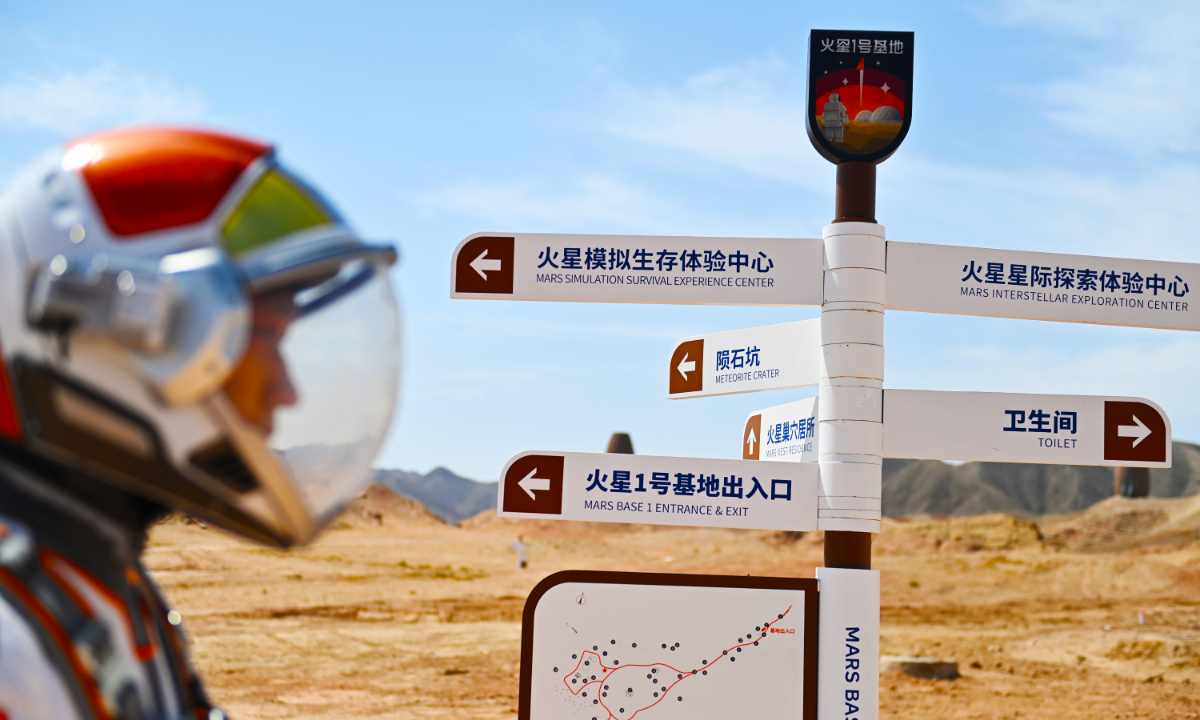
A tourist experiences extravehicular walk training at Mars Base 1 in Northwest China's Gansu Province on May 15, 2023. Photo: VCG
'We do science'
"In the past two years, Mars Base 1 has demonstrated significant and steady growth in both visitor numbers and revenue," an employee in charge of the scenic spot told the Global Times. "Benefiting from China's ongoing space fever, supportive policies for study tours, we saw a 120 percent increase in visitors in 2023 compared to 2022, with revenue growing by approximately 50 percent," the employee said.
Online engagement has been particularly explosive. Through science-focused short videos and immersive experience clips on Douyin, Xiaohongshu and Weibo, the base has attracted massive attention from younger audiences, becoming a key driver of visitor traffic.
The core visitor demographic is predominantly composed of Gen Z travelers and young families, drawn by key appeal factors including the pursuit of novel experiences, immersive participation and hands-on interaction, cognitive enrichment, and engaging, fun activities.
"At Mars Base 1, we don't just hear about science - we do science," one middle schooler told the Global Times after participating in the Mars Survival Camp. "The formulas from class suddenly made sense when I had to apply them in simulated spacecraft controls - now I understand why astronauts operate the way they do."
China's 2025 Government Work Report has underlined the need to promote the safe and sound development of commercial space, the low-altitude economy and other emerging industries. This was the second mention of commercial space in the Government Work Report, according to media reports.
National policies have also provided strong support for the integrated development of aerospace and tourism. In 2025, the State Council issued guidelines for measures on further cultivating new growth points to boost cultural and tourism consumption, in which it explicitly encouraged the development of diversified low-altitude tourism products and supported suborbital experience projects in space tourism.
Against this backdrop, regions including Beijing, Shanghai, Shandong and Guangdong have actively rolled out space tourism-related projects by fully utilizing their aerospace resources, comprehensively promoting the deep integration of aerospace and cultural tourism industries.
Growing public demand for science education has driven the integrated development of aerospace and tourism markets. Media reports show that during the 2024 summer vacation, ticket sales for domestic space-related attractions increased by 59 percent year-on-year, while orders for space and rocket-themed vacation products rose by 48 percent. Notably, hotel bookings in Ulanqab, Inner Mongolia and Wenchang, Hainan grew by 18 and 21 percent, respectively, due to increasing popularity of space tourism.
RELATED ARTICLES