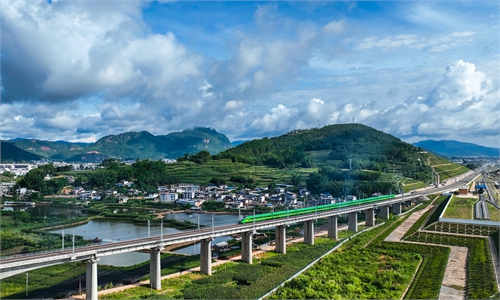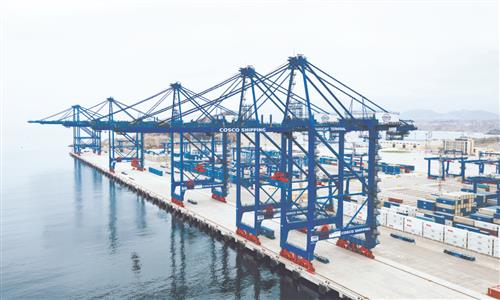
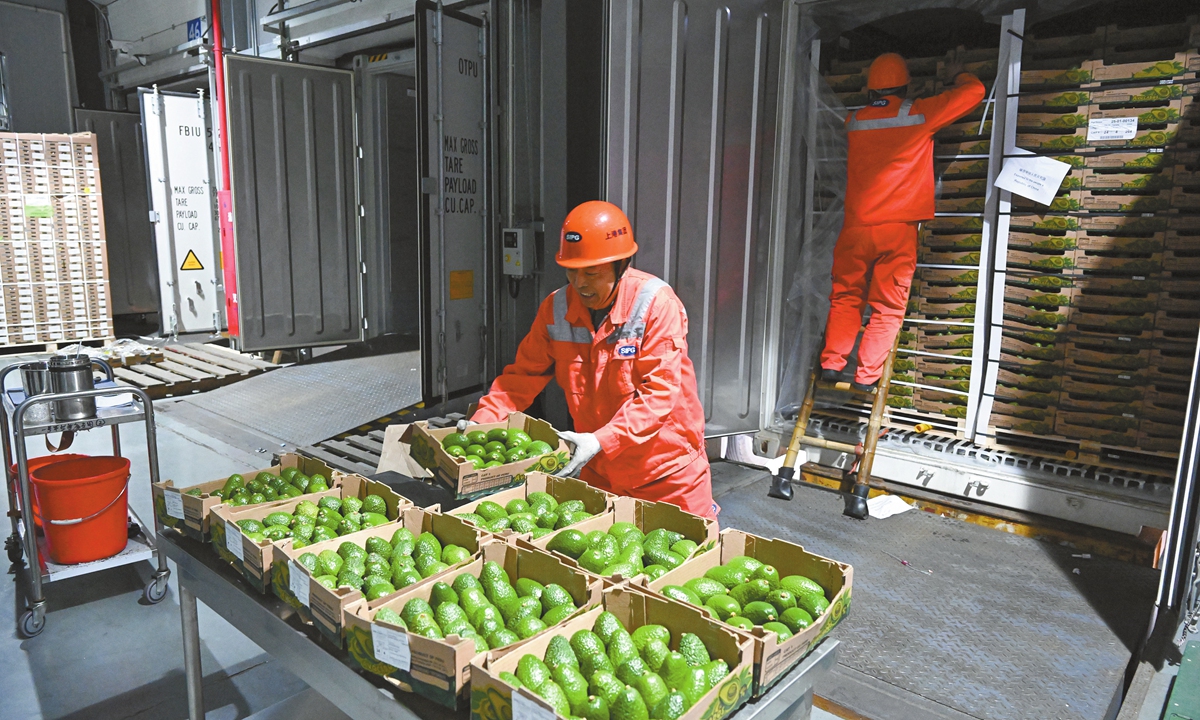
Port workers load fresh Peruvian fruit from Chancay Port in Peru, which arrived at Shanghai's Yangshan Port, onto trucks for distribution on December 19, 2024. Photo: VCG
As the global economy undergoes profound transformation, Peru is recalibrating its development strategy by increasingly embracing win-win international cooperation — with China emerging as a key partner in the world.
Peru consistently demonstrates development potential not only in mining, but also in tourism, agricultural exports, and productive sectors linked to marine and meteorological resources. Integrating this potential into major global value chains is of critical importance for Peru.
However, our main challenge lies in transforming this wealth of raw materials into added value. This is precisely where the Belt and Road Initiative (BRI) represents a valuable opportunity for us. We need to focus on strengthening our domestic markets to become more competitive, adopt green energy, and seize the opportunities presented by having a port hub.
The Chancay Port project, a flagship of Peru-China cooperation, stands as a testament to this strategic alignment.
Of course, this transformation won't happen overnight, and there will always be challenges and risks. But no one imagined that nearly 50,000 tons of cargo would move through the Chancay megaport in just six months, from November to April, in trade with Asia. That is undeniably significant in both economic scale and impact. Commercial activity, income, and tax revenue from November and December have been extraordinary. If Chancay continues at this pace, it could contribute no less than 1.5 percent of Peru's GDP—an extraordinary prospect for the country.
Yet such progress is unfolding against a complex geopolitical backdrop.. Powerful actors are increasingly attempting to disrupt new paths of development for the Global South.
As we often say, it's impossible to cover the sun with one finger, right? There is undeniable geopolitical attention. One country that once championed free trade is now embracing protectionism.
The shift in Peru's trade patterns over the past three decades is revealing.
For Peru, China is now its largest trading partner. Thirty years ago, the trade relationship between China and the US in Peru was 27 to 1 — overwhelmingly in favor of the US. Back then, the US was our main trade partner. But what happened over the past 30 years? This shift was not the result of imposition, but as a result of market forces, investment, initiatives, cooperation, and reciprocity.
This is not just a matter of trade figures — it reflects a broader development model that prioritizes dignity and production.
Today, I believe our country is beginning to understand — and demonstrate — what we truly want: development for our people, a dignified life, and investment that enables creation and production. This is exactly what's happening through Peru's partnership with China, our No.1 trading partner, and this is a process that cannot be stopped. There may be political noise, but the pursuit of our people's development will always outweigh everything else.
Ironically, those who once defined the rules of globalization are now turning their backs on them.
Life is full of paradoxes. Those who once championed free markets now are trying to return to protectionism. But that's impossible. Global trade cannot go back to the prehistoric era. It simply cannot.
Free trade has taught us standards of cooperation, mutual benefit, shared values, and peace. It has shown us that what is exchanged is not only goods and services, but also cultures. When some realize they are losing ground, they react arbitrarily—imposing irrational tariffs and trade barriers driven by psychological impulses or political disputes. But such actions will inevitably fail, because these practices no longer align with the spirit of this new civilizational era founded on mutual benefit and consensus.
At this civilizational crossroads, unity and consensus across the Global South is more vital than ever.
Today's civilization is in crisis and urgently needs shared platforms like the BRICS economies and the Global South. Here, we embrace sovereignty, the right of peoples to self-determination, dialogue, peace, and respect for diversity—all within a framework of free trade as a superior value.
I firmly believe in the power of cooperation across the Global South. What we need is a peaceful kind of leadership—one of intelligence, innovation, and openness to dialogue—not driven by ideology, but by the desire for better lives, access to education, cultural identity, and self-determination. That's what makes us happier, and I believe the consolidation of the Global South is unstoppable.
The US' attempt to impose unmanageable tariff rates reflectsits commercial and technological vulnerabilities. This reveals a contradiction and incoherence with the free-market economy it once so strongly proclaimed. The US fails to realize that this offensive would ultimately backfire like a boomerang, further impacting its already weakened economy.
Cooperation among Global South nations is no longer optional—it is a civilizational imperative.
The author is Member of Congress of Peru and Chairman of the Special Congressional Committee on the Chancay Port Project.
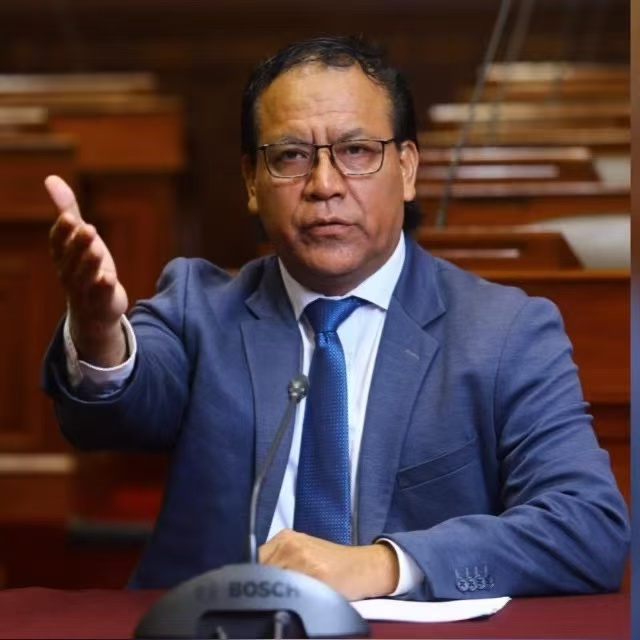
Roberto Sánchez Palomino Photo: Courtesy of Roberto Sánchez Palomino
RELATED ARTICLES